
Kindergarten Addition and Subtraction Word Problems Within 10
Move from small-group stories within five to joining and taking away within ten. Read each story aloud and let the child use counters, fingers, or a drawing before recording an equation.
Let the child move the quantities
Nora has six counters on a play mat. Her friend brings three more. Nora answers three because she notices only the new group. Before asking her to change the answer, leave the original six in place and slide the three new counters beside them. Ask, “How many are on the mat now?”
Keep these counters on the mat.
Slide these beside the first group.
6 + 3 = 9
Touch each counter once. There are nine counters altogether.
The first six do not disappear when the three arrive. Invite the child to sweep a hand around both groups and count each object once. Move a counted counter a little to one side if keeping track is difficult. Once the action is clear, an adult can write 6 + 3 = 9 and point to what each number represents.
Make taking away visible
Now start with nine counters. Give four to a pretend friend, placing those four outside the mat. Five stay on the mat: 9 − 4 = 5. Ask Nora to point to the counters still with her before counting. An answer of four may describe the removed group rather than the group the question asks about.
Draw the story in the open space
For joining, draw the starting counters first and then the arriving counters. Circle the new group or use a second color if available. For taking away, draw the starting number, cross out the number that leaves, and count the uncrossed marks. Dots are enough; the quality of the artwork is not the mathematical task.
The printed equation and answer boxes are places to record the result, not a requirement that a kindergartener writes independently. An adult may write the equation the child explains. A correct action, drawing, or spoken explanation can show understanding even when numeral writing is still developing.
Use fingers or a ten frame to keep track
Have up to ten counters ready. A ten frame can help organize them: fill one space with each starting counter, then add or remove the changed amount. For 7 + 3, three empty spaces become filled and the total is ten. The frame helps track one counter at a time; the child does not have to memorize all the facts within ten to use this page.
Include zero without making it a trick
A story may start with no counters, add none, or give away all of them. For 8 − 8, the empty mat is the result and the answer is zero. For 7 + 0, no new counters arrive, so seven remain. Ask what action happened rather than insisting that every addition makes a group larger.
Try two short read-aloud activities
Use counters to act out these two examples together. Read each question aloud, let the child show what happens, and ask them to explain their answer. Then try the four printable stories below.
Put together two groups that are already there
One basket has 6 apples. Another has 4. How many altogether?
Place six counters in one pretend basket and four in another. Ask the child to point to each group, then sweep a hand around both groups. The story does not say that new apples arrive; it asks for the total of two groups that already exist. Those two parts still make one whole: 6 + 4 = 10.
If the child answers four, ask which basket that number describes. Keep both groups in view and count every apple once. Then spread the same counters farther apart and ask whether the total changed. Moving the objects changes their arrangement, not their number.
Hide all seven: zero visible does not mean none exist
7 apples are on a plate. Hide 7. How many can you still see?
Put seven counters on a plate or mat and cover all seven with a sheet of paper. Ask the exact question: how many can you still see? None are visible, so 7 − 7 = 0. The seven counters still exist under the paper. Lift it afterward to show the difference between the number on the plate and the number currently visible.
In the picture, crossed-out apples represent the hidden group; the marks do not mean that the apples have disappeared. A child who answers seven may be counting all the apples on the plate, including the hidden ones. Repeat what the question asks before treating the answer as a calculation error.
Choose the next step from what the child shows
This set contains four short, one-step stories with starting amounts, changes, and results from zero through ten. Some are still within five; the source retains those accessible cases. Choose the within-five page when tracking several counters is tiring. When this range is comfortable, ask the child to explain why their equation matches the action. Unknown starting amounts, comparison stories, and two-step problems are different structures and are not mixed into this set.
Read one story aloud at a time and allow objects, pointing, or drawing before asking for a number. The goal is representing the action, not reading speed or a timed facts test.
Make a practice set
Choose what to print. Selecting both shows the answer key on screen and prints the questions followed by the answers.
After the practice
Ask the child to point to the starting group, the change, and what the question asks for. Check the model before checking handwriting. Return to within-five stories if keeping track of the counters is the main challenge.
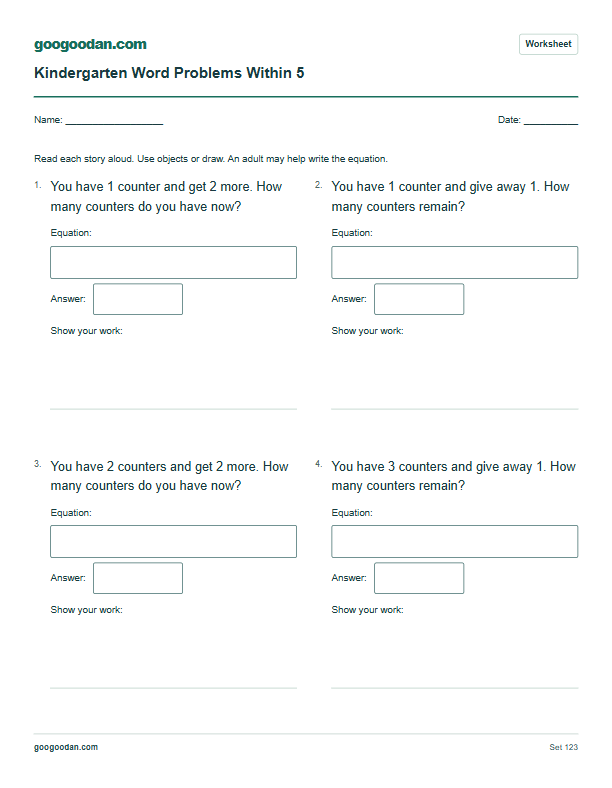 Word problems
Kindergarten Word Problems Within 5
Listen to a short story, act it out, and draw or write an answer within 5.
4 problems · Answer key included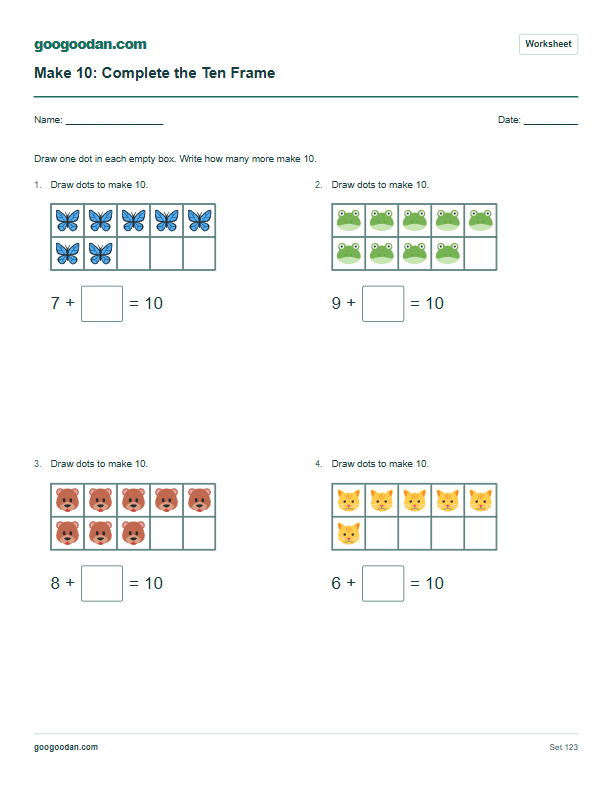 Draw and count activity
Making 10 with Ten Frames Worksheets
Draw a dot in each empty box, then write how many more make 10. Start with 5–9 pictures in a two-row frame.
4 problems · Answer key included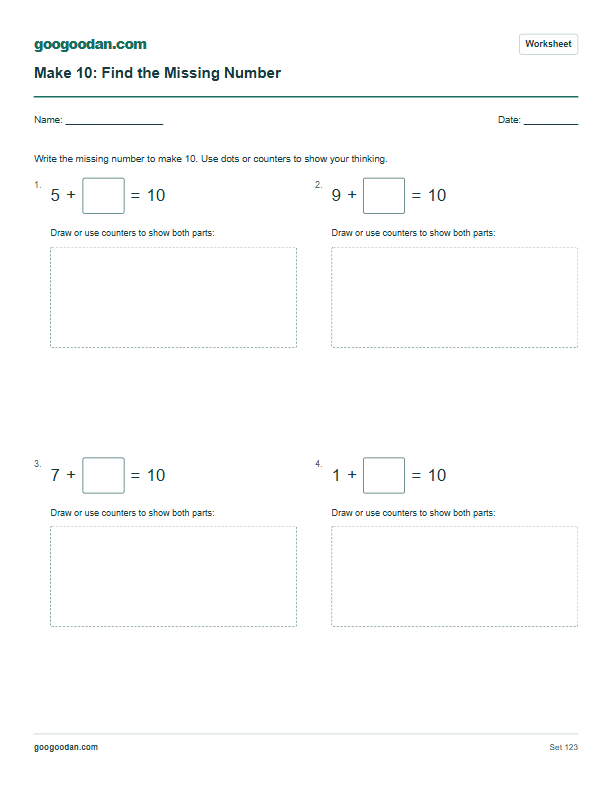 Missing number and drawing activity
Make 10 Missing Addend Worksheets
Find the missing part in an addition equation that totals 10. Use the drawing space or counters to explain your answer.
4 problems · Answer key included
More about addition · Kindergarten worksheets
Kindergarten selected skill connection: Selected K.OA.A.1 and K.OA.A.2: one-step result-unknown joining and taking-away stories within 10 using objects or drawings. See the Common Core grade guidance. This worksheet does not cover every requirement in the standard.