
Missing Part Number Bonds Worksheets Within 9
Split each pictured whole into two parts. Circle the requested number of pictures and record the other part. Choose two nonempty parts first, or practice a part with zero pictures.
The whole stays the same when you make two parts
Leo has seven picture cards. He circles three and says, “Now there are three.” His aunt points to the pictures outside the circles. They have not disappeared. Three pictures are in one part and four are in the other; all seven still belong to the whole group.
Start with 7 pictures. Circle 3 of them. Count the pictures outside the circles: 4. The whole is 7, and its two parts are 3 and 4. Together, 3 and 4 make 7.
On the number bond, the number labeled Whole describes every picture. The two connected numbers under Parts describe the circled and uncircled groups. Write the missing part, not the whole again.
See which number describes which group
Read the direction aloud and point to the pictures. Touch every picture once to check the whole. Then choose the requested number and draw a small circle around each selected picture. Count the unmarked pictures to find the other part.
The given part in the diagram is the number of pictures to circle. The empty part is the number outside the circles. A number bond records how quantities fit together; its connecting lines are not arrows telling objects to leave the page.
Circle any pictures that make the requested part
The selected pictures do not have to be next to one another. If the direction says to circle three, any three distinct pictures make that part. The answer key circles the first few as one clear example, but a child can choose different pictures and still have the correct split.
Check the quantity rather than the position of the rings. Circling the same picture twice does not put two pictures into a part. If the markings overlap, ask the child to point to each selected picture once so you can see the intended group.
Distinguish splitting from taking away
Nothing is crossed out or removed in this activity. Both parts are still visible. The same quantities could appear in a subtraction story, but here the focus is on one whole made from two parts. Use the words “circled part” and “other part” before introducing operation symbols.
After a child explains the picture, you can say the addition sentence aloud: “Three and four make seven.” Check it by counting both parts together. This connects the diagram to addition without making a written equation the first step.
Use real objects when the diagram feels abstract
Give the child the same total using counters or blocks. Move the given number onto one small mat and leave the rest on another. Point to the two mats as the parts, then bring them together to show the whole.
Try a different split with those same counters and notice that the total has not changed. This is an optional conversation beyond the single missing part requested in each printed question. Each worksheet includes four different whole-and-given-part combinations.
Check the reasoning and the record
The free printable answer key keeps the original pictures, shows one valid set of circles, and fills the missing part in red. Check three things: the total number of pictures, the number circled, and the number outside. A correct diagram should describe those groups.
An adult may record the number a child says or read the directions aloud. If handwriting is difficult, accept pointing, grouping real objects, or explaining the two parts. The activity is intended to develop part-whole understanding, not to judge drawing neatness.
The default activity uses totals from 2 through 9 and two nonempty parts. Choose “One empty part (0)” below for two questions with a given part of zero and two with a missing part of zero. Both activities have four questions and keep totals within 9. Neither includes a whole of 10 or teen numbers. Choose the related making-10 activity when the child is ready to work with a total of ten.
Can one part be empty?
Yes. Try this together with seven counters and two small mats. Put none on the first mat and all seven on the second. There are still seven counters altogether. The empty mat has zero counters; zero describes that part, rather than something we forgot to count.
The whole is seven and the known part is zero. The other part must contain all seven counters: 7 − 0 = 7. Say “zero and seven make seven” and point to both mats. Counting the first mat as one because there is one mat would mix up the objects being counted. We are counting counters, not mats.
What if the given part already contains the whole?
Move all seven counters onto the first mat. None need to go on the second. If the whole is seven and one part is seven, the other part is zero. Nothing is lost: the two parts still account for all seven counters.
Write 7 − 7 = 0, then check by saying “seven and zero make seven.” An unanswered box and an answer of zero are different. Once the child has counted the empty group, write 0 in its box to record the answer.
Practice an empty part on paper. In the Activity menu below, choose “One empty part (0).” For “Circle no pictures,” leave every picture unmarked and count them as the other part. For “Circle all,” mark every picture and write 0 for the part outside the circles. Choose “Two nonempty parts” to return to the original activity. Once the child can describe an empty part, connect that idea to the zero examples in the missing addend guide. Keep the counters available when moving from a picture to an equation.
One object and a full group of ten
One object can be split into one object and no objects. If the given part is 0, the missing part is 1. If the given part is 1, the missing part is 0. There is no way to split a single whole object into two nonempty groups without cutting it, so this is a useful moment to explain why zero belongs in a number bond.
Try the same action with ten counters. Circle none and all ten remain in the other part; circle all ten and none remain. Check by putting the parts together: 0 + 10 = 10 or 10 + 0 = 10. The number of circles drawn around objects does not change how many objects there are altogether.
Choose One empty part (0) above the worksheet to practice this. Each four-question sheet mixes two wholes from 2 to 9 with two wholes of 1 or 10. Those two questions may use the same whole; every sheet does not necessarily include both 1 and 10. Two questions give 0 as a known part and two have 0 as the answer. For two nonempty parts, switch back to the standard activity, which keeps wholes from 2 to 9.
Make a practice set
Choose what to print. Selecting both shows the answer key on screen and prints the questions followed by the answers.
After the practice
Check both groups. Different pictures may be circled as long as the two parts have the right counts and make the pictured whole.
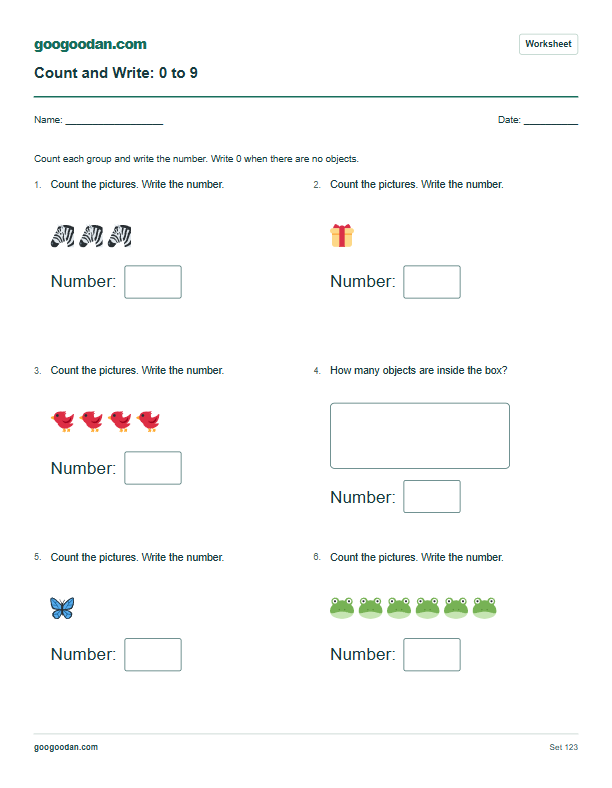 Picture activity
Count and Write Worksheets for Kindergarten
Count picture groups from 1 to 9 and write 0 for an empty group. Touch each object once and record the total.
6 problems · Answer key included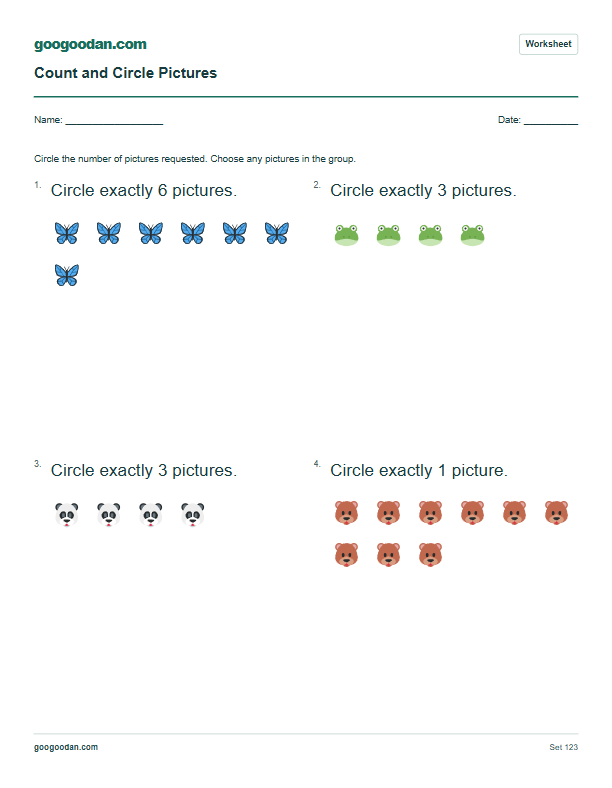 Picture activity
Count and Circle Worksheets for Kindergarten
Circle a requested number of pictures. Any selection with the right count is correct.
4 problems · Answer key included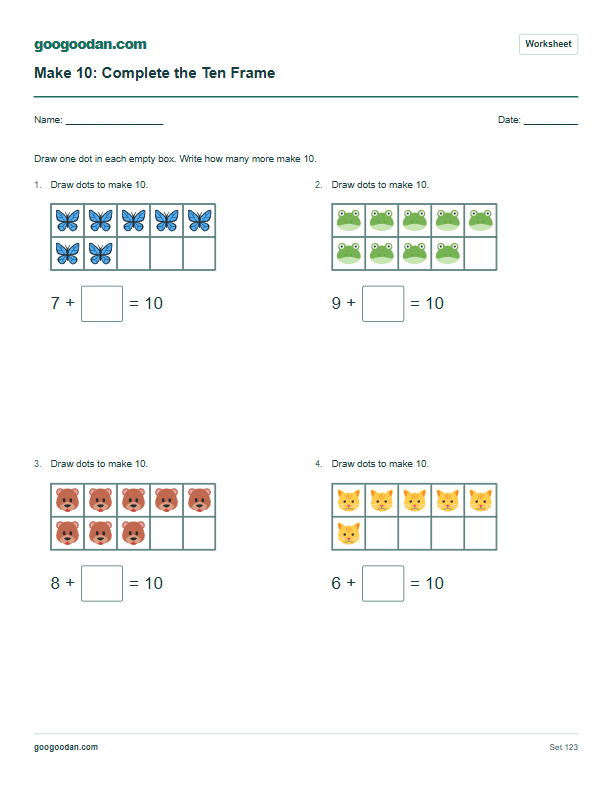 Draw and count activity
Making 10 with Ten Frames Worksheets
Draw a dot in each empty box, then write how many more make 10. Start with 5–9 pictures in a two-row frame.
4 problems · Answer key included
More about addition · Kindergarten worksheets
Kindergarten selected skill connection: Supporting K.OA.A.3: split totals 2–9 into two nonzero parts and record the missing part. Does not include totals of 10 or zero parts. See the Common Core grade guidance. This worksheet does not cover every requirement in the standard.