
True or False Addition Equations Worksheets
An equation is true when both sides have the same value. Calculate the sum and compare it with the number on the other side.
The equal sign means the same value
In 4 + 3 = 7, the left side has a value of seven and the right side also has a value of seven. The statement is true because both sides match. Read the equal sign as “has the same value as,” rather than as a signal to write an answer.
4 + 3 = 8 is false.
Four counters and three more make seven counters. Seven and eight are different amounts, so the two sides do not have the same value.
Check each side
First find the sum on the left. Then read the number on the right. Compare those two values before choosing True or False. Pointing to each side can help a child keep the displayed number separate from the sum they calculated.
Explain a false statement
For 6 + 2 = 9, say, “Six plus two is eight, and eight is not nine.” The answer is False. You may write the correct sum in the working space to explain, but keep the original equation visible so the child can show what was wrong.
Explain a true statement too
For 5 + 4 = 9, a child might count on four from five or use a known fact. Ask what each side is worth. A correct guess of True is less informative than an explanation that both sides equal nine.
Keep the meaning broader than this sheet
Equality also works when the number is on the left: 7 = 4 + 3 says that both sides have value seven. Discuss this example aloud, while recognizing that the generated questions on this worksheet all use addition on the left and one number on the right.
About these six questions
Each set contains three true and three false original equations in a varying order. Addends range from 2 through 9. Correct sums range from 4 through 18, and the displayed right-hand number can be as large as 19.
In this original bank, every false equation has a right-hand number one greater than the correct sum. These are focused addition checks, not a complete assessment of equality. Subtraction equations and calculations on both sides are not generated here. Explain every decision rather than guessing from the number of true answers already found.
Make a practice set
Choose what to print. Selecting both shows the answer key on screen and prints the questions followed by the answers.
After the practice
Ask what each side is worth. For a false equation, explain the mismatch before writing the correct sum.
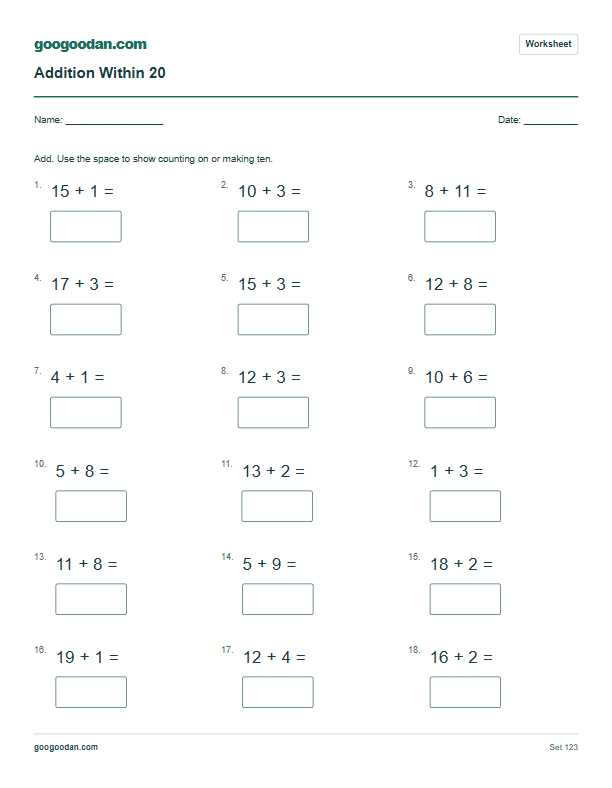 Calculation practice
Addition Within 20
Count on or make ten to add two numbers.
18 problems · Answer key included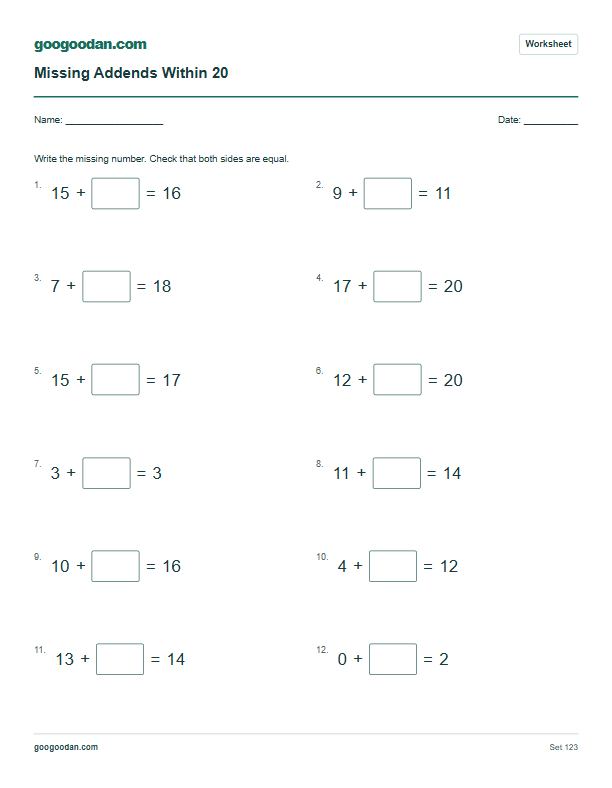 Missing-number practice
Missing Addend Worksheets Within 20
Find the missing part of an addition equation; use counting on or subtraction.
12 problems · Answer key included
More about addition · Grade 1 worksheets
Grade 1 selected skill connection: 1.OA.D.7. See the Common Core grade guidance. This worksheet does not cover every requirement in the standard.