
Fraction Scaling Word Problems: Making Amounts Larger
Explain why a fraction greater than one makes a positive amount larger. Use one copy plus part of a copy to understand the product.
One and a half times means one copy plus half a copy
Ava starts with 3/4 of a measuring unit. She needs a new amount that is 1 1/2 times as much. She wonders whether multiplying by a fraction always makes an amount smaller. Ask her to compare the multiplier with one before she calculates. The multiplier 1 1/2 is greater than one, so the new amount must be larger than the original 3/4.
Read 1 1/2 times as much as one full copy of the original amount plus half of another copy. The extra half is half of 3/4, not half of one measuring unit. Keeping those meanings separate is the key to the problem.
Find the extra amount, then combine
The original 3/4 is six eighths of the fixed unit. Half of that amount is three eighths. Put the six original sections and the three extra sections together: 6/8 + 3/8 = 9/8. Ava needs 9/8 of the unit, or 1 1/8 units.
The product is larger than the starting amount, just as predicted. It is also less than twice the starting amount, because 1 1/2 is between one and two. Use both comparisons as a quick reasonableness check.
Connect the picture to fraction multiplication
Write the scale factor 1 1/2 as 3/2. Then 3/4 × 3/2 = 9/8. The picture explains this product as three half-copies of the original amount. Each half-copy is 3/8, and three such copies total 9/8.
The same relationship can also be written as 6/8 × 9/6 = 9/8. Simplifying 6/8 to 3/4 and 9/6 to 3/2 changes the names of the fractions, not their values. A child may use either exact representation as long as the reasoning and final amount agree.
Start with more than one unit
Now Ava starts with 1 1/2 units and again needs 1 1/2 times as much. The first 1 1/2 is an amount; the second is a scale factor. They happen to have the same numerical value, but they play different roles.
Half of the original 1 1/2 units is 3/4 of a unit. Add that extra amount to the original: 1 1/2 + 3/4 = 2 1/4. The model uses quarters throughout, so six quarters plus three quarters gives nine quarters.
The multiplication equation is 3/2 × 3/2 = 9/4. The original values 1 5/10 and 15/10 are equivalent to these two factors. The exact product 9/4 and the mixed number 2 1/4 describe the same amount.
Separate the multiplier from the increase
Making an amount 1 1/2 times as large means keeping the original amount and adding half of it. It does not mean adding another 1 1/2 copies on top of the original. That would give 2 1/2 times the original amount.
Use the sentence “The new amount is ___ times the original amount.” Then ask how much of the original must be added. For 1 1/2 times, add half of the original; for 2 1/2 times, combine two full copies and half a copy. Avoid the ambiguous phrase “times more.”
Multiply mixed numbers without losing their whole parts
Change a mixed number to an equivalent improper fraction before using the fraction multiplication rule. For 1 1/2, two halves make the whole and one more half makes three halves. Multiplying only the fractional halves would ignore both whole parts and produce a much smaller number.
Multiply the numerators and multiply the denominators, then simplify. Alternatively, split the scale factor into whole copies and a fractional copy as the diagrams show. Both approaches must give the same exact amount. A whole-number product is possible even when both factors are non-whole fractions.
Check the result in the story
Every multiplier on this worksheet is greater than one and less than three. Therefore each positive answer must exceed the starting amount and be less than three times that amount. A result below one unit can still be correct when the original amount is small; it only needs to be larger than the original amount.
For a second check, divide the new amount by the original amount and recover the scale factor. Keep the measuring unit fixed in a diagram. Changing the size of a drawn whole between rows could make an incorrect calculation look convincing.
What the four printed questions include
The questions ask you to make an amount larger using a fractional multiplier. Each starting amount is a positive non-whole fraction below 4. Each multiplier is a non-whole fraction between 1 and 3, and each result is below 8. Sets can include proper fractions and amounts above one; they do not promise the same mixture on every sheet.
Values are shown as exact simplified fractions or whole numbers, and reduced denominators do not exceed 24. Write an equation and use the work area for a same-scale model, split-copy calculation, or multiplication check. Equivalent mixed-number answers are valid. These short amount comparisons focus on scaling; they do not treat fractions as counts of people or finished objects.
Make a practice set
Choose what to print. Selecting both shows the answer key on screen and prints the questions followed by the answers.
After the practice
Ask what one copy represents. Compare the product with the starting amount and explain how much extra was added.
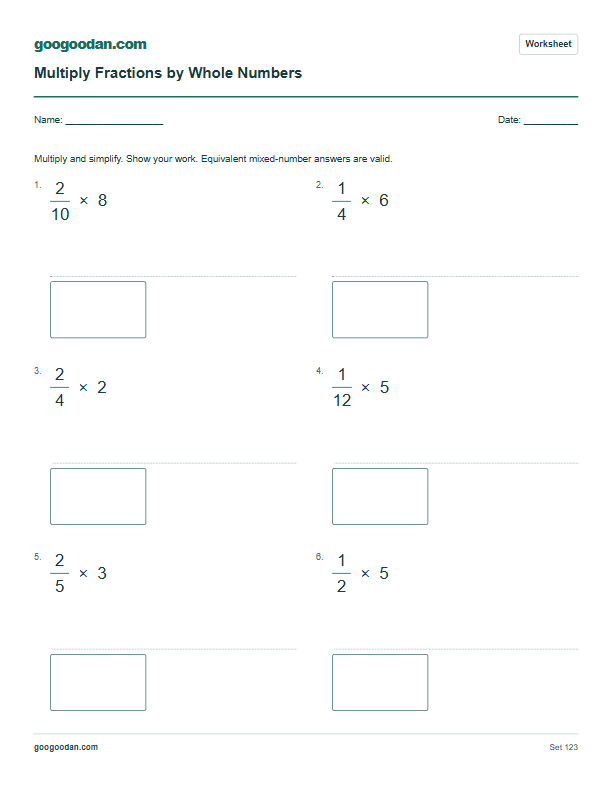 Calculation practice
Multiplying Fractions by Whole Numbers Worksheets
Count repeated groups of equal fraction parts and simplify the product.
6 problems · Answer key included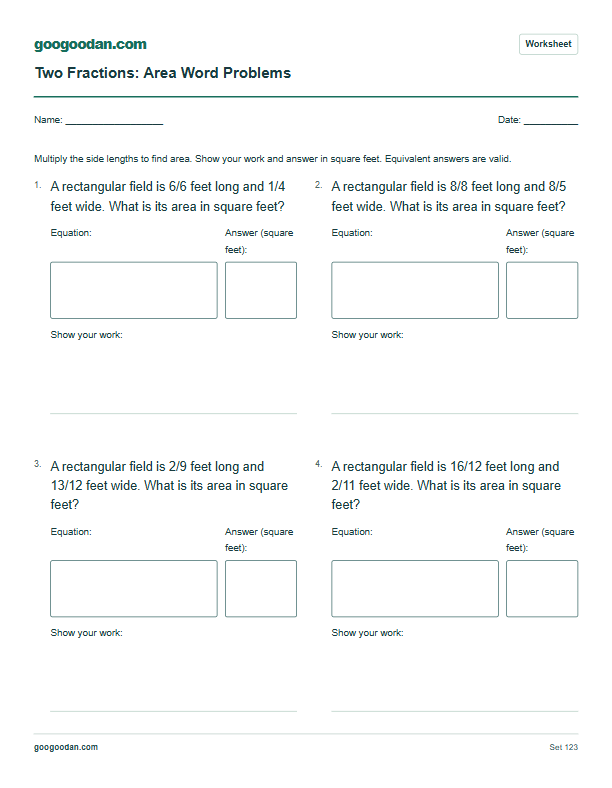 Word problems
Multiplying Two Fractions Word Problems: Area
Find rectangle area when both side lengths are written as fractions; include lengths greater than one foot.
4 problems · Answer key included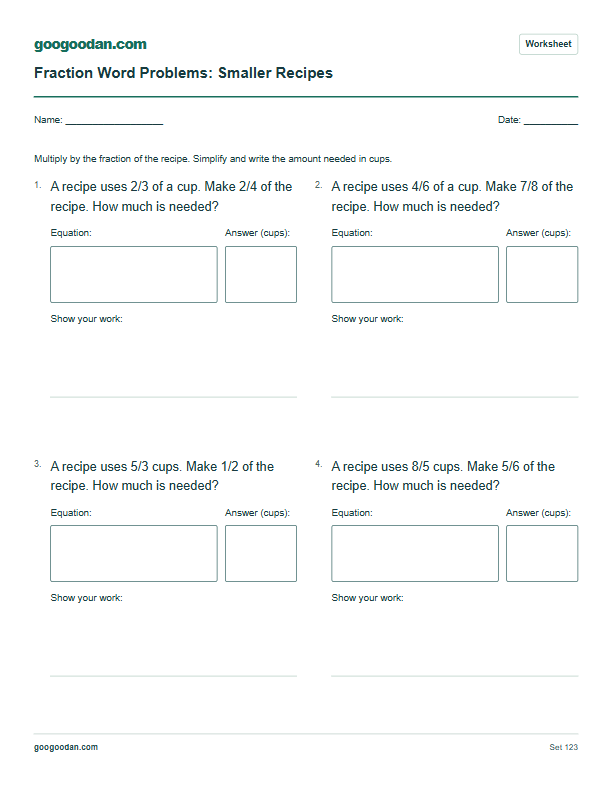 Word problems
Fraction Multiplication Word Problems: Recipes
Make a fraction of a recipe. Scale amounts below and above one cup while keeping the cup unit.
4 problems · Answer key included
More about multiplication · Grade 5 worksheets
Grade 5 selected skill connection: Selected 5.NF.B.5b and 5.NF.B.6: interpret multiplication by a nonwhole factor greater than one as scaling a positive fractional amount up. Exact products; does not cover every scaling or multiplication context. See the Common Core grade guidance. This worksheet does not cover every requirement in the standard.