
Fraction Multiplication Word Problems: Recipes
Help a child distinguish half a recipe from half a cup. Scale the original ingredient amount and keep the measuring unit unchanged.
Lena wants half a recipe, not half a cup
A recipe calls for 3/4 of a cup of an ingredient. Lena wants to make half the recipe. She reaches for a half-cup measure because she sees “half.” Before measuring, ask, “Half of what?” She needs half of the original 3/4-cup amount, not half of a full cup.
Half the recipe uses half as much of each ingredient. Picture 3/4 of a cup divided into two equal shares. Each share is 3/8 of a cup, so Lena needs 3/8 of a cup for the smaller recipe.
Each full bar represents one cup. Every small part is 1/8 of a cup. The whole does not change when the recipe gets smaller.
Keep the cup and the recipe separate
The cup is the unit used to measure the ingredient. The fraction 1/2 tells how much of the original recipe Lena is making. It is a scale factor, not a second ingredient amount measured in cups. Taking a fraction of an amount means multiplying the amount by that fraction.
3/4 × 1/2 = 3/8
Three fourths of a cup for a full recipe becomes three eighths of a cup for half the recipe.
In the bar model, one cup is split into eight equal parts. The original 3/4 cup fills six of those parts. Half of six parts is three parts. The three selected pieces still each measure one eighth of a cup; they do not become thirds simply because there are three of them.
Multiply the numerators and denominators
For 3/4 × 1/2, multiply the numerators, 3 × 1 = 3, and the denominators, 4 × 2 = 8. The product is 3/8. The second partition makes each original fourth half as large, creating eighths. That gives the denominator multiplication a meaning beyond a rule to memorize.
For 2/3 of a cup scaled to 2/4 of a recipe, calculate 2/3 × 2/4 = 4/12 = 1/3 cup. Simplifying 2/4 to 1/2 before multiplying is also valid. Equivalent fractions describe the same amount, so either route should give an equivalent answer.
A smaller recipe can still need more than one cup
Suppose the original recipe uses 3/2 cups, which is 1 1/2 cups. Making 3/4 of that recipe requires 3/2 × 3/4 = 9/8 cups, or 1 1/8 cups. The result is still more than one cup, but it is less than the original 1 1/2 cups. “Smaller” compares the new amount with the old amount, not automatically with one cup.
These worksheets show amounts above one cup as improper fractions. A child may rewrite 3/2 as 1 1/2 to understand the quantity, then use 3/2 for multiplication. The answer key keeps exact simplified fractions such as 9/8; the equivalent mixed number 1 1/8 is also correct. Do not round a fractional cup to a whole cup.
Predict before calculating
Every recipe multiplier in this set is positive and less than one. Therefore, the needed amount must be positive and smaller than the original ingredient amount. If Lena gets 3/2 cups when scaling 3/4 cup to half a recipe, the answer has grown instead of shrunk. A quick comparison reveals that she may have divided by 1/2 rather than multiplied by it.
A product can equal exactly one cup. For example, 3/2 × 2/3 = 1. One cup is less than the starting 3/2 cups, so it satisfies the smaller-recipe check. Fractions in the question do not require a non-whole fraction in the final answer.
Respond to three common mistakes
If a child writes 1/2 cup for the first example, ask them to point to the original amount on the bar and share that amount in half. If they add 3/4 + 1/2 = 5/4, they have treated the recipe fraction as extra cups. Have them describe what is being added; no extra ingredient is introduced when the batch is made smaller.
If they write 3/4 × 1/2 = 3/4, they may have multiplied only the numerators. Compare that answer with the prediction: half a recipe cannot use the full recipe's original amount. Partition the fourths into eighths again and count only the selected half.
Use equivalent answers to check the work
Double the answer of 3/8 cup to recover 6/8 cup, which is 3/4 cup. For a different scale factor, explain how the selected equal shares relate to the original amount. For example, to take 2/3 of 3/2 cups, split 3/2 into three equal shares of 1/2 cup and use two shares: one cup.
In the final box, write the number of cups; the printed “Answer (cups)” label supplies the unit. In a sentence, write “3/8 of a cup” for an amount below one and “9/8 cups” for an amount above one. The fraction of the recipe itself has no cup unit.
Use the printable practice after the model
Each set has four different recipe stories: two starting with less than one cup and two starting with more than one but less than two cups. Every multiplier is a proper fraction, and the original input denominators range from 2 to 8. Some fractions are not simplified, so students can practice equivalent forms without changing the original numbers.
Use the work area to draw a cup bar, partition the original amount, or show fraction multiplication and simplification. The page focuses on smaller recipes with exact quantities. It does not cover doubling recipes, scaling by factors greater than one, or converting cups to other kitchen units. Adults can read the story aloud while the child explains what the fraction refers to.
Make a practice set
Choose what to print. Selecting both shows the answer key on screen and prints the questions followed by the answers.
After the practice
Ask whether the answer is smaller than the original amount and why the unit is cups, not a fraction of a recipe.
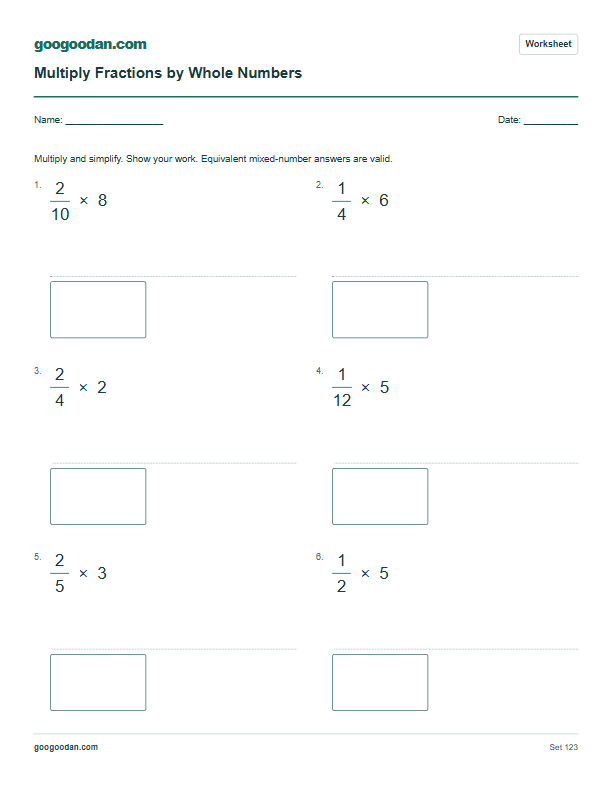 Calculation practice
Multiplying Fractions by Whole Numbers Worksheets
Count repeated groups of equal fraction parts and simplify the product.
6 problems · Answer key included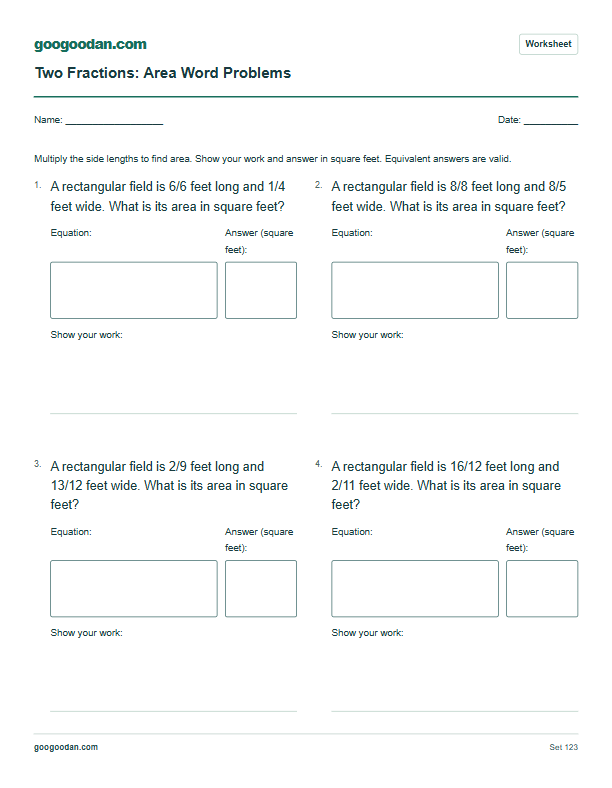 Word problems
Multiplying Two Fractions Word Problems: Area
Find rectangle area when both side lengths are written as fractions; include lengths greater than one foot.
4 problems · Answer key included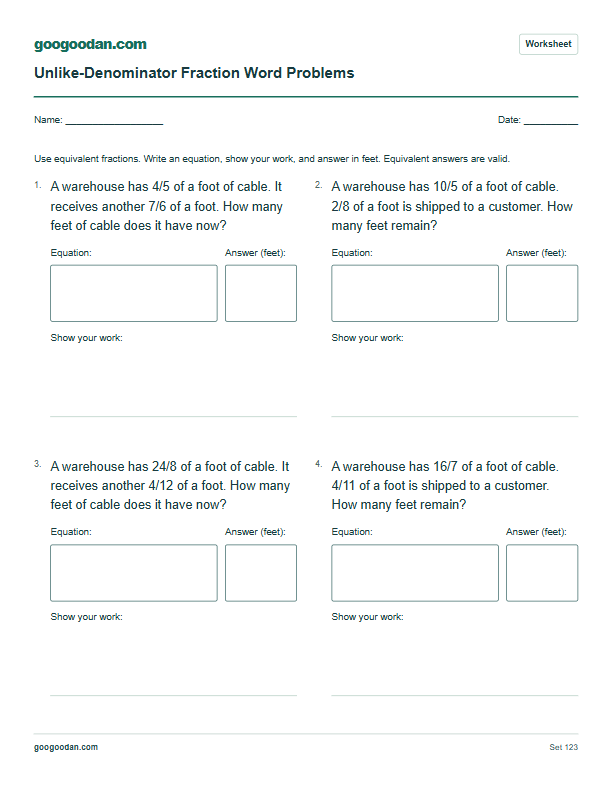 Word problems
Adding and Subtracting Fractions Word Problems With Unlike Denominators
Use equivalent fractions to combine or remove cable lengths measured against the same one-foot whole.
4 problems · Answer key included
More about multiplication · Grade 5 worksheets
Grade 5 selected skill connection: Selected 5.NF.B.6 with scaling reasoning from 5.NF.B.5: multiply proper or improper cup amounts by a proper fraction. No enlarged batches or mixed-number notation in the generated inputs. See the Common Core grade guidance. This worksheet does not cover every requirement in the standard.