
Multiplying Two Fractions Word Problems: Rectangle Area
Use two fractional side lengths to measure a rectangular surface. A unit grid explains why the numerators and denominators multiply, including when a side is longer than one foot.
Two fractional sides make an area model
Noah sketches a rectangular field that is 2/3 of a foot long and 3/4 of a foot wide. He remembers that fraction addition often needs equal denominators, so he starts looking for a common denominator. Pause and ask him what the drawing measures. He is covering a surface, and the two fractions describe different directions along its edges.
Start with a one-foot-by-one-foot reference square. Split its height into three equal rows and its width into four equal columns. Mark two rows for the length and three columns for the width. Their overlap is the field. The twelve small rectangles all have the same area, even though their sides have different lengths.
2/3 × 3/4 = 6/12 = 1/2 square foot
Each small cell is 1/3 foot tall and 1/4 foot wide, so twelve equal-area cells cover one square foot. The shaded rectangle contains six cells. The unshaded cells are part of the reference square, not part of the field.
Where the numerator and denominator come from
There are three rows and four columns in the complete square, making 3 × 4 = 12 equal-area cells. Each cell covers 1/12 of a square foot. The field covers two rows of three cells, making 2 × 3 = 6 cells. Its area is therefore 6/12 of a square foot.
This gives a reason for multiplying numerators and multiplying denominators. The numerators count the selected rows and columns. The denominators describe how the one-foot sides are partitioned. Unlike adding equal-sized parts, this multiplication builds a new area unit from two length units. A common denominator is not required before multiplying.
Simplify without changing the surface
Six of the twelve equal-area cells cover half the reference square. Divide the numerator and denominator of 6/12 by six to get 1/2. The shaded surface stays the same; only the name of its size changes. The answer is 1/2 square foot, not 1/2 foot.
Noah could simplify across factors before multiplying: in 2/3 × 3/4, the threes cancel and 2/4 becomes 1/2. Explain that this means dividing factors in the numerator and denominator by the same nonzero number. It is a multiplication shortcut, not permission to erase matching digits or cancel terms in an addition problem.
Fractions can describe lengths beyond one foot
This worksheet also includes improper fractions. A length of 5/3 feet extends beyond one foot; a width of 7/4 feet does too. Their product is 35/12 square feet, or 2 11/12 square feet. To sketch it, extend the unit grid beyond a single square instead of squeezing the entire field into a one-square-foot outline.
A second method is to use mixed-number parts. Since 5/3 = 1 + 2/3 and 7/4 = 1 + 3/4, the four subrectangles have areas 1, 3/4, 2/3, and 1/2 square foot. Adding them gives 35/12. This is an optional check after the basic area model is clear. The printed inputs themselves are fractions, not mixed numbers.
Make a size prediction
For two positive side lengths below one foot, the rectangle fits inside the reference square and its area is less than one square foot. In the 2/3-by-3/4 example, the product is also numerically smaller than either factor. Multiplication does not always make a number larger: taking a fraction of a positive amount can make it smaller.
When both lengths exceed one foot, the area exceeds one square foot. When one is below one and the other is above one, neither conclusion follows automatically. For example, 1/2 × 3/2 = 3/4, while 1/2 × 3 = 3/2. Use the actual measurements and a rough sketch rather than a rule that every fractional answer must be small.
Use the four problems purposefully
Underline the two side lengths, write their product, and label a sketch in the working space. Calculate, simplify, and write square feet with the answer. Compare an equivalent fraction or mixed number with the key before marking it wrong. Adding the two lengths or using a perimeter formula will not find the covered surface.
Each input has a numerator from 1 to 20 and a denominator from 2 to 12. Fractions may be proper, improper, unreduced, or equal to a whole number. The four problems all ask for rectangle area; they do not cover missing sides, perimeter, or every kind of fraction word problem. Begin with the fraction-by-whole-number area sheet if two fractional directions are still confusing.
Make a practice set
Choose what to print. Selecting both shows the answer key on screen and prints the questions followed by the answers.
After the practice
Have the child explain one cell in the grid before checking the product. If a length exceeds one foot, extend the drawing past the reference square. If the arithmetic is correct, check the square-foot unit and compare equivalent forms of the answer.
 Word problems
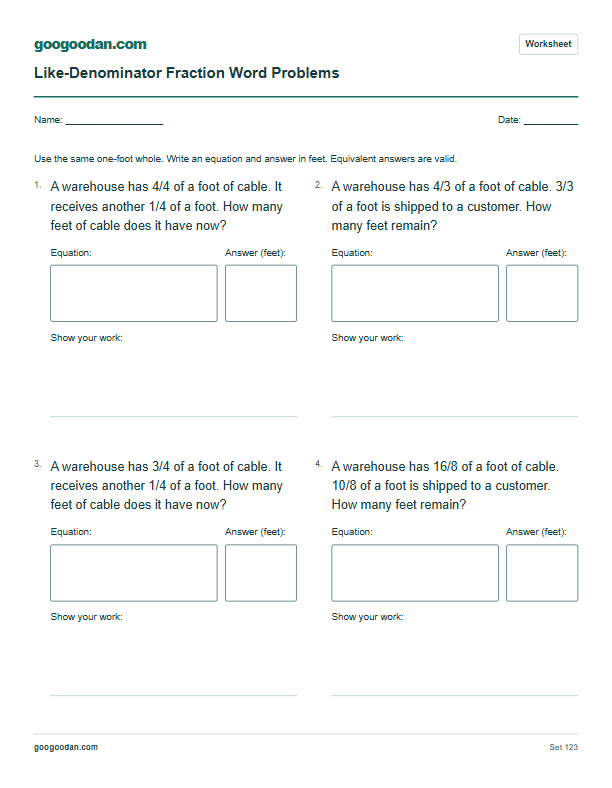
Adding and Subtracting Fractions Word Problems With Like Denominators
Combine or remove fractional cable lengths measured using the same one-foot whole.
4 problems · Answer key included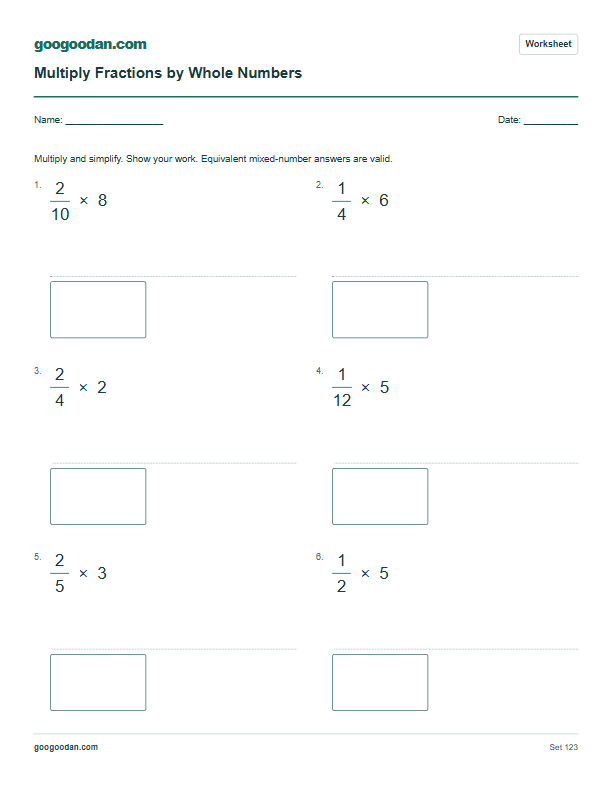 Calculation practice
Multiplying Fractions by Whole Numbers Worksheets
Count repeated groups of equal fraction parts and simplify the product.
6 problems · Answer key included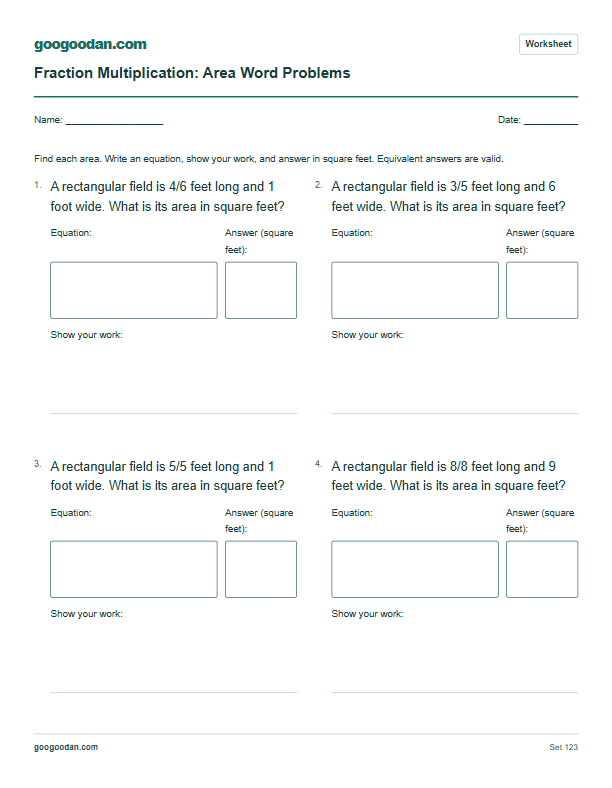 Word problems
Fraction Multiplication Word Problems: Rectangle Area
Multiply a fractional side length by a whole-number side to find area in square feet.
4 problems · Answer key included
More about multiplication · Grade 5 worksheets
Grade 5 selected skill connection: 5.NF.B.4.b; 5.NF.B.6 (rectangle area with both sides written as fractions). See the Common Core grade guidance. This worksheet does not cover every requirement in the standard.