
Fraction Multiplication Word Problems: Rectangle Area
Connect fraction multiplication to a measurable surface. Read two side lengths, sketch equal strips, and find the area in square feet. These are Grade 5 area applications of multiplying a fraction by a whole number.
From a side length to an area
Maya reads that a rectangular field is 3/4 of a foot long and 3 feet wide. She adds the two measurements and writes 3 3/4 feet. Her addition is accurate, but it answers a different question. Area asks how much surface the rectangle covers, not how long the two sides are together.
Ask Maya to point to each dimension on a sketch. Then introduce a square foot: a square measuring one foot along each side. That square is the whole used when measuring area. A foot measures a length; a square foot measures a surface.
3/4 × 3 = 9/4 = 2 1/4 square feet
The full outline is 3 feet by 1 foot. Only the shaded part is the field: 3 feet wide and 3/4 of a foot long. Each column contains three quarter-square-foot pieces.
Why multiplication fits this story
Split the width into three strips, each one foot wide. Every strip is 3/4 of a foot long, so each covers 3/4 of a square foot. The three strips cover 3/4 + 3/4 + 3/4 = 9/4 square feet. Multiplication records the same reasoning as 3/4 × 3.
The denominator stays four because the pieces being counted are still quarters of a square foot. The numerator counts nine of those pieces. Multiplying the denominator by three would change their size and produce 9/12, which is only 3/4 of one square foot. That cannot represent all three strips.
Describe an answer greater than one
Four quarters make one square foot. Nine quarters therefore make two full square feet and one quarter left over: 2 1/4 square feet. The improper fraction 9/4 and the mixed number 2 1/4 describe exactly the same surface. The answer key uses a simplified fraction or whole number; an equivalent mixed-number answer is valid.
Children do not need to convert every fraction before multiplying. For a field 7/4 feet long and 2 feet wide, count two strips of 7/4 square feet: 14/4 = 7/2 = 3 1/2 square feet. The length exceeds one foot, so the drawing needs more than a single one-foot row. Keeping the unit visible matters more than drawing a decorative rectangle.
Check size before checking arithmetic
If the length is less than one foot, the area is less than the numerical width expressed in square feet. For 3/4 × 3, the area should be between zero and three square feet. If the length equals one foot, the two numbers match. If it is greater than one foot, the area is larger than that benchmark. These comparisons use a one-foot-long reference rectangle with the same width.
Another check is to divide the area by the whole-number width. Dividing 9/4 square feet into three equal strips gives 3/4 square foot per strip. Because each strip is one foot wide, its length is 3/4 foot, matching the story.
Keep the equation, unit, and drawing connected
Have the child underline the two side lengths and circle the word area. Write an equation, draw a labeled rectangle or equal strips in the working space, and simplify the product. Finish with square feet. Adding the sides does not find area, and multiplying the sides does not find the distance around the field. Perimeter is a different measurement.
An unreduced input such as 6/8 is intentional. It represents the same length as 3/4. The child may simplify first or simplify the final product. Accept either route when the equation and final value agree.
What this printable set covers
These four Grade 5 word problems reuse one rectangle-area context with fresh numbers. The fractional length has a numerator from 1 to 12 and denominator from 2 to 12; the whole-number width is 1 to 9 feet. Lengths can be below, equal to, or above one foot. The set does not include two fractional side lengths, mixed-number inputs, missing sides, or perimeter questions. Use the fraction-by-whole-number calculation sheet first if the arithmetic is the main obstacle.
Make a practice set
Choose what to print. Selecting both shows the answer key on screen and prints the questions followed by the answers.
After the practice
Check the meaning of the units before marking the calculation. Ask the child to show one square foot and explain how the rectangle is divided into equal strips. If the answer differs from the key, compare equivalent fractions before treating it as an error.
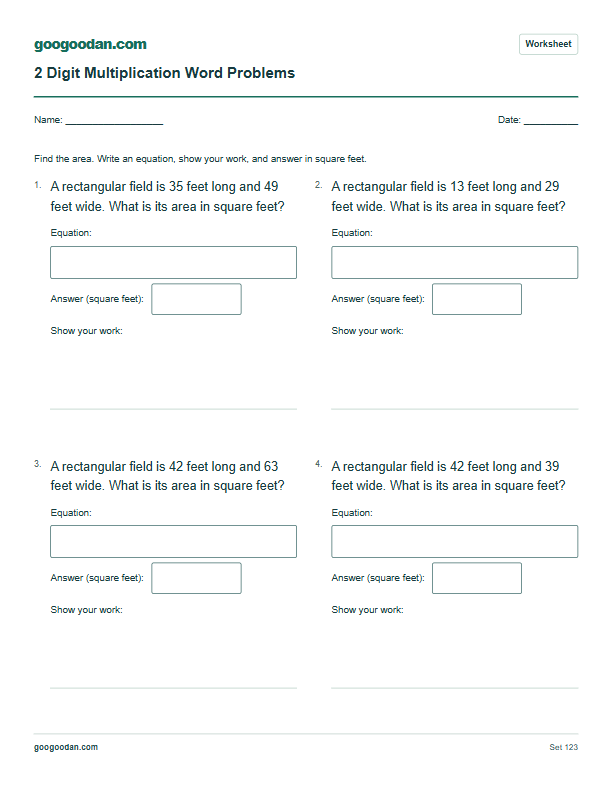 Word problems
2 Digit Multiplication Word Problems: Rectangle Area
Multiply two two-digit side lengths to find a rectangular field’s area in square feet.
4 problems · Answer key included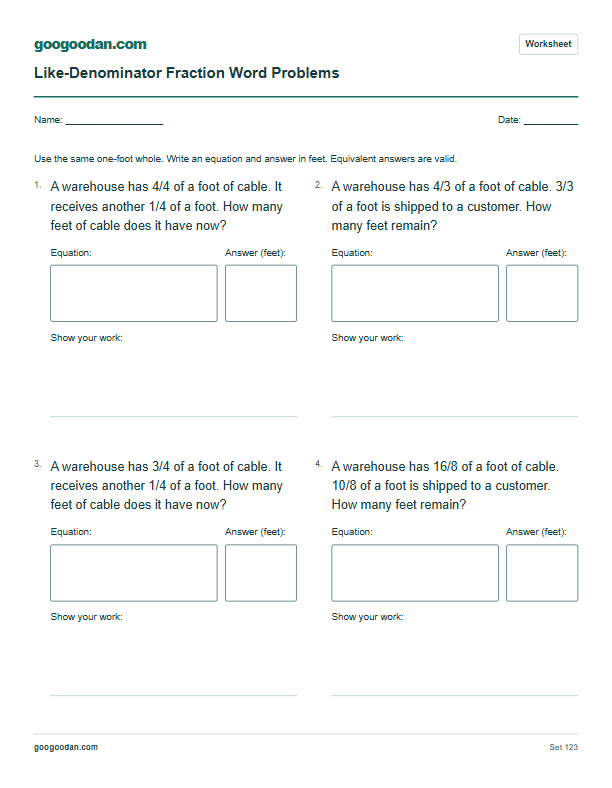 Word problems
Adding and Subtracting Fractions Word Problems With Like Denominators
Combine or remove fractional cable lengths measured using the same one-foot whole.
4 problems · Answer key included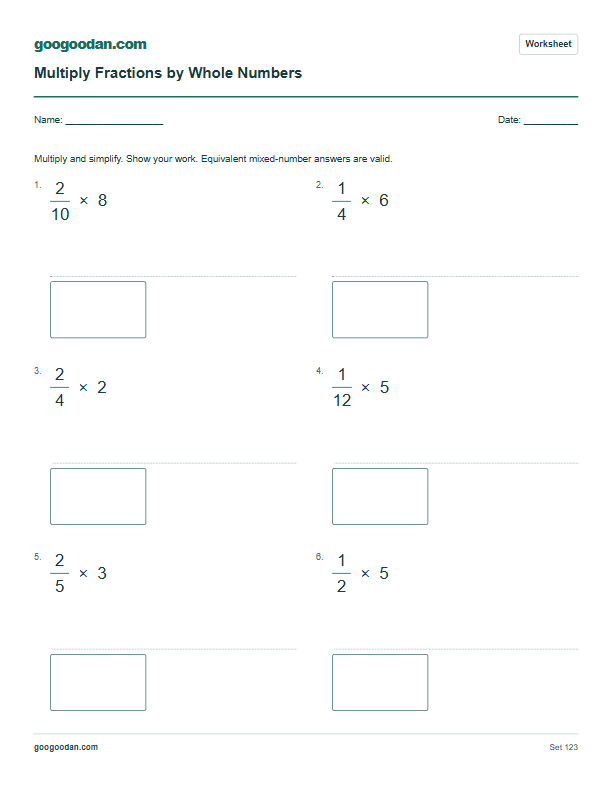 Calculation practice
Multiplying Fractions by Whole Numbers Worksheets
Count repeated groups of equal fraction parts and simplify the product.
6 problems · Answer key included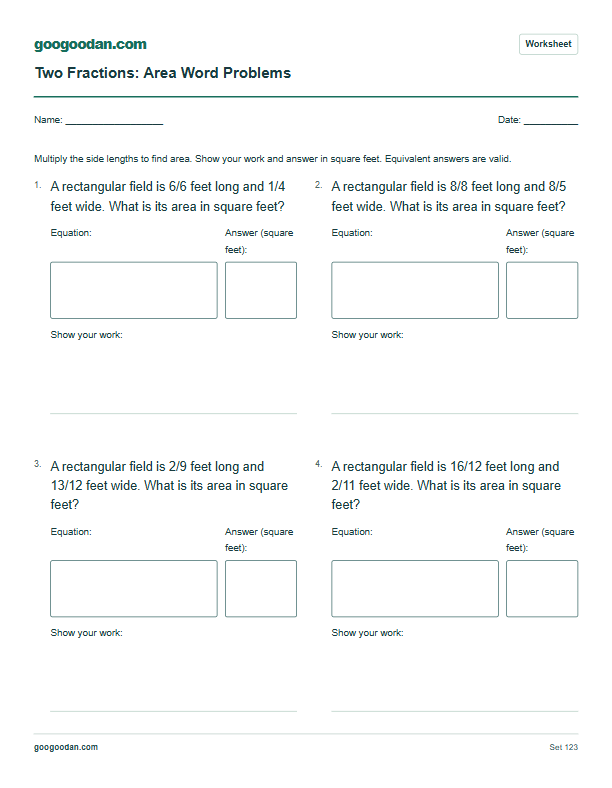 Word problems
Multiplying Two Fractions Word Problems: Area
Find rectangle area when both side lengths are written as fractions; include lengths greater than one foot.
4 problems · Answer key included
More about multiplication · Grade 5 worksheets
Grade 5 selected skill connection: 5.NF.B.4.b; 5.NF.B.6 (one fractional side and one whole-number side only). See the Common Core grade guidance. This worksheet does not cover every requirement in the standard.