
Equal Groups Division Word Problems
Is the missing number the number of groups, or the amount in each group? Compare both meanings of division with pictures, then solve four exact-division stories using facts from 2 to 9. For larger totals, choose Sharing: two-digit answers to practice finding the amount in each group.
One division equation can answer two different questions
Owen has 24 counters for a table game. First he wants to put four counters in every bag. Later he empties the bags and shares all 24 counters equally among four players. He writes 24 ÷ 4 = 6 both times. His calculation is right, but the six describes a different thing in each story.
Four in each bag: find how many groups
Owen knows the total and the size of each group. He puts four counters in a bag, then fills another bag the same way until none remain. Ask the child to circle four counters at a time and count the circles, not the counters inside one circle.
Owen makes six bags. Here the answer is 6 groups. Counting 4, 8, 12, 16, 20, 24 takes six jumps of four. Those jumps count the bags; 24 counts all the counters. The matching missing-factor equation is □ × 4 = 24, so 24 ÷ 4 = 6.
Four players: find how much is in each group
Now the four describes the number of groups. Owen draws four empty spaces, one for each player, and gives one counter to every player in turn. After six rounds each player has six counters. The groups stay equal as he shares.
Here the answer is 6 counters in each group. We already knew that there were four groups. The matching equation is 4 × □ = 24. Reading “six” without naming what it counts would hide the difference between the two situations.
Label the known quantity before drawing
For any equal-group division story, write three labels: total, number of groups, and amount in each group. Fill in the two known quantities and put a question mark beside the one being asked for. When group size is known, circle that many at a time. When the number of groups is known, draw those groups first and share the total among them.
If the child draws four groups of four, only 16 counters have been used. Count the counters in the model and compare that total with 24. Add the remaining counters equally instead of changing the number of players. This checks the story as well as the multiplication fact.
Check with multiplication and the answer's meaning
For the bags, six groups of four use 24 counters. For the players, four groups of six use 24 counters. Both models return to the given total, but each must also match the information in its own question. A correct total alone does not show that the groups were interpreted correctly.
What this printable set practices
In the default division-facts activity, four questions alternate between finding group count and group size. The facts use divisors and quotients from 2 to 9, with totals no greater than 81. Every division is exact: this set does not include remainders, fractional shares, zero, or division by one. Each question has space for an equation and a drawing or calculation. The answer label identifies whether the result counts groups or an amount in each group.
After solving, cover the answer label and ask the child to explain what the quotient represents in a complete sentence. Use the multiplication and division story set next to practice deciding which operation is needed, rather than only which kind of division is being described.
Share a larger total equally
In the Sharing: two-digit answers activity, the total is known and the number of groups is known. The missing amount is always the share in one group. Each sheet has four exact-division questions, with two through nine groups and a two-digit amount in each. This is different from asking how many groups can be made from a fixed group size.
Split the total into helpful parts
Imagine placing 75 counters into five equal groups. Drawing all 75 counters is possible, but the bar model lets us keep track of the whole and the equal shares without counting each object. There are five sections because the story already tells us the number of groups. The value in each section is what we must find.
Split 75 into 50 + 25. Sharing 50 among five groups gives ten to each group. Sharing the remaining 25 gives another five to each group. Each group therefore has 10 + 5 = 15. Write 75 ÷ 5 = 15 and check that five groups of 15 use all 75 counters.
The parts 50 and 25 were chosen because both divide evenly by five. They do not have to be the tens and ones in the original number. Splitting 75 into 70 + 5 is also a valid decomposition, but it is less convenient for this whole-number sharing strategy. The goal is to choose useful equal shares while keeping the total unchanged.
Regroup when a place value will not share evenly
For 116 shared between two groups, start with one hundred, one ten, and six ones. Exchange the hundred for ten tens. Now there are eleven tens and six ones. Give five tens to each group, using ten tens. Exchange the remaining ten for ten ones; together with the original six ones, there are sixteen ones. Give eight ones to each group. Each share is five tens and eight ones, or 58.
The value never changes during those exchanges: 116 is also 11 tens + 6 ones and 10 tens + 16 ones. A child who writes 53 may have shared the ten tens and six ones but forgotten the extra ten. Ask the child to account for every part of the total before correcting the written answer.
Check the answer and what it represents
For the first picture, 5 × 15 = 75. For the second, 2 × 58 = 116. Multiplying the number of groups by the amount in one group must recover the original total. The answer 58 means an amount in each group, not 58 groups. Have the child finish the sentence “Each group has…” and point to one section of the bar.
On the student worksheet the equal sections contain question marks. Count the sections to confirm the known number of groups, then calculate the unknown value. The bar shows equality; its printed width is not a ruler for measuring the answer. Its scale applies only inside that problem.
Choose between exact sharing and remainders
This larger-sharing activity has no leftover amount. It excludes division by one, division by zero, fractional answers, and finding the number of groups. Not every sheet includes the same regrouping pattern. When a total cannot be shared evenly in whole units, use the division and remainder word problems and discuss what the leftover means in that situation.
Make a practice set
Choose what to print. Selecting both shows the answer key on screen and prints the questions followed by the answers.
After the practice
Ask what is known before the child calculates. Have the child name what the answer counts, then multiply to check that all of the original amount has been used.
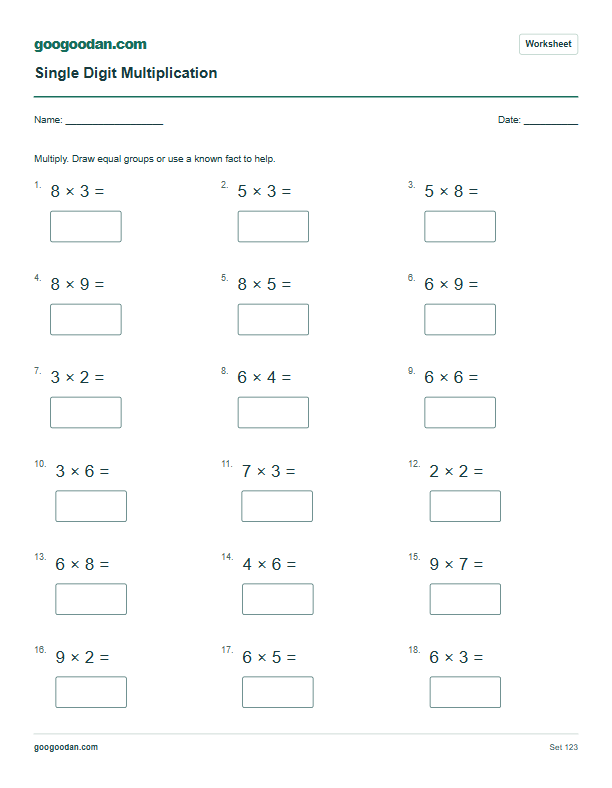 Calculation practice
Single Digit Multiplication Worksheets
Use equal groups and arrays to practise multiplication facts with factors from 2 to 9.
18 problems · Answer key included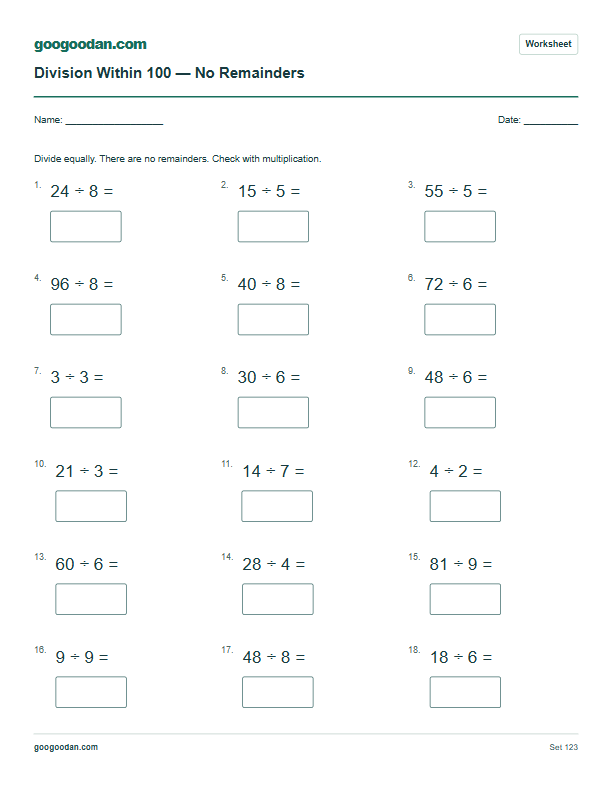 Calculation practice
Division Without Remainders Worksheets
Share equally or make equal groups, then check each quotient with multiplication.
18 problems · Answer key included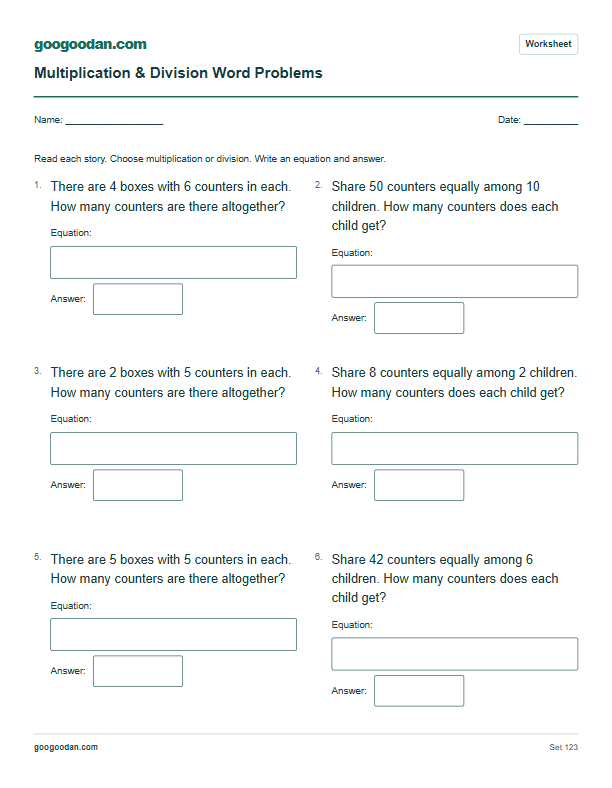 Word problems
3rd Grade Multiplication and Division Word Problems
Choose mixed facts, zero-and-one groups, or two- and three-digit group amounts. Explain what the answer counts.
6 mixed stories or 4 focused multiplication stories · Answer key included
More about division · Grade 3 worksheets · Grade 4 worksheets
Grade 3 selected skill connection: Default division-facts activity: 3.OA.A.2–3 (selected whole-number equal groups: find group count or group size; exact division facts with factors 2–9). See the Common Core grade guidance. This worksheet does not cover every requirement in the standard.
Grade 4 selected skill connection: Supporting 4.NBT.B.6 with the larger-shares option: exact division by 2–9 with two-digit quotients; selected equal-sharing cases only, no remainders. See the Common Core grade guidance. This worksheet does not cover every requirement in the standard.