
2D Shape Recognition Worksheets for Kindergarten
Trace each flat shape and name it. Use its sides and corners, not its color or position. An adult may read the names and write a spoken answer.
A turned square is still a square
Noah looks at a shape resting on one corner. “That is a diamond,” he says. An adult turns a square paper card to the same position, then turns it back. Nothing has been cut off or stretched: the four sides and four corners are still there. Noah traces the edges and sees that changing the position did not change the shape.
The square on this worksheet rests on a corner. It has four equal straight sides and four square corners. Its mathematical name is still square. The word “diamond” may describe its appearance in everyday conversation, but square is the name used for this picture in the answer key.
Trace all the way around the picture before naming it. Turning the page can help a child recognize the square, then check that the same edges are present when the page turns back.
Three shapes to recognize
A triangle has three straight sides and three corners. Follow one side at a time, stopping briefly at each corner. The triangle shown here is just one example; triangles do not all have to look like this particular picture.
A square has four equal straight sides and four square corners. Four sides alone are not enough to prove that a shape is a square. Other four-sided shapes exist. For these pages, the pictured four-sided shape has been checked to have equal sides and square corners.
A circle has a curved boundary. There are no straight sides or corners to count. Trace the curve continuously, without inventing a corner where you started. The starting point of your finger is not a corner in the shape.
Let recognition come before spelling
The direction includes three names: triangle, square, and circle. Read them aloud if needed. Invite the child to say the name, point to the word, or copy it into the box. An adult may record a spoken answer. A child who recognizes a triangle but cannot spell “triangle” has shown the shape knowledge this activity is intended to practice.
Each picture has its own wide answer box. Use the picture to explain the choice before focusing on how neatly the name is written. The worksheet contains six pictures: two triangles, two squares, and two circles. The order can change with a new set, but each page includes all three names.
Help with a plausible wrong answer
If a child calls the turned square a triangle, trace slowly and count each straight edge exactly once. The top point can attract attention, but the whole boundary matters. Mark the starting corner lightly with a finger and stop when you return there.
If a child calls it a diamond, acknowledge the familiar word and demonstrate with a square paper card. Show that the four equal sides and square corners stay the same while the card turns. Avoid teaching that every diamond-shaped drawing is a square: this particular drawing is a square because of its properties.
Try the idea away from the worksheet
Look for a circular lid, a square paper tile, or a triangular paper piece. Trace the flat outline you are talking about. A lid is a solid object, but its face can have a circular outline; this page is about that flat shape, not the name of the whole solid object.
Turn a paper shape and let the child name it again. This informal extension adds examples beyond the fixed pictures in the generator. Comparing different sizes and orientations is useful next practice, but it is not fully assessed by this small set.
Check and choose what comes next
The matching answer key preserves every picture and writes the name in red. Check the child's spoken explanation as well as the written word. The answer “quadrilateral” describes a broader family that includes this square; help the child also use the more specific name square.
These free printable worksheets cover a triangle, a circle, and a square resting on a corner. They do not cover all kindergarten shapes or every requirement of the geometry standards. When these examples are familiar, move to sorting and counting pictured shapes or compare real paper shapes before choosing harder geometry tasks.
Make a practice set
Choose what to print. Selecting both shows the answer key on screen and prints the questions followed by the answers.
After the practice
Ask the child to trace the boundary and explain one choice. Accept a spoken name when writing is still developing.
 Find, circle, and count activity
Sort and Count Shapes Worksheets for Kindergarten
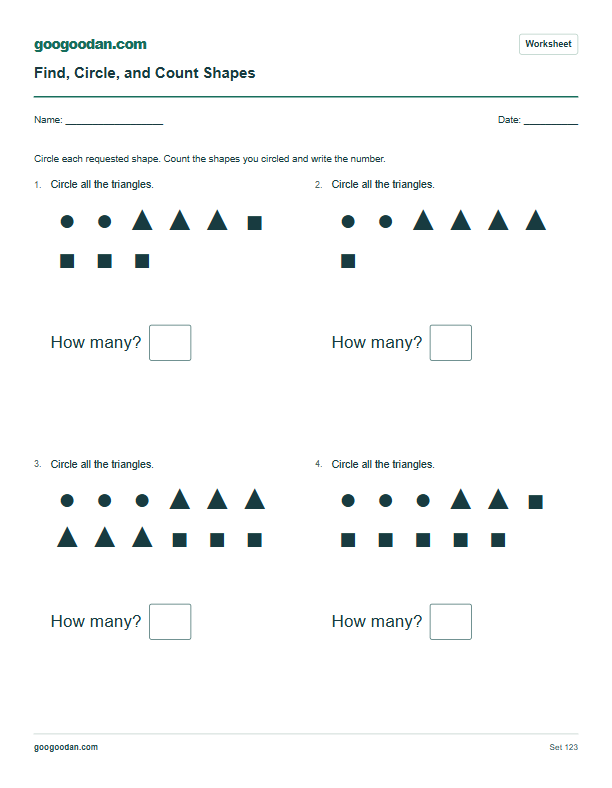
Circle every shape of the requested kind, then count the circles, triangles, or squares you selected.
4 problems · Answer key included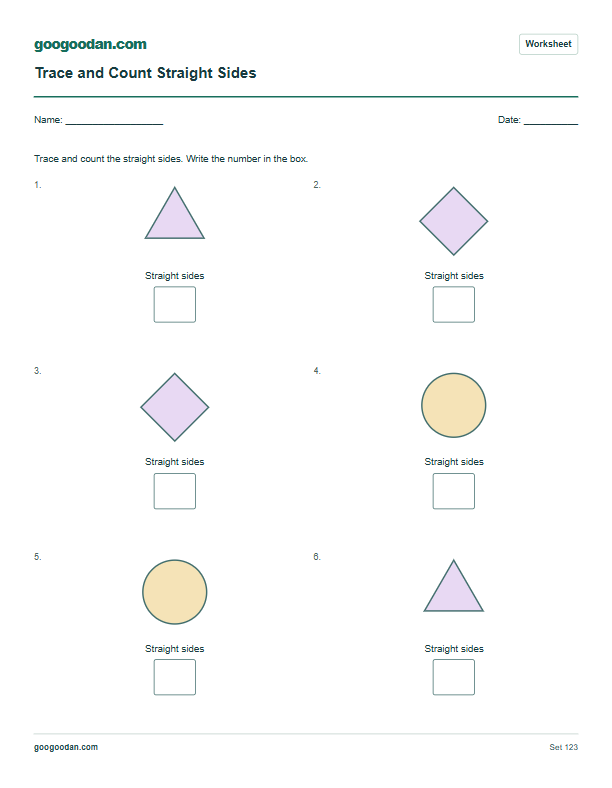 Trace and count sides activity
Counting Sides Worksheets for Kindergarten
Trace and count the straight sides of triangles, squares, and circles. A circle has a curved boundary and zero straight sides.
6 problems · Answer key included
More about shapes · Kindergarten worksheets
Kindergarten selected skill connection: Supporting K.G.A.2: name a pictured triangle, circle, and square resting on a corner. Fixed source examples only; not a full range of sizes, orientations, or shape families. See the Common Core grade guidance. This worksheet does not cover every requirement in the standard.