
Sort and Count Shapes Worksheets for Kindergarten
Find one kind of shape in each collection. Circle every match, then write how many you found. An adult can read the shape names aloud.
Count one kind of shape at a time
Maya sees circles, triangles, and squares on her page. She starts counting every picture and announces the total. Her teacher points to the instruction: “Circle all the triangles.” Maya has counted carefully, but she has answered a different question. Now she needs to choose which pictures belong in her count.
A collection might contain two circles, three triangles, and four squares. If the question asks for triangles, circle the three triangles and write 3. The circles and squares stay on the page, but they do not belong to the category being counted.
First name the kind of shape. Next mark every matching picture. Finally count only the marked pictures. Separating these actions helps a child keep track of both the sorting rule and the number.
What makes a match?
A category is a group whose members share a chosen feature. Here the feature is shape. The page uses circles, upright triangles, and upright squares. Circles have a curved boundary; the pictured triangles have three straight sides; the squares have four equal straight sides and four square corners.
Show the child one example of the requested shape before starting. Say its name and trace its outline together. There is no need to read the instruction independently: an adult can say, “Find every square,” while the child points and circles.
Circle first, then count
Move across the pictures from left to right, continuing onto the next row when needed. Draw a ring around each matching shape. Keep the other shapes unmarked. After checking the whole collection, touch each ring once and say the counting words in order.
The last counting word tells how many shapes were selected. Write that number in the box, or let an adult record the number the child says. Each requested category contains between one and six shapes. The whole collection can contain more than six, so counting every picture will not answer the question.
Notice where the count goes wrong
If the marked shapes are correct but the number is not, check one-to-one counting. A child may touch one shape twice, skip the first shape on a new row, or say the next number before moving a finger. Count the same marked collection slowly without changing the sorting rule.
If the count is correct but some rings surround the wrong shapes, revisit the category instead. Ask the child to trace an outline and compare it with the example. Do not use the total alone to judge the response: two different mistakes can happen to leave the same number of marked shapes.
Move from the page to real objects
Offer a few paper circles, triangles, and squares. Ask the child to move one kind onto a separate mat and count it. This adds the physical act of sorting, which the printed page cannot provide. Then try another category with the same pieces.
The worksheet already places like shapes next to one another. Keep that support while the child learns the rule. Sorting a mixed pile independently, comparing all category totals, and ordering categories by their counts are further activities, not tasks assessed by this page.
Check the choice as well as the number
The free printable set contains four activities and a matching answer key. The key rings every requested shape in red and gives its count in the answer box. Compare both the rings and the written number with the child's work. Invite the child to explain one selection by pointing, tracing, or speaking.
Use New numbers for another set of the same activity. These pages cover three familiar pictured shapes in a fixed orientation. They do not assess every kind of triangle, rotated shapes, rectangles beyond squares, or the full kindergarten geometry curriculum.
Make a practice set
Choose what to print. Selecting both shows the answer key on screen and prints the questions followed by the answers.
After the practice
Check both the marked shapes and their count. An adult may read the directions or record a spoken answer.
 Picture activity
Count and Write Worksheets for Kindergarten
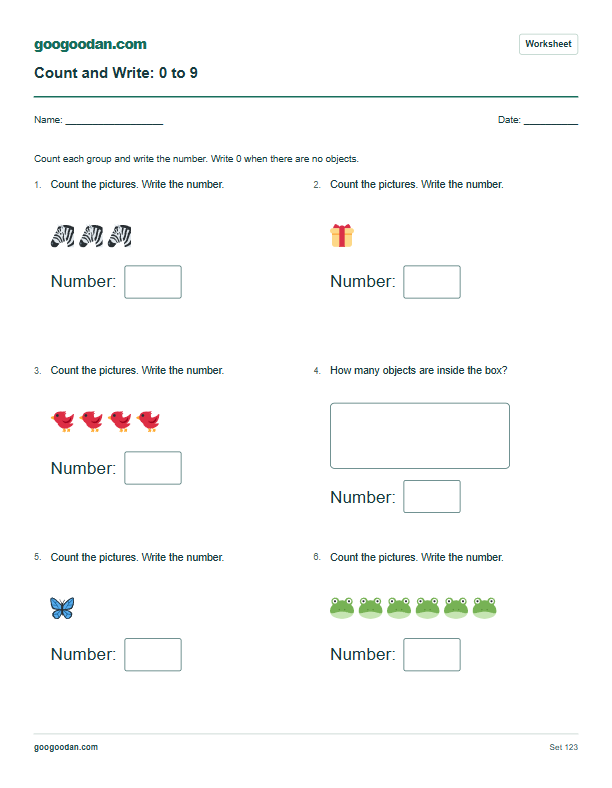
Count picture groups from 1 to 9 and write 0 for an empty group. Touch each object once and record the total.
6 problems · Answer key included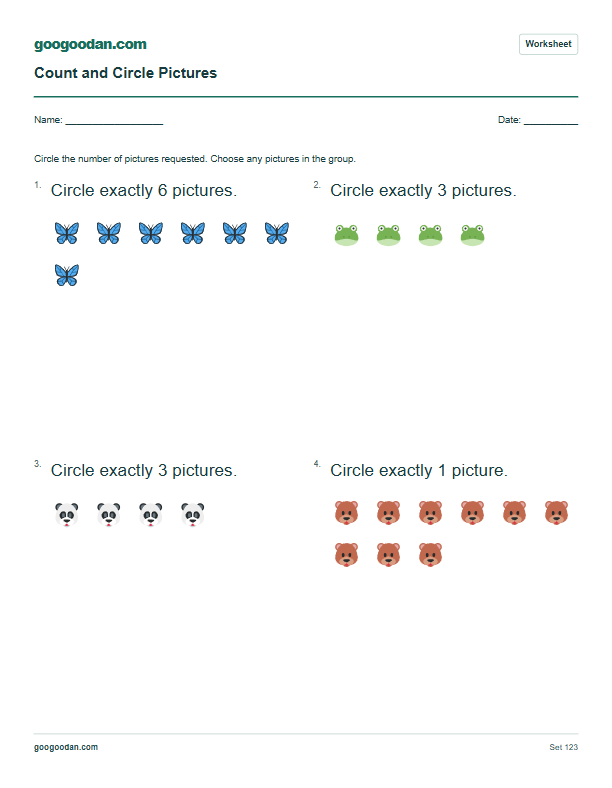 Picture activity
Count and Circle Worksheets for Kindergarten
Circle a requested number of pictures. Any selection with the right count is correct.
4 problems · Answer key included
More about numbers · Kindergarten worksheets
Kindergarten selected skill connection: Supporting K.MD.B.3: identify one given shape category and count its 1–6 members. Does not cover sorting categories by count; source shapes are already grouped. See the Common Core grade guidance. This worksheet does not cover every requirement in the standard.