
Counting Sides Worksheets for Kindergarten
Look at the boundary, not just the shape name. Trace each straight edge once and write how many straight sides the shape has.
Count the straight parts of the boundary
Ella runs her finger around a circle and says, “One side, because I went around once.” Her brother points to the direction: count the straight sides. Ella traces again. Her finger keeps turning along a curve; there is no straight edge between two corners. She writes 0 in the box and explains that the circle still has a boundary.
For these worksheets, a side means a straight boundary segment between neighboring corners. A triangle has 3 straight sides. The pictured square has 4. A circle has 0 straight sides, because its entire boundary is curved.
Choose a starting corner on a polygon. Trace one straight edge to the next corner and say “one.” Continue around the shape, counting each edge once. Stop when you return to the starting corner.
Keep the question precise
Some informal classroom conversations describe the curved boundary of a circle as a curved side. This activity asks specifically for straight sides, so the circle's answer is zero. It is not asking how many trips your finger makes around the picture or whether the picture has an outline.
When a child answers 1 for the circle, ask what was counted before correcting it. If the child means one continuous curved boundary, that observation is useful. Contrast it with a triangle's straight edge and return to the exact wording of the question.
Trace rather than guess from the name
Knowing the word triangle can help, but invite the child to show all three edges. Lightly trace one edge, pause at the next corner, and continue. A small pencil tick beside each completed edge can keep track of the count without covering the picture.
The square in this set rests on a corner. Its sloping edges are still straight. Count all four, including the lower edges that may be easy to overlook. Turning the sheet changes where the edges point, not how many there are.
Avoid counting an edge twice
Returning to the starting point can make a child count one more edge. Put a finger at the first corner before moving the other finger along the boundary. When the tracing finger returns to that marked corner, every edge has been visited once and the count is finished.
For a triangle and square, corners and sides happen to have matching counts. Ask the child to trace the straight segments on this page so you can see which feature is being counted. This worksheet does not separately assess corner counting or the properties of solid shapes.
Connect zero to something visible
Zero does not mean the circle is missing. It means there are none of the requested straight parts. Compare a paper circle with a paper triangle: the triangle has straight edges that can line up with a ruler, while the circle curves away. Let the child say “no straight sides” before writing 0.
An adult may read the direction, write a spoken number, or help position the paper. The goal is to attend to the boundary and count the right feature, not to test independent reading or handwriting.
Check with the picture
Each free printable page includes two triangles, two squares, and two circles from the existing picture bank. The matching answer key keeps the same shapes and writes 3, 4, or 0 in red. When checking, ask the child to demonstrate one count by tracing instead of simply copying the key.
If the child already knows the answers, compare safe paper shapes away from the page and ask why turning one does not change its side count. The generator uses fixed examples of three familiar shapes; it does not supply every kind of triangle, other quadrilaterals, hexagons, or three-dimensional objects.
Use the related shape-naming worksheet when a child needs help with the names. Choose this counting activity when the child is ready to describe an attribute and explain how it was counted.
Make a practice set
Choose what to print. Selecting both shows the answer key on screen and prints the questions followed by the answers.
After the practice
Ask the child to trace each straight edge once. For a circle, accept the explanation “no straight sides” and record 0.
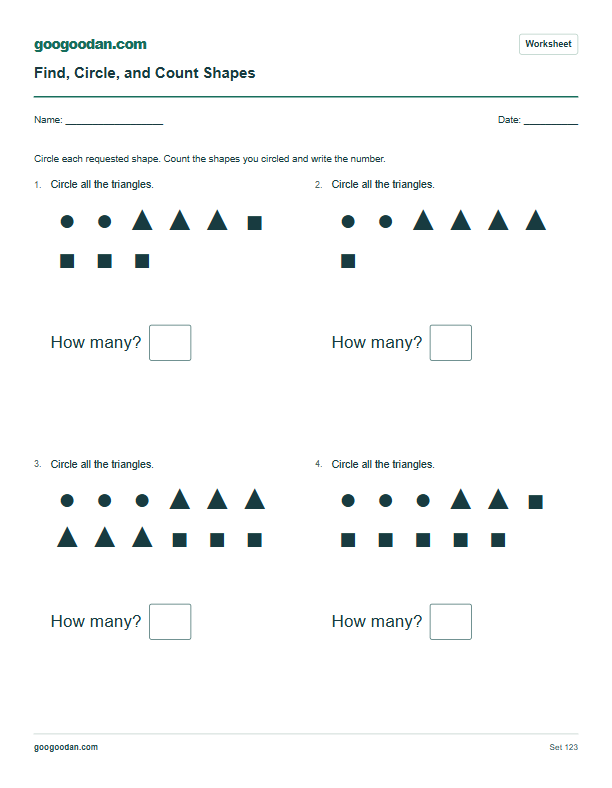 Find, circle, and count activity
Sort and Count Shapes Worksheets for Kindergarten
Circle every shape of the requested kind, then count the circles, triangles, or squares you selected.
4 problems · Answer key included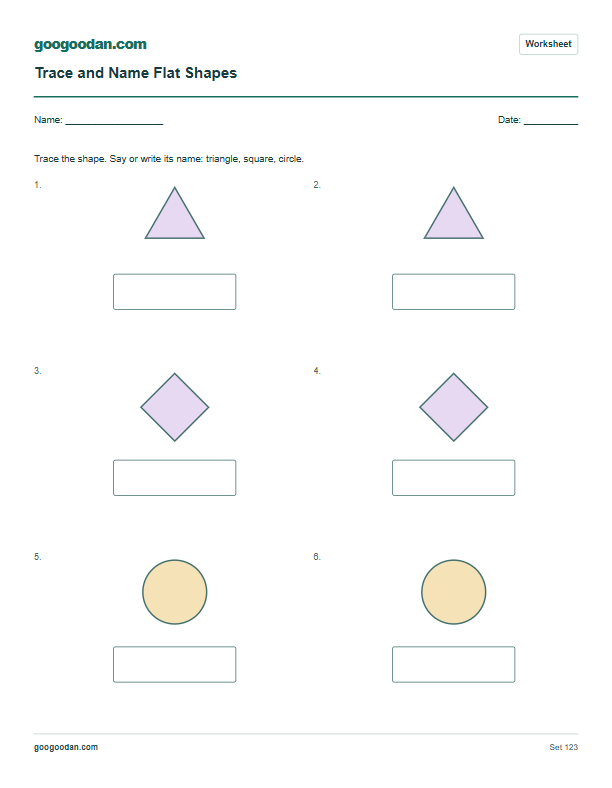 Trace and name shapes activity
2D Shape Recognition Worksheets for Kindergarten
Trace and name a triangle, square, or circle. Notice that a square is still a square when it rests on a corner.
6 problems · Answer key included
More about shapes · Kindergarten worksheets
Kindergarten selected skill connection: Supporting K.G.B.4: describe straight-side counts for three pictured flat shapes (circle 0, triangle 3, square 4). Not a full comparison of shape sizes, orientations, corners, or solids. See the Common Core grade guidance. This worksheet does not cover every requirement in the standard.