
Explain Your Thinking Word Problems
A correct number is a useful start. Explaining what the numbers mean shows whether the child understands the story. Find the amount used, then describe how the starting amount and the amount left are connected.
A reason should connect the calculation to the story
The class prepares 15 cookies for a bake sale. After using some, 6 remain. Ruby writes 15 − 6 = 9. When asked why, she says, “Because I subtracted.” That tells which operation she used, but it does not yet explain why subtraction answers the question.
Starting amount: 15 cookies.
Amount left: 6 cookies.
Amount used: unknown.
15 − 6 = 9
One explanation: “The used cookies and the six left make the starting fifteen. I remove the six left to find the nine used.”
Separate choosing from explaining
First let the child solve. Then ask what each number in the equation represents. Fifteen is the original whole, six is the known remaining part, and nine is the missing used part. Those labels turn an operation into a reason.
A sentence such as “I counted from six up to fifteen and counted nine more” can also be correct. Ask the child to explain that the nine counts the missing part. The goal is a sound connection between the story and the method, not a memorized sentence.
Use a drawing before a sentence
Some first graders can explain an idea aloud or with counters more easily than they can write it. Draw fifteen dots, mark six as remaining, and group the other nine as used. Ask the child to point while describing the two parts. A short label or drawing in the explanation area is acceptable when the relationship is clear.
Check an explanation with three questions
- Does it name the quantity being found?
- Does it connect the starting whole with the used and remaining parts?
- Do the equation and final answer fit that relationship?
Spelling and sentence length do not decide whether the math is correct. A brief sentence, a labeled model, or a clear oral explanation may demonstrate the same understanding. If the reasoning is sound but an arithmetic fact is wrong, address that calculation separately.
This set contains four one-step subtraction stories with numbers below twenty. The answer key includes an example explanation for each. Other mathematically valid explanations should be accepted; the printed wording is not a script children must copy.
Make a practice set
Choose what to print. Selecting both shows the answer key on screen and prints the questions followed by the answers.
After the practice
Choose one answer and ask the child to rebuild the starting collection by joining the amount used and the amount left. Use that check to strengthen an incomplete explanation rather than asking for a longer sentence alone.
 Word problems
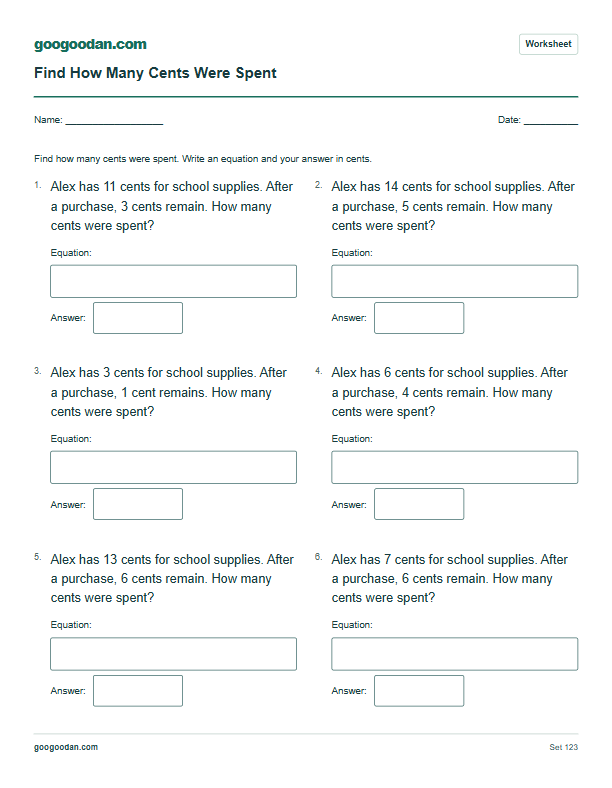
Find the Missing Change Word Problems
Use the starting amount and what remains to find how many cents were spent.
6 problems · Answer key included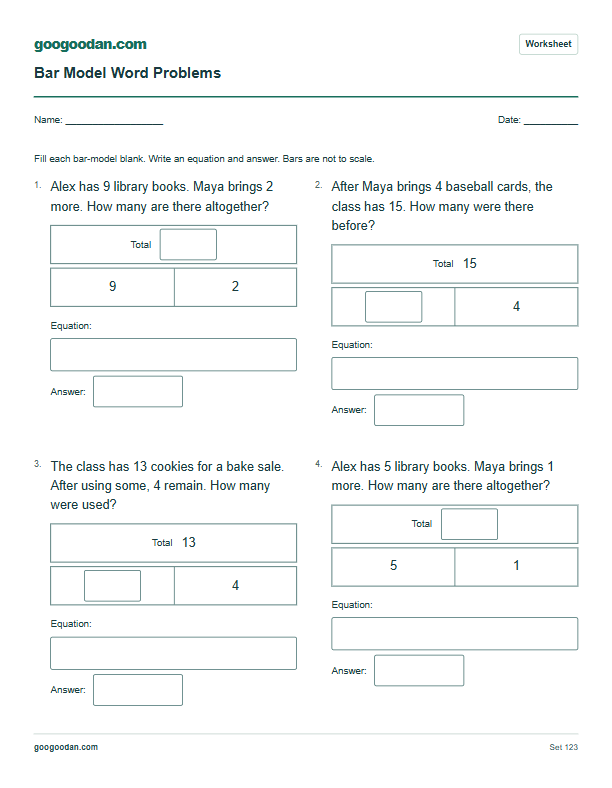 Word problems
Bar Model Word Problems
Use a whole-and-parts diagram to find the total, the starting amount, or the amount used.
4 problems · Answer key included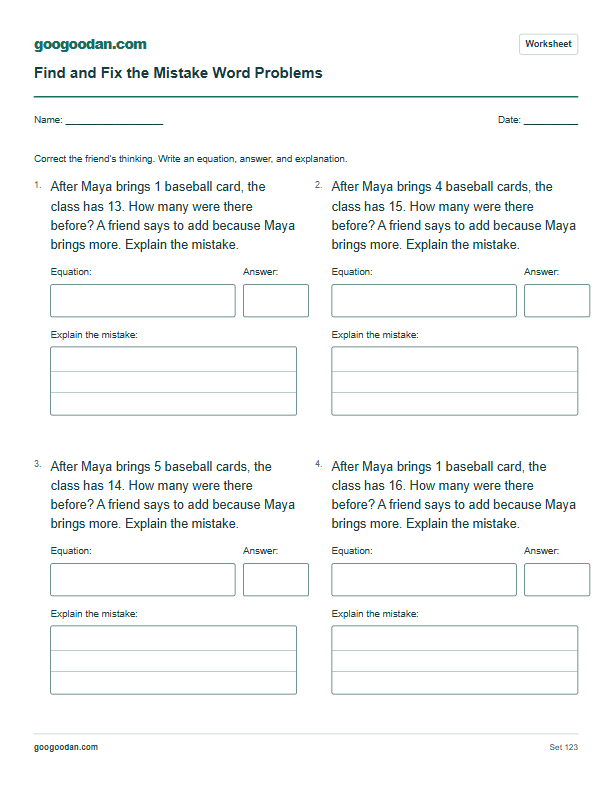 Word problems
Error Analysis Word Problems: Find and Fix the Mistake
Correct a friend who chooses addition just because more items arrive.
4 problems · Answer key included
More about subtraction · Grade 1 worksheets
Grade 1 selected skill connection: 1.OA.A.1 (selected subtraction stories and reasoning support). See the Common Core grade guidance. This worksheet does not cover every requirement in the standard.