
Error Analysis Word Problems: Find and Fix the Mistake
A friend notices that more items arrive and immediately chooses addition. Check which quantity the question asks for before agreeing. Find the starting amount and explain how to correct the friend’s reasoning.
A helpful clue can become an unhelpful shortcut
After Maya brings 4 baseball cards, the class has 13. The question asks how many cards were there before. A friend says, “Maya brings more, so we should add.” Lily knows that adding often matches receiving more things, but she pauses to check what the thirteen represents.
The friend’s calculation: 13 + 4 = 17.
The missing quantity: the number of cards before Maya arrived.
? + 4 = 13
13 − 4 = 9
Nine cards were there before. The final thirteen already includes Maya’s four cards.
Locate the mistake in the reasoning
The friend can add thirteen and four correctly. The mistake is choosing those two quantities as separate groups to combine. Here, four is already a part of thirteen. Adding it to thirteen counts the incoming cards a second time.
This distinction matters when helping a child. Practicing more addition facts will not fix a misunderstanding about which quantity is the total. Begin by labeling “before,” “received,” and “after,” then decide where the blank belongs.
Give the friend a useful correction
A response such as “That is wrong” does not explain how to improve it. Try, “Thirteen is the total after the cards arrive. Take away the four new cards to find the nine that were there before.” A drawing of thirteen counters with four separated can communicate the same correction.
Check by replaying the event
Use the proposed starting amount of nine. Add the four cards Maya brings. The result is thirteen, matching the story. Now try the friend’s starting answer of seventeen: adding four would produce twenty-one, so it cannot describe the stated ending.
A child can write 9 + 4 = 13 as a check or use 13 − 4 = 9 to find the answer directly. Both support the same corrected reasoning. The explanation should distinguish the starting amount from the ending total and say why adding the two printed numbers does not find the start.
Evaluate the idea, not the wording
These four questions repeat the same kind of mistaken claim with new numbers within twenty. The answer key provides an example explanation. Accept other correct wording or a clear labeled drawing. This is practice in one specific reasoning error, not a test of every possible addition or subtraction mistake.
Make a practice set
Choose what to print. Selecting both shows the answer key on screen and prints the questions followed by the answers.
After the practice
Ask the child to invent a different question for which adding the two printed numbers would be correct. Comparing that question with the original helps separate the calculation from the meaning of the quantities.
 Word problems
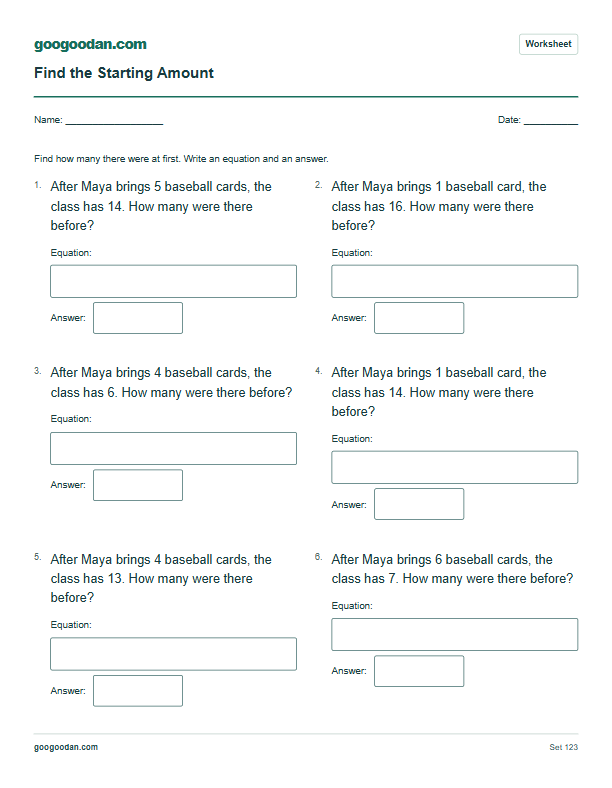
Find the Starting Amount Word Problems
Work backward from a final total to find how many there were before.
6 problems · Answer key included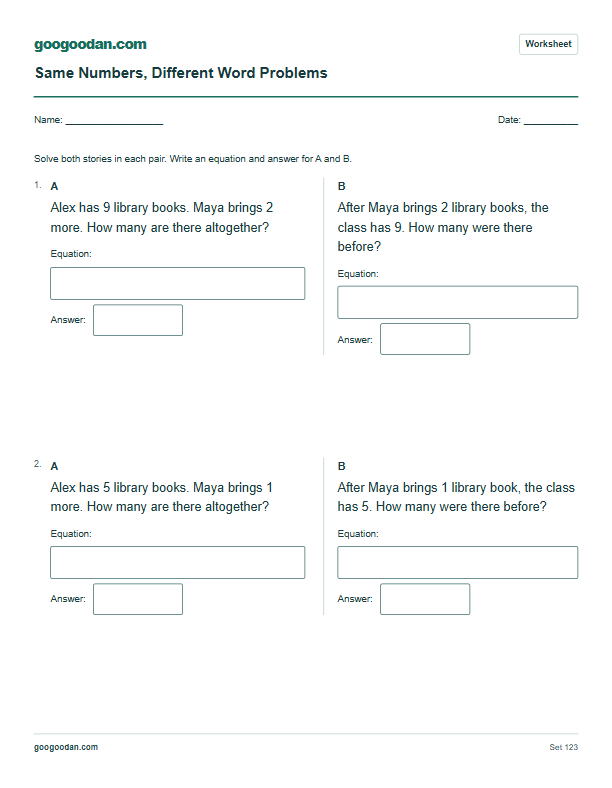 Word problems
Same Numbers, Different Questions Word Problems
Compare two stories with the same numbers: find the new total in one and the starting amount in the other.
2 pairs · 4 word problems · Answer key included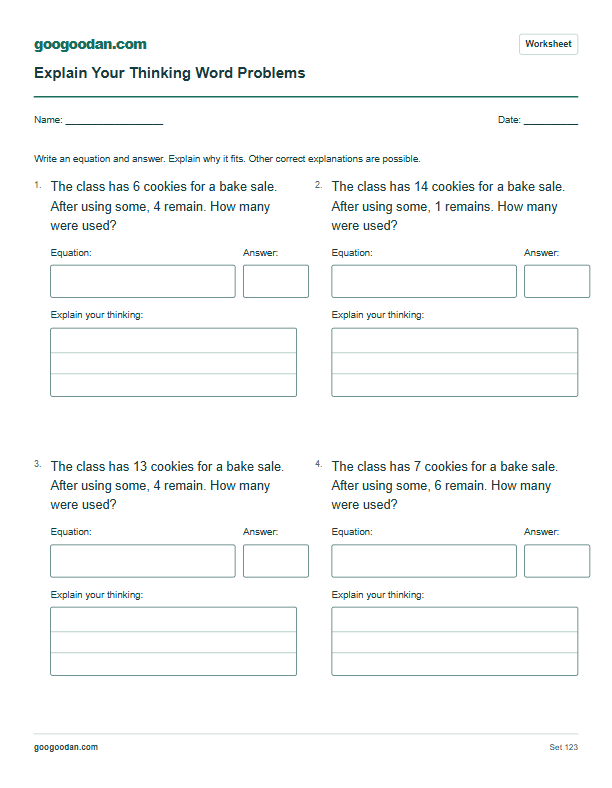 Word problems
Explain Your Thinking Word Problems
Explain why the equation fits a taking-away story.
4 problems · Answer key included
More about subtraction · Grade 1 worksheets
Grade 1 selected skill connection: 1.OA.A.1 (selected subtraction stories and reasoning support). See the Common Core grade guidance. This worksheet does not cover every requirement in the standard.