
Grade 5 Decimal Scaling Word Problems
Compare two ribbon lengths using a decimal multiplier. Predict whether the second ribbon is shorter or longer, multiply, and check the exact length in meters.
A decimal multiplier compares two lengths
The first ribbon gives the starting length. The second ribbon is a stated number of times as long. Multiply the first length by that multiplier to find the second length. A multiplier below 1 makes the ribbon shorter; a multiplier between 1 and 2 makes it longer, but less than twice as long.
A shorter second ribbon
The first ribbon is 6.8 meters long. The second ribbon is 0.4 times as long as the first. How long is the second ribbon?
Split 6.8 into 6 + 0.8. The partial products are 6 × 0.4 = 2.4 and 0.8 × 0.4 = 0.32. Add them: 2.4 + 0.32 = 2.72. Check the size: because 0.4 is below 1, the answer must be below 6.8 meters.
A longer second ribbon
The first ribbon is 1.1 meters long. The second ribbon is 1.1 times as long as the first. How long is the second ribbon?
Split the multiplier into 1 + 0.1: 1.1 × 1 = 1.1 and 1.1 × 0.1 = 0.11. Add the partial products: 1.1 + 0.11 = 1.21 meters.
Explain the decimal point and catch mistakes
Each factor is a number of tenths. For 6.8 × 0.4, multiply 68 × 4 = 272, then divide by 100: 272 hundredths equals 2.72. Writing 27.2 fails the size check. Multiplication does not always make a number larger.
If a child adds 6.8 + 0.4, return to the words “times as long.” The 0.4 is a multiplier, not another length to add. If a partial-product calculation gives 2.432, add 2.4 and 0.32 by place value instead of joining their digits.
Keep the length unit and the exact answer
The multiplier has no unit, so the result is a length in meters. It is not an area and does not use square meters. Keep the exact product; do not round to tenths. An equivalent answer with a trailing zero, such as 1.50 instead of 1.5, has the same value.
Use this four-problem worksheet
Each set has four ribbon stories: two with shorter second ribbons and two with longer second ribbons. First lengths are positive, non-whole-number tenths below 10 meters. Multipliers are positive, non-whole-number tenths below 2. Products are exact in hundredths. Predict whether each answer will be smaller or larger, show multiplication and partial products, then check the answer against the first length. The worked examples above illustrate the method; they are not guaranteed to appear in every set.
Make a practice set
Choose what to print. Selecting both shows the answer key on screen and prints the questions followed by the answers.
After the practice
Ask the child to explain why the second ribbon is shorter or longer, check the decimal point using the expected size, and label the answer in meters.
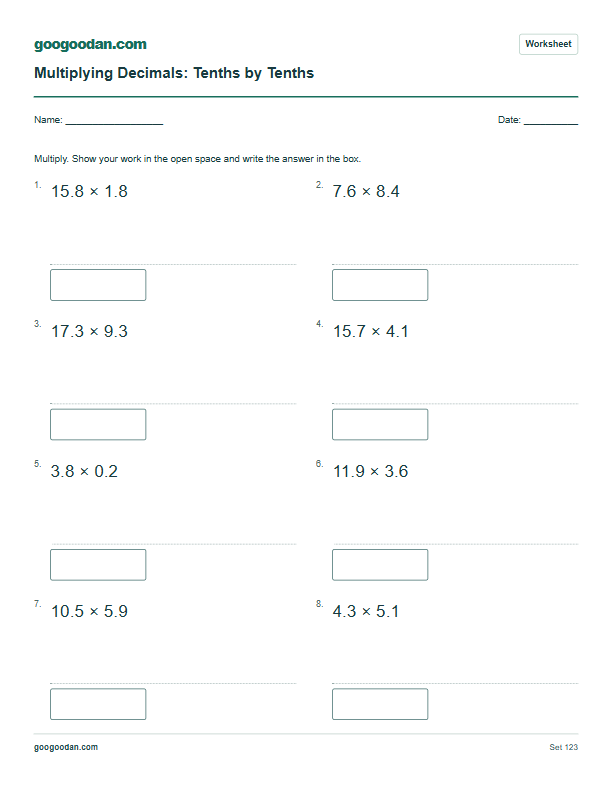 Calculation practice
Multiplying Decimals Worksheets – Tenths by Tenths
Use tenths and hundredths to explain the product, then show your work.
8 problems · Answer key included
More about multiplication · Grade 5 worksheets
Grade 5 selected skill connection: 5.NBT.B.7 (selected decimal multiplication using models and place-value reasoning). See the Common Core grade guidance. This worksheet does not cover every requirement in the standard.