
Multiplying Decimals Worksheets – Tenths by Tenths
Explain how tenths multiplied by tenths become hundredths. Then print eight problems with space for a drawing, partial products, or a written method.
Why do tenths times tenths make hundredths?
Maya works out 0.6 × 0.4. She knows that six times four is twenty-four, so she writes 2.4. Before correcting the decimal point, ask what the numbers mean. She is finding four tenths of six tenths of a whole. Taking a part of an amount smaller than one should give an even smaller amount.
Build the idea with a hundredths square. Divide one whole square into ten equal columns and ten equal rows. Six columns span six tenths of the width. Four rows span four tenths of the height.
The overlapping rectangle covers 4 rows × 6 cells = 24 cells. Each cell is one hundredth of the whole square. Therefore 0.6 × 0.4 = 0.24. The other cells are unshaded; the square still represents one whole.
Connect the picture to a written method
Six tenths is 6 ÷ 10, and four tenths is 4 ÷ 10. Multiplying the numerals 6 and 4 gives 24, but each original factor was ten times smaller than its whole-number version. The product must be one hundred times smaller: 24 ÷ 100 = 0.24.
This explains why these problems use two decimal places in the full product before removing any unnecessary final zero. Counting written decimal places can help check the method, but the place-value explanation tells the child why it works. For 0.2 × 0.3, write 0.06, not 0.6: six hundredths needs a zero in the tenths place.
Use partial products when the factors are larger
Try 2.4 × 1.3. Break 1.3 into 1 + 0.3. One group of 2.4 is 2.4. Three tenths of 2.4 is 0.72 because 24 tenths times 3 tenths gives 72 hundredths. Add the partial products: 2.4 + 0.72 = 3.12.
Another written method is to multiply 24 by 13, obtaining 312, then divide the product by 100 to account for the two factors of ten. Both methods reach 3.12. Invite the child to use the open work area for a labeled drawing, partial products, or a written calculation, then put the final value in the answer box.
Multiplication does not always make a number larger
Compare 4.8 × 0.5 with 4.8 × 1.5. One half of 4.8 is 2.4, which is smaller than 4.8. One and a half groups of 4.8 total 7.2, which is larger. The size of the multiplier matters. Use a strip or a group of counters to make the half-group visible instead of relying only on a rule.
For a multiplier between zero and one, a positive product is smaller than the starting positive amount. A multiplier greater than one gives a larger amount. Ask whether an answer should increase or decrease before checking the exact multiplication.
See seven tenths of 4.9
For 4.9 × 0.7, the whole strip represents 4.9. Divide it into ten equal parts. One part is 4.9 ÷ 10 = 0.49. Seven tenths means selecting seven of those parts.
If the child writes 0.7, ask what amount the whole strip represents. The number 0.7 describes the fraction of the strip selected; 3.43 describes the resulting amount. Check exactly: 49 hundredths × 7 = 343 hundredths = 3.43. The answer is below 4.9 because three of the ten parts were not selected.
Accept equivalent decimal answers
For 1.5 × 0.4, a full hundredths answer is 0.60. This is the same value as 0.6 because sixty hundredths equal six tenths. Likewise, 2.5 × 0.8 = 2.00 = 2. An answer does not become wrong because its final zeros differ from the answer key.
A zero inside a number has a different job: 0.06 is not the same as 0.6. Read both answers aloud by place value, or shade six cells and sixty cells on separate hundredths squares to compare the quantities.
Estimate before checking the answer key
For 15.8 × 1.8, nearby whole numbers give 16 × 2 = 32. The exact product, 28.44, is reasonably close. An answer such as 284.4 is on the wrong scale. An estimate checks the size of the result; it does not replace the exact calculation.
Each printable set contains eight multiplication problems. Both factors have one decimal place: the first is positive and below 20, and the second is positive and below 10. Products are exact to hundredths, though the key may show a shorter equivalent form. Zero factors, whole-number factors, and factors written to two decimal places are not included in this set. New numbers provides another set with the same scope and a matching answer key.
Make a practice set
Choose what to print. Selecting both shows the answer key on screen and prints the questions followed by the answers.
After the practice
Choose one problem and explain the place value of its product. Accept equivalent final-zero forms, and use an estimate to check its size before starting another set. Next, use the decimal scaling word problems to compare ribbon lengths and explain when multiplying makes an amount smaller or larger.
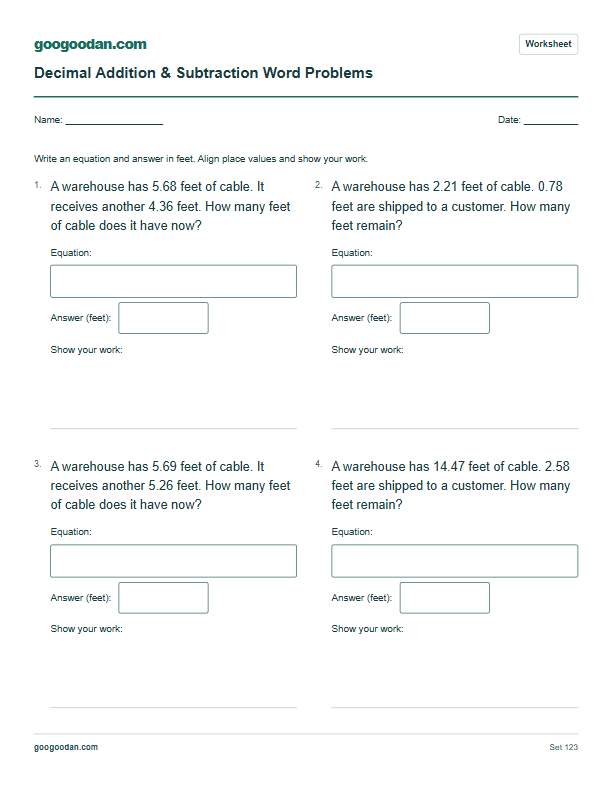 Word problems
Adding and Subtracting Decimals Word Problems
Combine cable lengths or find what remains, using place value through hundredths.
4 problems · Answer key included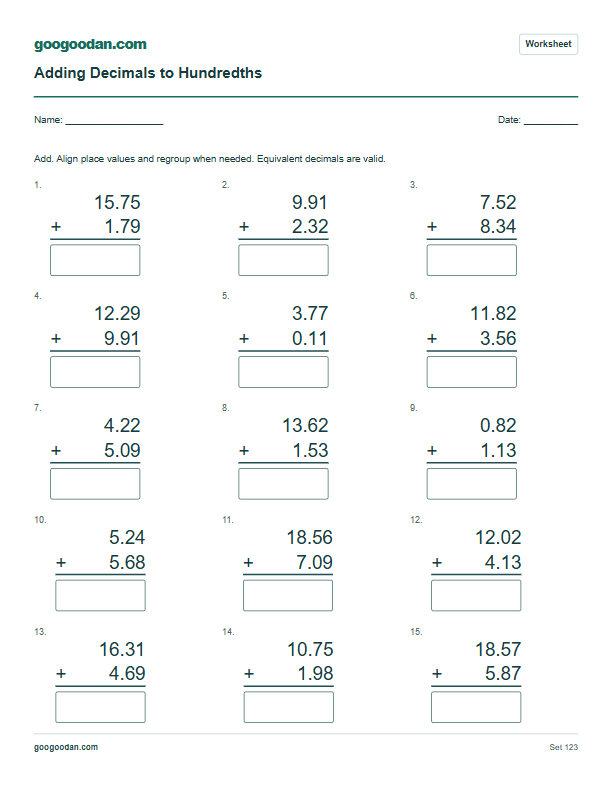 Calculation practice
Adding Decimals to Hundredths Worksheets
Align decimal points and exchange ten hundredths for one tenth.
15 problems · Answer key included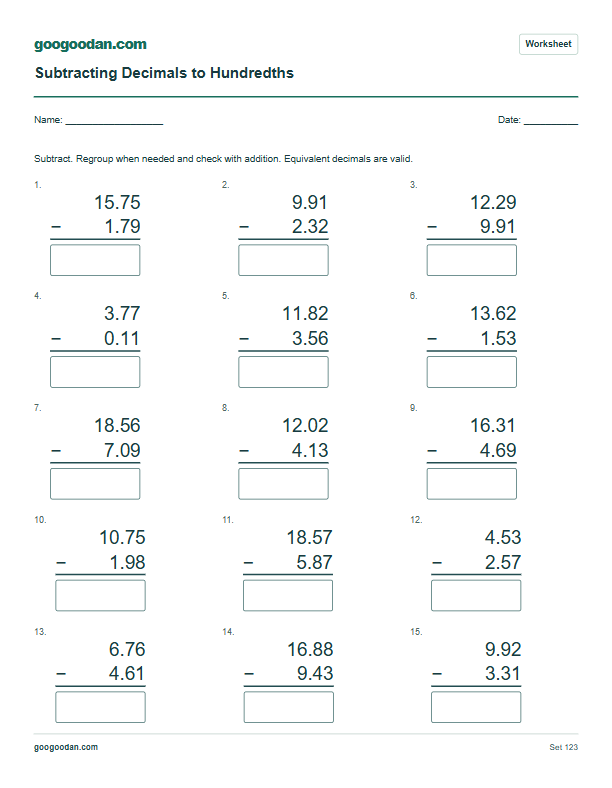 Calculation practice
Subtracting Decimals to Hundredths Worksheets
Align decimal points and rename tenths and hundredths before subtracting.
15 problems · Answer key included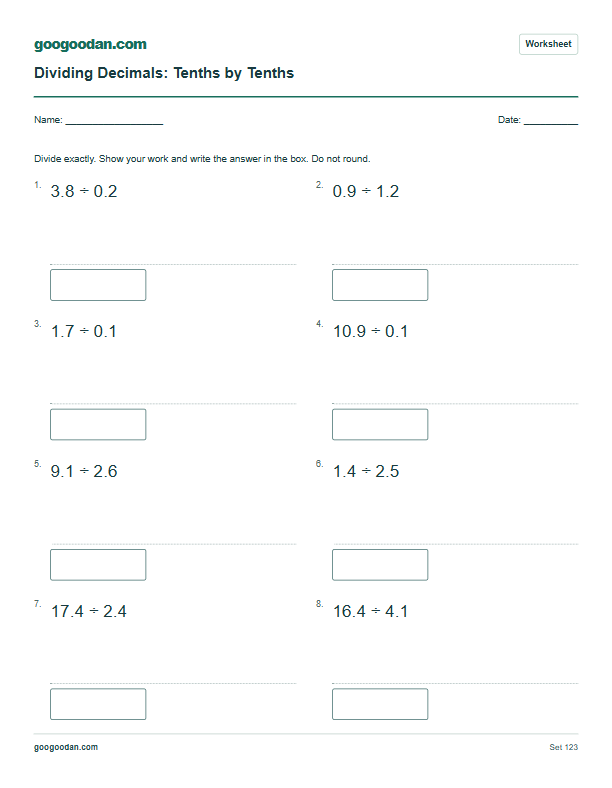 Calculation practice
Dividing Decimals Worksheets – Tenths by Tenths
Scale both numbers together, divide exactly, and check with multiplication.
8 problems · Answer key included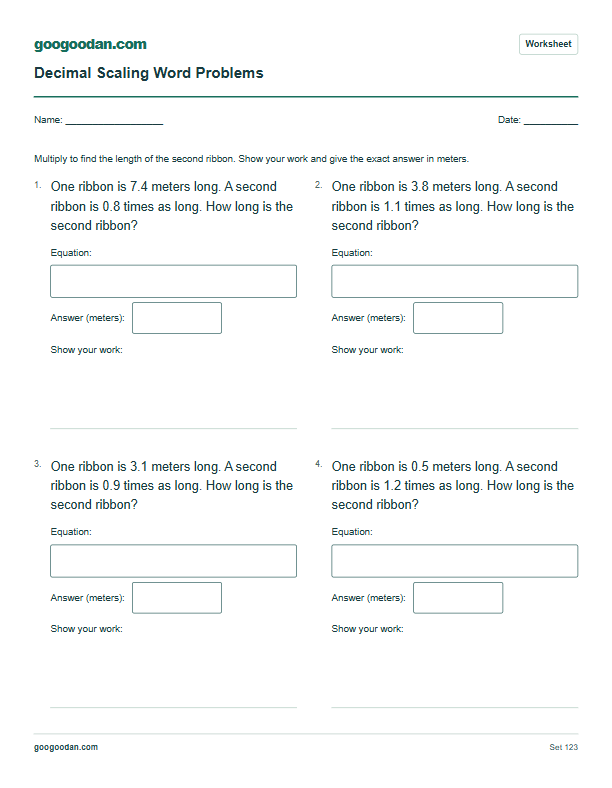 Word problems
Decimal Scaling Word Problems
Compare ribbon lengths using decimal multipliers below and above one. Explain the scale and keep exact answers.
4 problems · Answer key included
More about multiplication · Grade 5 worksheets
Grade 5 selected skill connection: 5.NBT.B.7 (selected decimal multiplication using models and place-value reasoning). See the Common Core grade guidance. This worksheet does not cover every requirement in the standard.