
Dividing Decimals by Whole Numbers Word Problems
Measure how many full and partial groups fit in a decimal amount. Include the fraction of the last group, then use multiplication to check.
The last part still counts toward the amount
Leo reads a problem with a total amount of 17.5 and a full group size of 7. He makes two full groups, then stops because the amount left is too small for another full group. Two is the number of complete groups, but this question asks for the amount in groups, including any part of one group.
Two full groups use 14 units. The remaining 3.5 units are half of a 7-unit group. The total is therefore 2 + 0.5 = 2.5 groups.
The empty dashed half is a reference showing the size of a complete third group. It is not extra material and is not included in the total of 17.5.
Identify what one group means
Here, a group is a measuring amount that can be partly filled. Each full group holds seven units of the same quantity. Saying “half a group” means 3.5 units because 3.5 is half of 7. It does not mean half a person or half a complete object.
Write total amount ÷ amount in one full group. The answer measures how many groups' worth of the quantity there are. Reversing 17.5 and 7 would ask how much of the entire total fits into one group, a different relationship.
Do not confuse the leftover amount with the fraction of a group
Leo first writes 2.35 because he sees two groups and 3.5 units left. The digits after the decimal point cannot simply record the leftover amount. They must describe a fraction of one full group.
Find that fraction by comparing the leftover 3.5 with the group size 7: 3.5 ÷ 7 = 0.5. The missing step is converting leftover units into groups. This is why 2.5 is correct and 2.35 is not. Ask the child to name the unit for each number: 3.5 is an amount; 0.5 is a fraction of a group.
Connect the model to written division
The same calculation can be recorded with place values. Divide 17 ones by 7: the quotient has 2 ones, and 3 ones remain. Exchange those 3 ones for 30 tenths and combine them with the 5 tenths in 17.5. There are now 35 tenths to divide by 7.
Thirty-five tenths divided by seven is five tenths. Record 5 in the tenths place of the quotient. The result is 2 ones and 5 tenths, or 2.5. The decimal point helps keep the whole-number and fractional parts in their correct places; it does not tell the child to stop dividing.
When a problem needs hundredths, a final zero may be written in the dividend to continue an exact calculation. For example, 10.2 and 10.20 are the same amount. The added zero makes a place value explicit rather than making the number larger.
An answer below one can describe a partial group
A different problem gives a total of 7.5 and a full group size of 10. There is not enough for one complete group, but the amount is not zero. Since 7.5 is three quarters of 10, 7.5 ÷ 10 = 0.75. The answer is three quarters of one group.
Compare the total with the group size before calculating. A positive total smaller than one group gives a quotient between zero and one. A total larger than one group gives a quotient greater than one. Every set includes one example below one and three above one so the child has to interpret both situations.
Check the quotient by rebuilding the total
Multiply the proposed number of groups by the full group size. For the first example, 2.5 × 7 = 17.5. For the smaller example, 0.75 × 10 = 7.5. Both checks return the original total.
Checking only the complete groups would leave an amount unaccounted for. If Leo answers 2 for the first problem, 2 × 7 gives only 14. Ask him to locate the remaining 3.5 in the model and explain what fraction of the next group it represents.
This is not a rounding or container-count question
“How many full groups can be made?” and “How many containers are needed to hold everything?” ask different questions. The first would count only complete groups; the second might require another container for what remains. This worksheet instead asks for an exact amount in groups, including the fractional part.
Do not round the decimal answer up or down. An answer of 2.50 is equivalent to 2.5, and 3/4 is equivalent to 0.75 if the child explains the value. The key shows exact decimals, not a count of indivisible objects.
What this printable practices
Each page has four short quantity word problems. The total is positive, less than 20, and not a whole number. A full group holds a whole-number amount from 2 through 10. Every quotient is non-whole and can be written exactly through hundredths. There is one quotient below one and three above one.
These are measuring-group relationships. They do not describe sharing among a fractional number of people, complete-piece cutting, or rounding up purchases. Decimal divisors, repeating decimal answers, and whole-number quotients are outside this selected set. The guide supplies the model; the printable gives space for the child's own drawing or written division.
Have the child state the meaning of one full group, find the complete and partial groups, then multiply to check. This selected practice develops one decimal-division relationship rather than every kind of decimal word problem.
Make a practice set
Choose what to print. Selecting both shows the answer key on screen and prints the questions followed by the answers.
After the practice
Ask what the fractional part of the answer measures. Multiply the groups by the full group size to rebuild the total.
 Calculation practice
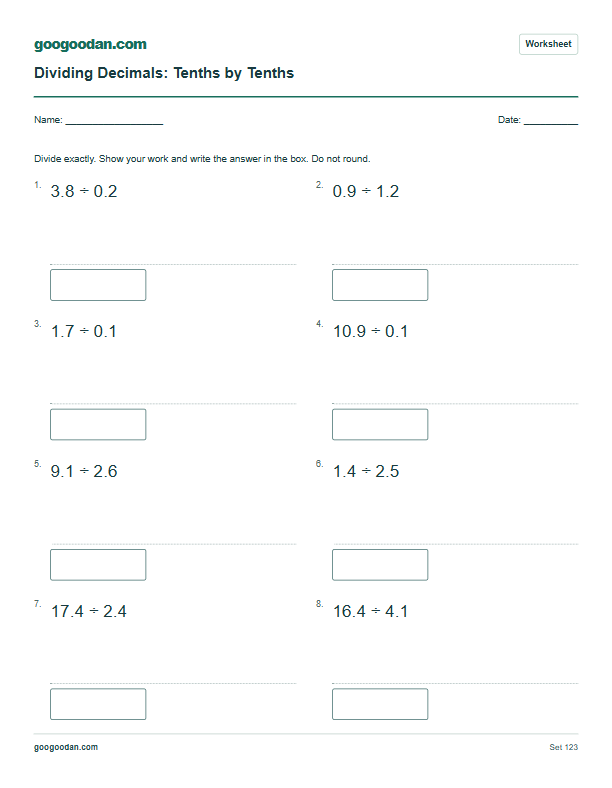
Dividing Decimals Worksheets – Tenths by Tenths
Scale both numbers together, divide exactly, and check with multiplication.
8 problems · Answer key included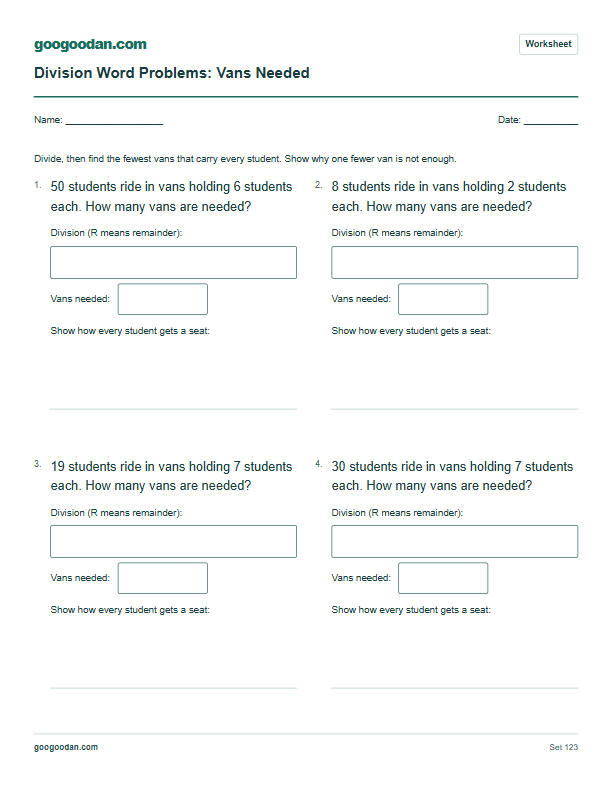 Word problems
Division Word Problems: Round Up the Remainder
Find the fewest vans that seat every student. Compare exact division with a remainder that needs one more van.
4 problems · Answer key included
More about division · Grade 5 worksheets
Grade 5 selected skill connection: 5.NBT.B.7 (selected decimal division through hundredths: measure full and partial groups; whole-number divisors from 2 to 10). See the Common Core grade guidance. This worksheet does not cover every requirement in the standard.