
Missing Numbers on a Number Line Worksheets for Kindergarten
Read the first label, count forward by one, and fill the missing number. Each short line has five evenly spaced marks and a large blank below one interior tick.
Use the labels to find a missing number
Ben sees a short number line labeled 3, 4, an empty box, 6, and 7. He writes 3 in the box because it is the third mark. He has counted the positions, but the line does not begin at one. The printed labels tell him where this part of the counting sequence starts.
Read the visible starting number first: point to 3 and say “three.” Move to the next mark and say “four.” One more step reaches the empty box: “five.” Continue with the printed 6 and 7 to check.
The missing number is 5. It is one more than four and one less than six. Counting forward and checking the next visible label lead to the same answer.
Count the numbers, not the position of the marks
A short number line can show only part of a longer counting sequence. The first printed mark might be 1, 2, 3, 4, or 5 on these worksheets. Begin with that label rather than automatically starting the spoken count at one.
Point to each mark as you say its number. Equal spaces represent equal counting steps here, and each step increases the value by one. The empty box replaces a number label; it is not an extra mark between two numbers.
Use the neighboring labels as a check
Find the visible number immediately before the blank. Count forward one to fill the box. Then count forward one more and compare it with the next printed number. For 5, blank, 7, the missing value must connect five to seven in single steps: 5, 6, 7.
Show what one step means
Make five spaces on scrap paper and place consecutive number cards below them. Hide one middle card. Move a small counter from the leftmost visible number toward the hidden card, saying one number at each space. Uncover the card to check after the child has made a prediction.
Another way is to build the quantity before the gap with blocks. Add one block to find the missing quantity, and another to reach the next printed number. This connects the line to amounts the child can see and touch.
Can more than one number fit between two numbers?
After Ben fills a single gap, try a different question with four number cards. This time every card is visible, and he must find all the cards that meet two conditions. Read the question aloud so that reading ability does not get in the way of comparing the numbers.
Point to every card that is greater than 1 and less than 4. More than one card may work.
Let the child check each card against both parts of the question. Use counters if needed: does its group have more than one counter, and fewer than four?
Show all the matching cards and explain why
The matching cards are 2 and 3. Saying 3 and 2 identifies the same cards and is also correct.
Two and three are each greater than one and less than four. One is not greater than itself. Four is not less than itself. The two end cards therefore do not match the question.
If Ben chooses only 2, he has found one correct card. Ask, “Does another card also pass both checks?” If he includes 4, compare a group of four counters with another group of four: they are equal, so neither has fewer counters.
This is an optional spoken or hands-on comparison. It does not change the printable activity: each line below still has exactly one missing numeral. A question asking for all matching cards can have several answers; a single blank on these counting-by-ones lines has just one.
Make room for a handwritten answer
The blank on the printable is larger than a small square typed into a sentence. Write one numeral in it. If the child knows the missing value but needs help forming the numeral, let them say the answer or choose a numeral card while an adult records it.
The answer box sits below its own tick, just like the printed numbers. Read the line from left to right after filling it. A numeral written in the wrong position can make a correct count hard to interpret, so point to the matching tick when checking.
Choose an appropriate next step
If the child has trouble identifying the immediate neighbors, try Before and After Numbers with a single given middle number. If they can find the missing value confidently, ask them to explain how both neighboring labels confirm it. There is no need to turn this small activity into a speed test.
Each page contains six different short lines. Every line has five consecutive numbers within one through nine, with one interior number missing. The first and last labels are always shown. The answer key preserves the same labels and fills only the missing numeral in red.
This set does not include skip counting, zero, teen numbers, or blanks at the ends of a line. New numbers changes the starting values and blank positions while keeping the one-step counting goal.
Make a practice set
Choose what to print. Selecting both shows the answer key on screen and prints the questions followed by the answers.
After the practice
Read each completed number line aloud. Check the answer using the labels immediately before and after it. Start from the printed first number, which is not always 1.
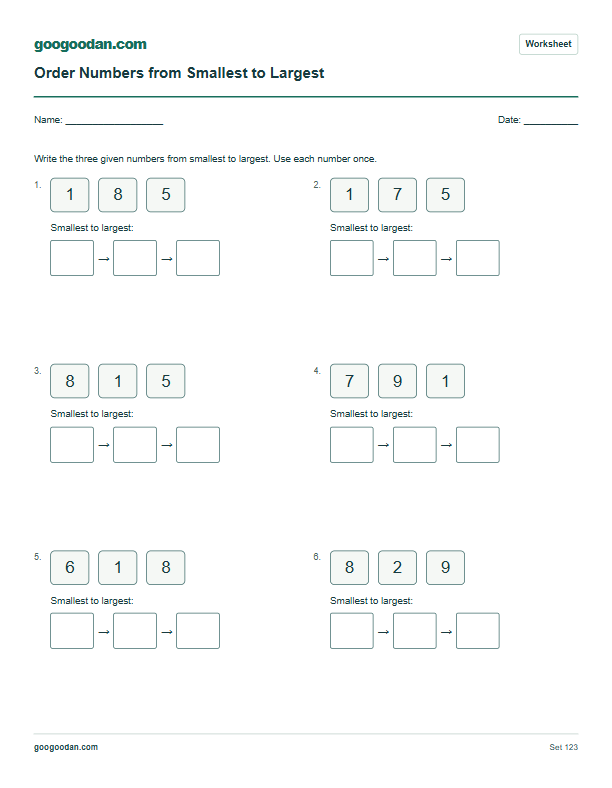 Number card activity
Ordering Numbers Worksheets for Kindergarten
Put three different numbers from 1–9 in order from smallest to largest. Use counters or number cards for support.
6 problems · Answer key included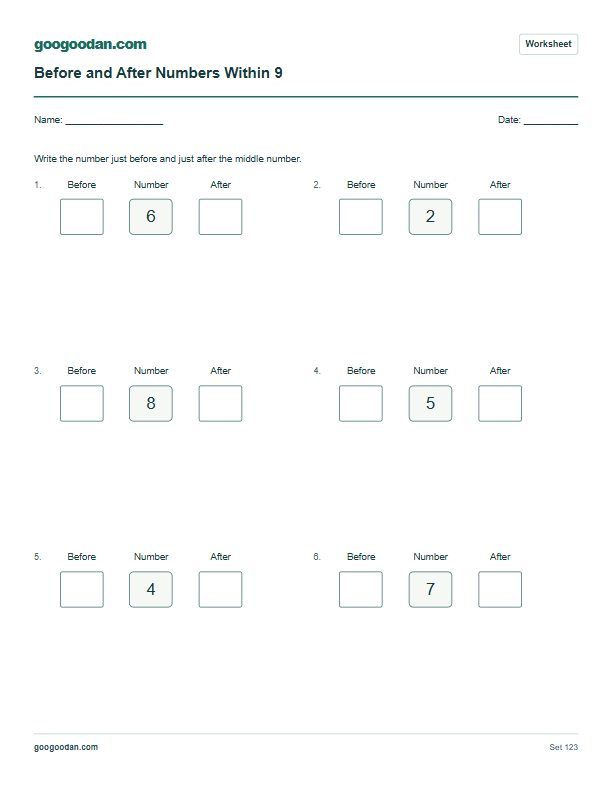 Number sequence activity
Before and After Numbers Worksheets for Kindergarten
Find the number just before and just after a given number. Count one step back and one step forward within 1–9.
6 problems · Answer key included
More about numbers · Kindergarten worksheets
Kindergarten selected skill connection: Supporting K.CC.A.2 practice: count forward from a given number, using a short number line within 9. See the Common Core grade guidance. This worksheet does not cover every requirement in the standard.