
Before and After Numbers Worksheets for Kindergarten – Free Printable
Find the number one step before and one step after a given numeral. Use a number path, counters, or spoken counting before writing in the two answer boxes.
Find the immediate neighbors of a number
Ava sees an empty box, the number 6, and another empty box. She writes 4 and 8. Both numbers are on the correct side of six in the counting sequence, but the task asks for the numbers just before and after. They must be one counting step away.
Start with a number path: write 1 through 9 on separate cards. Find 6. Touch the card immediately to its left: 5. Return to 6 and touch the card immediately to its right: 7.
Read the three numbers together: 5, 6, 7. The count changes by one at each step. Five goes in the Before box and seven goes in the After box.
Begin from the given number
Point to the middle numeral and name it. For the number after, count forward one step and stop. If a child starts from one every time, that can be a useful check, but invite them to begin directly from the given number when they are ready.
The number before can be harder because it asks the child to move back in the counting sequence. Use the number path or build the given quantity with counters and remove one. Compare that smaller group with the original to show why the previous number is one less.
Make one step visible
Place a small toy on the given numeral of a number path. Move it one space left to find Before, then move back to the given numeral. Move one space right to find After. Returning to the middle matters: taking two steps right after moving left can hide where each answer came from.
Keep before and after in their own boxes
A child may know the two neighboring numbers but reverse their positions. Read the labels aloud and point from left to right. Before is the number encountered immediately before the given number when counting forward; After is the number encountered immediately after it.
Let the child say the whole three-number sequence before writing. For a middle number of 3, the check is “2, 3, 4.” Hearing “4, 3, 2” describes counting backward, which is a different direction from the left-to-right sequence on this sheet.
Separate the number idea from pencil control
If the child points to the right cards but cannot write the numerals yet, let them use movable number cards or ask an adult to record the spoken answers. Knowing which number comes next does not require neat handwriting. Give numeral formation its own short practice when needed.
An adult can read the words Before, Number, and After aloud. The activity checks a small part of the number sequence; it is not a test of reading English labels independently.
Check the complete row
After filling both boxes, touch the three numbers from left to right and count them. Check that each number is one more than the previous one. If only one answer is wrong, revisit that single step instead of starting the whole page again.
Each printable set has six different middle numbers selected from 2 through 8. The answers stay within 1 through 9. The question sheet shows only the middle numeral; the matching answer key fills the two outer boxes in red. This set does not include zero, ten, teen numbers, or longer missing-number sequences.
For another way to use the same number relationships, arrange three number cards from smallest to largest. Remember that those cards can have gaps; the Before and After activity always asks for immediate neighbors.
Make a practice set
Choose what to print. Selecting both shows the answer key on screen and prints the questions followed by the answers.
After the practice
Read each completed row from left to right. Each step should increase by one. Use a number path to explain an answer before choosing a fresh set.
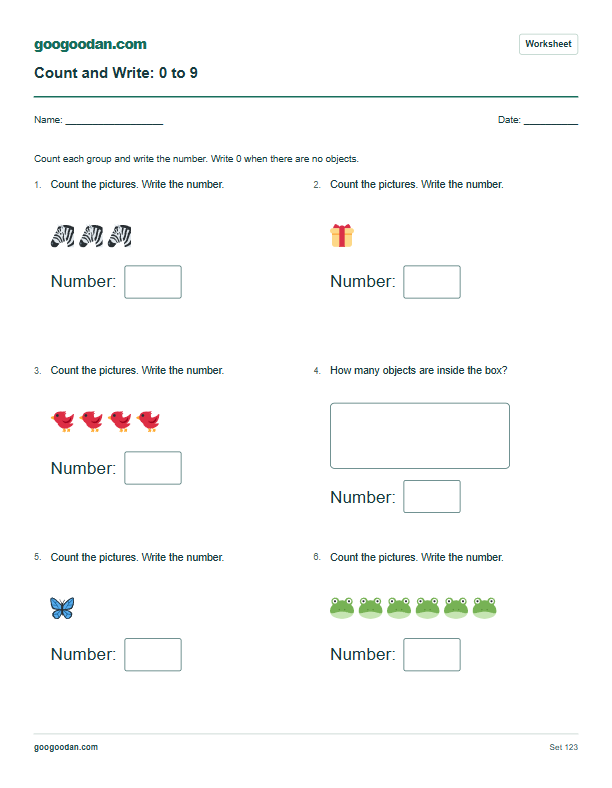 Picture activity
Count and Write Worksheets for Kindergarten
Count picture groups from 1 to 9 and write 0 for an empty group. Touch each object once and record the total.
6 problems · Answer key included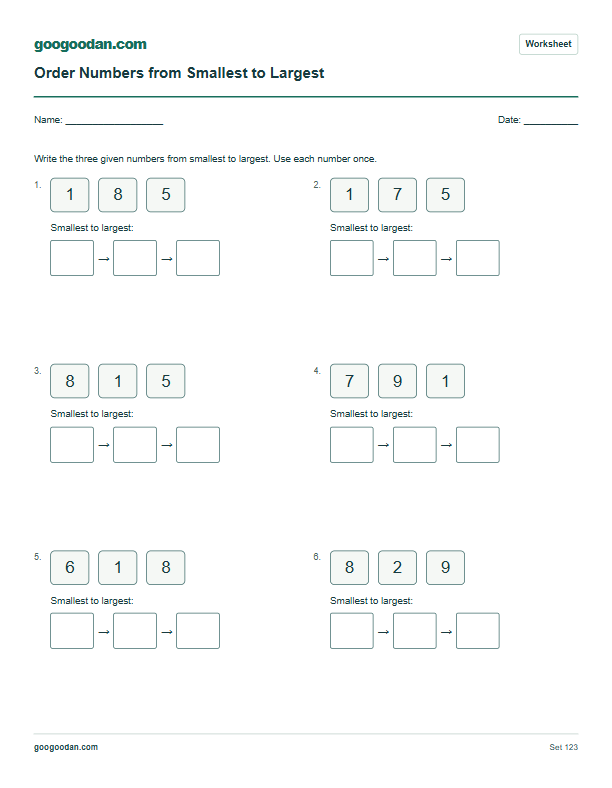 Number card activity
Ordering Numbers Worksheets for Kindergarten
Put three different numbers from 1–9 in order from smallest to largest. Use counters or number cards for support.
6 problems · Answer key included
More about numbers · Kindergarten worksheets
Kindergarten selected skill connection: Supporting number-sequence practice within 9; includes one step back and forward. See the Common Core grade guidance. This worksheet does not cover every requirement in the standard.