
Ordering Numbers Worksheets for Kindergarten – Smallest to Largest
Compare three number cards and write them from smallest to largest. Use objects or movable number cards to explain the order before recording it in the answer boxes.
Compare the numbers, then choose an order
Eli sees the cards 7, 2, and 5. He knows how to count to nine, but he copies 7, 2, 5 into the answer boxes. He has recorded the cards accurately; he has not yet used the direction “smallest to largest.” Help him compare the quantities before asking him to write again.
Try 7, 2, and 5 with counters: build a group for each card. Match the counters in pairs between two groups. The group with fewer counters represents the smaller number.
Two is the smallest. Between five and seven, five is smaller. The increasing order is 2 → 5 → 7. All three original numbers appear once.
Find the smallest first
Ask the child to point to the card that names the smallest quantity. Move a matching homemade number card to the left of the workspace, or write the chosen numeral in the first answer box. Keep the other two cards visible. Compare those two and choose the smaller one for the middle position.
The remaining number belongs in the last box. Check the result by comparing neighboring numbers: the first is smaller than the second, and the second is smaller than the third. This gives the child a way to check instead of waiting for an adult to say whether the answer is right.
Numbers do not have to be next to one another
The cards may be 1, 4, and 8. Counting aloud helps locate them in the number sequence, but the answer uses only the numbers printed on the cards. The order is 1, 4, 8. Do not fill the gaps with 2, 3, or another number that was not given.
Sometimes the cards are already in order
A set such as 2, 5, 9 needs no change. Read from left to right and check each neighboring pair. If the numbers are already increasing, copy that order into the boxes. There is no rule that every question must involve swapping cards.
If the child always reverses the row, compare the first and last quantities using objects. Smallest to largest begins with fewer objects. Largest to smallest would be a different direction and is not the task on this sheet.
Find two cards that traded places
Eli tries a different check. He sees four cards that were meant to go from smallest to largest, but two cards have traded places. Instead of starting the whole row again, he looks for a place where the numbers stop increasing.
Try it together: which two cards need to swap places?
Read from left to right. Four is less than six, but six is greater than the five that follows it. Ask the child to name the two cards before opening the explanation.
Show the swap and check the order
Swap 6 and 5. Saying 5 and 6 names the same two cards and is also correct. The order of those two names does not matter because both cards move.
Check the whole row after the swap: 4 is less than 5, 5 is less than 6, and 6 is less than 7. Every original card is still present once. The middle two cards needed to move in this example; in a different mixed-up row, check the actual numbers rather than assuming the middle is always wrong.
Use four homemade cards to let the child make the swap physically. A child can identify the correct two cards even if they cannot yet write both numerals. This short example checks an error; the printable worksheet below continues to ask for the complete order of three given cards.
Use movable objects without turning handwriting into the test
For a child who finds numerals difficult to write, make three separate number cards on scrap paper. Let the child arrange them and explain the order aloud. An adult may record the final answer. This worksheet has printed card pictures and answer boxes; it is not a cut-and-paste sheet.
Make a short number path from 1 through 9 if the child needs a visual reference. Find the three given numbers on the path. The one encountered first when counting forward is the smallest. Gradually remove the path when the child can compare familiar numbers without it.
Check one explanation before printing another set
Ask the child why the middle number belongs between the other two. A response using counters, fingers, or the number path can show the relationship even when the spoken explanation is brief. If the child is still guessing, return to comparing two picture groups before trying three numerals again.
Each printable page has six activities with three different numbers from one through nine. The answer key repeats the same cards and shows the increasing order in red. Change the numbers for fresh practice, or print a matching question-and-answer pair. Zero, ten, larger numbers, and descending order are not part of this set.
Make a practice set
Choose what to print. Selecting both shows the answer key on screen and prints the questions followed by the answers.
After the practice
Check that all three original numbers appear once and each number is smaller than the one after it. Ask the child to explain one comparison with objects or a number path.
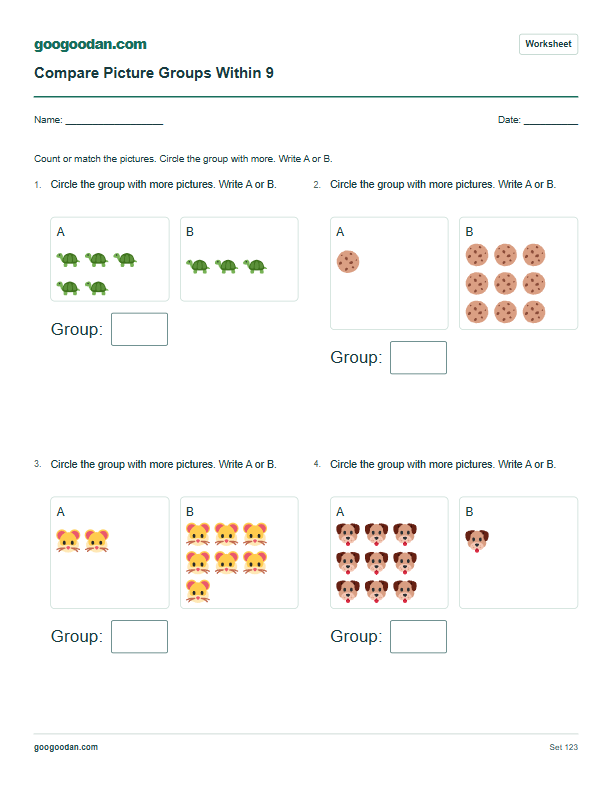 Picture activity
Compare Picture Groups Worksheets for Kindergarten
Match or count two groups and circle the group with more objects.
4 problems · Answer key included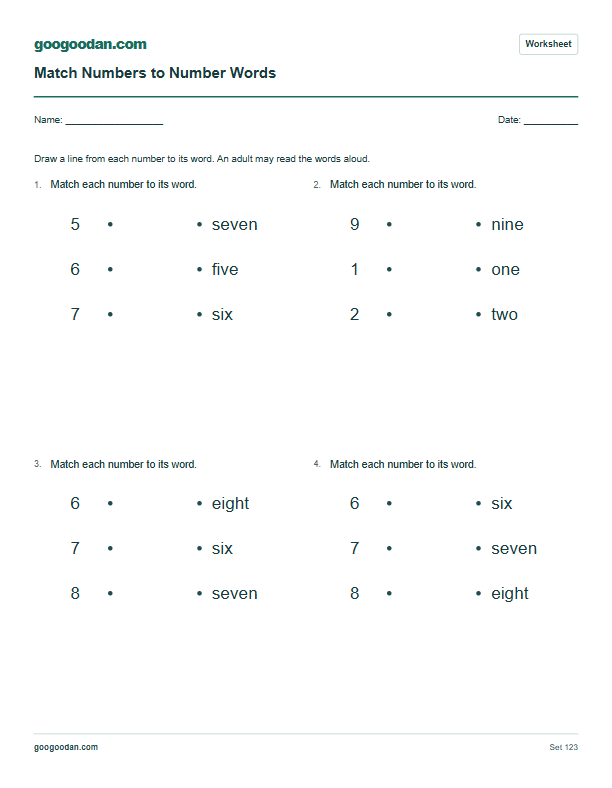 Matching activity
Number Word Matching Worksheets for Kindergarten
Draw lines from numerals 1–9 to their English number words. An adult can read the words aloud.
4 problems · Answer key included
More about numbers · Kindergarten worksheets
Kindergarten selected skill connection: K.CC.C.7 supporting practice: compare written numerals within 9 and order three of them. See the Common Core grade guidance. This worksheet does not cover every requirement in the standard.