
Measurement Unit Conversion Worksheets
The quantity stays the same when its unit changes. Count how many smaller units make each larger unit.
Smaller units give a larger count
A length of three meters can also be described as 300 centimeters. The length has not grown: centimeters are smaller, so more of them are needed to measure the same length.
1 meter = 100 centimeters
1 kilogram = 1000 grams
1 liter = 1000 milliliters
1 foot = 12 inches
Multiply by the number of smaller units
For 3 meters, count three groups of 100 centimeters: 3 × 100 = 300. For 4 kilograms, count four groups of 1000 grams: 4 × 1000 = 4000. Write the requested unit beside the result.
Keep the kind of measurement
Meters and centimeters describe length. Kilograms and grams describe mass. Liters and milliliters describe volume. Knowing that one kilogram is 1000 grams does not mean one kilogram equals 1000 milliliters; those measure different things.
Feet and inches use a different relationship
One foot is 12 inches. Five feet is 5 × 12 = 60 inches. Do not use 100 or 1000 just because those factors work for the metric pairs on this sheet.
Check by grouping back
If 6 liters becomes 6000 milliliters, grouping 6000 milliliters into groups of 1000 should recover 6 liters. For 84 inches, groups of 12 recover 7 feet. This inverse check supports the conversion even though the worksheet asks only for the smaller unit.
About this practice
Each sheet reuses four original questions, one for each relationship above. Starting amounts are whole numbers from 2 through 9. Metric conversions stay within the metric system; feet to inches stays within the customary system.
This sheet does not convert between metric and customary systems, use decimal or mixed-unit amounts, or ask for reverse conversions. It covers selected relationships rather than all measurement units.
Make a practice set
Choose what to print. Selecting both shows the answer key on screen and prints the questions followed by the answers.
After the practice
Ask why the numerical answer grew even though the measured quantity stayed the same.
 Picture activity
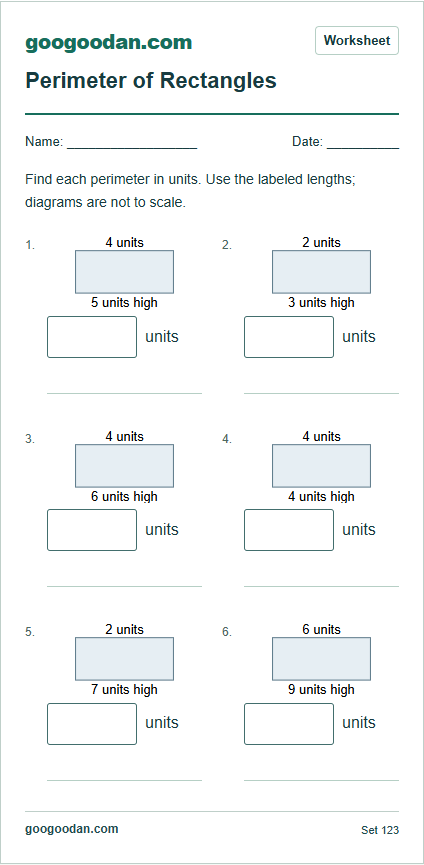
Rectangle Perimeter Worksheets
Use labeled side lengths to find the distance around a rectangle.
6 problems · Answer key included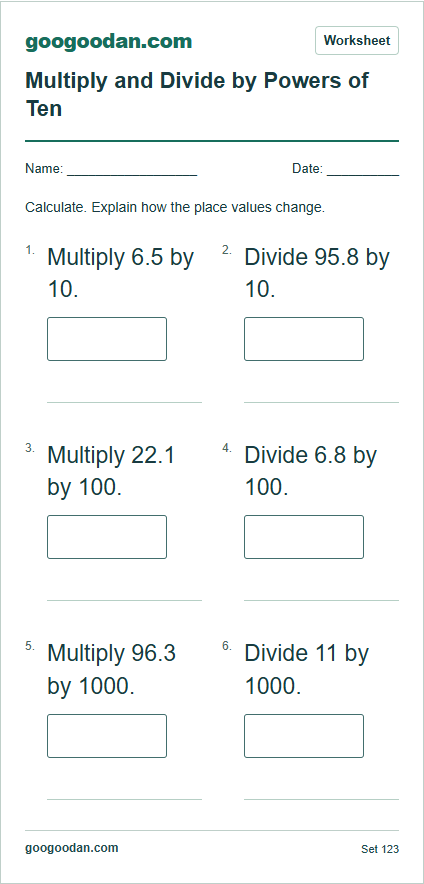 Calculation practice
Multiply and Divide by 10, 100, and 1,000
Explain place-value changes when multiplying and dividing by powers of ten.
6 problems · Answer key included
More about measurement · Grade 4 worksheets
Grade 4 selected skill connection: 4.MD.A.1. See the Common Core grade guidance. This worksheet does not cover every requirement in the standard.