
Multiply and Divide by 10, 100, and 1,000 Worksheets
Follow the value of each digit as the number becomes ten, one hundred, or one thousand times as large or small.
Multiplying by ten changes each digit's value
In 3.6, the 3 represents three ones and the 6 represents six tenths. Multiplying by ten makes them three tens and six ones, giving 3.6 × 10 = 36. Each digit represents ten times its previous value.
Repeat the change for 100 and 1,000
Multiplying by 100 is multiplying by ten twice. Multiplying by 1,000 is multiplying by ten three times. Thus 4.2 × 100 = 420 and 4.2 × 1,000 = 4,200. Zeros fill places that have no nonzero digit.
4.2 → 42 → 420 → 4,200
Each step multiplies the value by ten. Track the 4 from ones to tens, hundreds, and thousands.
Division makes each digit's value smaller
For 36 ÷ 100, each digit represents one hundredth of its old value. Three tens become three tenths, and six ones become six hundredths, giving 0.36. Check by multiplying 0.36 by 100 to recover 36.
Zeros hold empty places
In 7 ÷ 1,000 = 0.007, the zeros keep the seven in the thousandths place. Writing 0.7 would give seven tenths, which is one hundred times too large. Name the tenths, hundredths, and thousandths places while reading the result.
Predict and check
All starting numbers here are positive. Multiplication by these factors increases the value; division decreases it. Use that check first, then apply the inverse operation to check the exact answer.
About these six questions
Each set contains one multiplication and one division question for each of 10, 100, and 1,000. Original starting values range from 0.1 through 99.9, including whole numbers. Selected answers have at most three decimal places.
To keep that answer range, division by 1,000 uses whole-number inputs from the original bank. Other questions can use tenths. The source does not ask children to write exponent notation. Equivalent trailing-zero forms are acceptable, though the key may show a shorter decimal.
Make a practice set
Choose what to print. Selecting both shows the answer key on screen and prints the questions followed by the answers.
After the practice
Choose one answer, name the value of a digit, and use the inverse operation to check it.
 Calculation practice
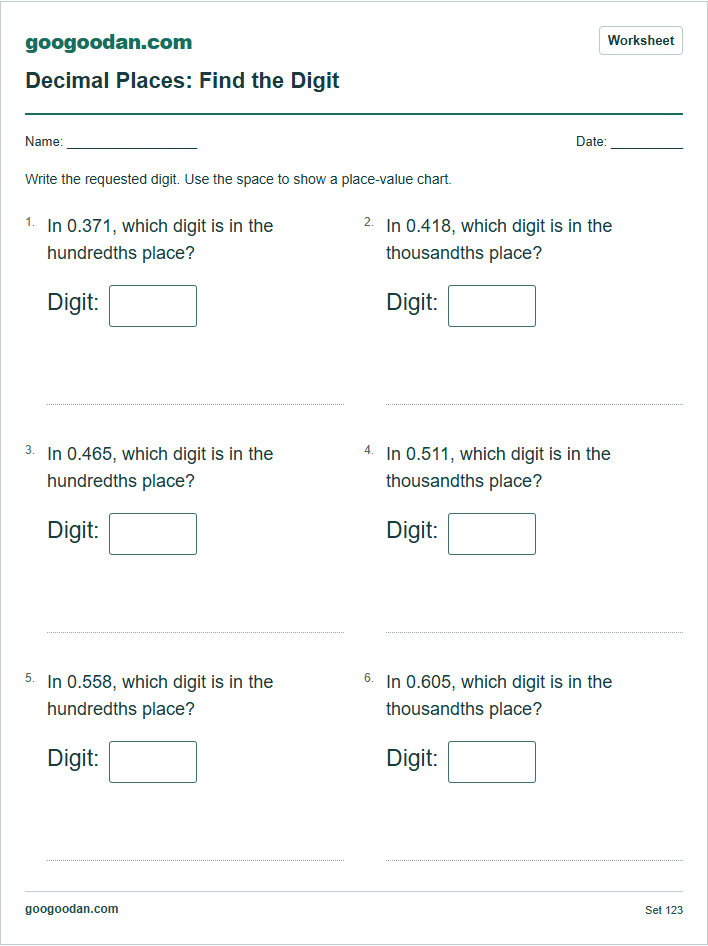
Decimal Place Value: Find the Digit
Identify the tenths, hundredths, or thousandths digit, including zero.
6 problems · Answer key included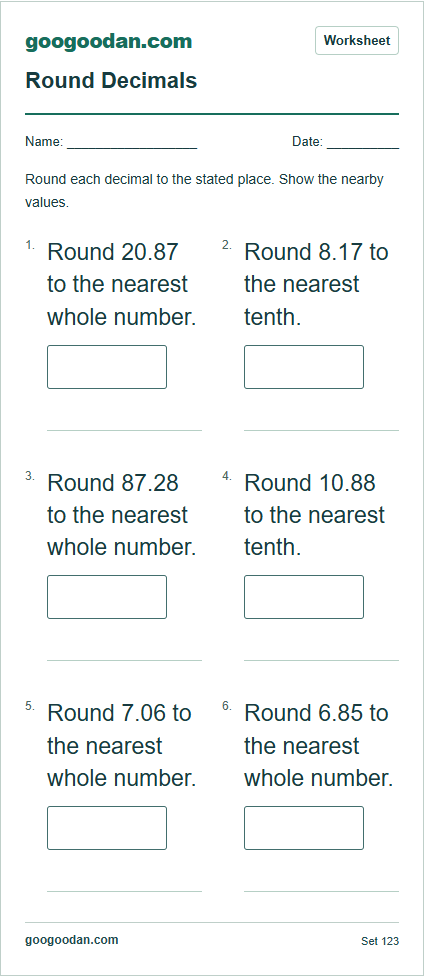 Calculation practice
Rounding Decimals
Round to a whole number or tenth using nearby values.
6 problems · Answer key included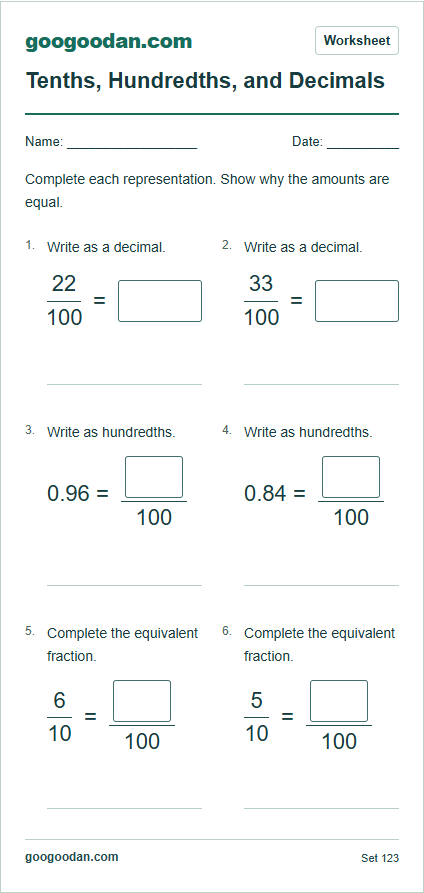 Calculation practice
Tenths, Hundredths, and Decimals
Connect hundredths to decimals and rename tenths as hundredths.
6 problems · Answer key included
More about numbers · Grade 5 worksheets
Grade 5 selected skill connection: 5.NBT.A.2. See the Common Core grade guidance. This worksheet does not cover every requirement in the standard.