
Prime, Composite Numbers, and Multiples Worksheets
Use factor facts to classify a number and decide whether it is a multiple of another number.
Count the positive factors
A prime number has exactly two positive factors: one and itself. Seven is prime because only 1 and 7 divide it without a remainder. A composite number has more than two positive factors. Twelve is composite because its factors include 1, 2, 3, 4, 6, and 12.
12 = 1 × 12 = 2 × 6 = 3 × 4
A factor pair other than one times the number proves that the number is composite. To call a number prime, check that no such pair exists.
Do not confuse odd with prime
Nine is odd but composite: 3 × 3 = 9. Two is even and prime because its only positive factors are 1 and 2. Every even number greater than two has two as an additional factor, so it is composite.
Why one is different
One has only one positive factor. It is neither prime nor composite. The generated questions start at two, but knowing why one is excluded helps keep the definitions precise.
Test whether a number is a multiple
To decide whether 42 is a multiple of 6, look for a whole-number multiplication fact. Since 6 × 7 = 42, the answer is Yes. Forty-three is not a multiple of six: six equal groups cannot make forty-three with a whole number in each group.
Show a reason
For a composite answer, write a factor pair that uses neither factor as one. For a prime answer, list the possible small divisors you checked. For a multiple question, write a matching multiplication fact or show that division leaves a remainder.
When checking factor pairs, stop after the pairs begin reversing. For 36, the pairs 1 × 36, 2 × 18, 3 × 12, 4 × 9, and 6 × 6 cover every possibility; reversing a pair does not give new factors.
About these six questions
Each sheet contains three prime-or-composite questions and three multiple checks. Numbers to classify or test range from 2 through 100. Multiple checks use divisors from 2 through 9.
The activities are balanced, but a particular sheet does not guarantee both prime and composite answers or both Yes and No answers. These questions do not ask for a complete factor-pair list or prime factorization. The answer key gives the classification; review the explanation in the working space separately.
Make a practice set
Choose what to print. Selecting both shows the answer key on screen and prints the questions followed by the answers.
After the practice
Ask for evidence: a factor pair, a divisor check, or a multiplication fact. An odd number is not automatically prime.
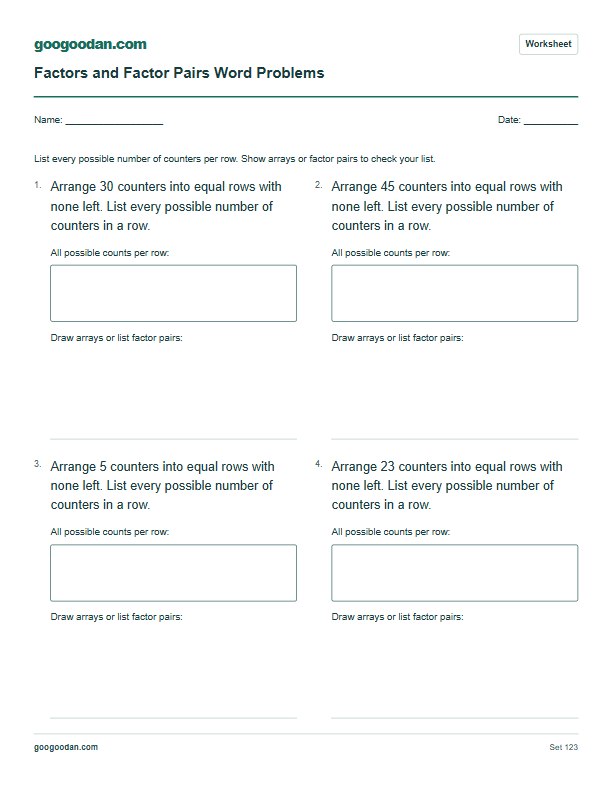 Word problems
Factors and Factor Pairs Word Problems
Arrange counters into equal rows with none left. Find every possible count per row and check that the factor list is complete.
4 problems · Answer key included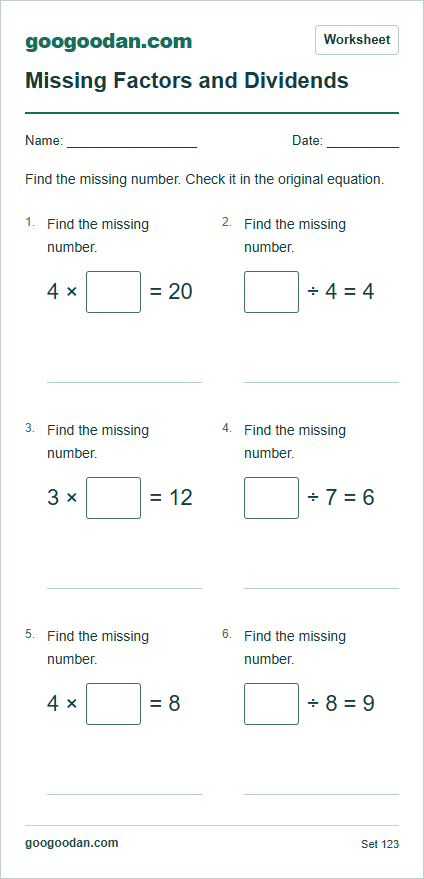 Calculation practice
Missing Factors and Dividends
Use related multiplication and division facts to find the missing number.
6 problems · Answer key included
More about numbers · Grade 4 worksheets
Grade 4 selected skill connection: 4.OA.B.4. See the Common Core grade guidance. This worksheet does not cover every requirement in the standard.