
Factors and Factor Pairs Word Problems
Find every row size that uses all the counters. Connect arrays, multiplication pairs, and division with no remainder to a complete factor list.
Finding one arrangement is only the beginning
Emma has 12 counters for a table game. She arranges them into 3 rows with 4 counters in each row and writes 4 as her answer. Her arrangement works: every row is equal and no counters are left. But the question asks for every possible number of counters in a row, so she needs to keep looking.
Try 2 rows of 6 and 1 row of 12. Turning each array gives 6 rows of 2 and 12 rows of 1. Turning the first array gives 4 rows of 3. The possible row sizes are 1, 2, 3, 4, 6, and 12. Those numbers are the factors of 12.
Turn each arrangement to see 12 rows of 1, 6 rows of 2, and 4 rows of 3.
Possible counts per row: 1, 2, 3, 4, 6, 12
These are six possible row sizes. There are three factor pairs when reversed pairs are counted only once.
Keep row size separate from number of rows
In an arrangement of 3 rows of 4, the row size is 4 and the number of rows is 3. Both numbers belong to the factor pair because 3 × 4 = 12. They describe different roles in that particular drawing, even though turning the array lets them exchange roles.
This worksheet asks for the possible counts per row, so the answer is a list of numbers. A child may use multiplication pairs in the working space to discover that list. Do not replace the list with just the number of arrangements: writing 6 says how many factors 12 has, but it does not tell the reader which row sizes work.
Use division to test a proposed row size
Suppose Emma tries 5 counters per row. Two complete rows use 10 counters, leaving 2. That fails the condition "with none left." Five is not a factor of 12. If she tries 6 per row, two complete rows use all 12, so 6 belongs in the answer.
The same check can be written as division. A row size works when the total divided by that row size is a whole number with no remainder. This connects the list of factors to both multiplication facts and equal sharing, rather than asking the child to guess a collection of numbers.
Search in order so no factors disappear
For 24 counters, begin with 1 × 24. Test 2 next and record 2 × 12. Then record 3 × 8 and 4 × 6. Five does not divide 24 evenly. At 6 × 4 the pair has already appeared in reverse, so the search has reached the pairs already recorded.
Collect both numbers from every pair and put them in order: 1, 2, 3, 4, 6, 8, 12, 24. Starting with 1 and testing smaller factors in sequence makes this stopping point reliable. Stopping because one attempted row size fails is not reliable; 5 fails here, but 6 is still a factor.
Drawing every possible array for a large total can take a long time. Draw one or two examples to explain the meaning, then use a list or table of factor pairs to finish the search. The working area accepts either method.
A square pair contributes one new number
With 36 counters, the pairs are 1 × 36, 2 × 18, 3 × 12, 4 × 9, and 6 × 6. The factor 6 appears twice in the last multiplication, but it belongs only once in the list of possible row sizes. The complete list is 1, 2, 3, 4, 6, 9, 12, 18, 36.
A square array is a useful visual check. Turning a 6-by-6 array does not create a different row size. Ask the child to explain that before erasing a repeated 6, so the correction comes from the meaning of the list.
Some totals have only two choices
For 13 counters, only 1 per row or 13 per row uses every counter in equal rows. There is one factor pair, 1 × 13, and two different factors. A whole number greater than 1 with exactly those two factors is prime. Other totals, such as 12, allow additional factor pairs and are composite.
These terms can help describe what the child notices, but the printed question still asks for all row sizes. The source sets use totals from 2 through 100; they do not include 1, and they are not a complete test of prime numbers or multiples.
Check completeness, not just individual answers
Before looking at the answer key, verify that every listed number divides the total exactly. Then check that 1 and the total are present, every factor has its partner, and the ordered search did not skip a smaller candidate. Being correct about the numbers already written is different from proving that none were missed.
The answer key lists each factor once in ascending order. A correct list in another order is mathematically equivalent. Encourage an organized final list because it makes missing values and accidental repetitions easier to spot.
Make a practice set
Choose what to print. Selecting both shows the answer key on screen and prints the questions followed by the answers.
After the practice
Check that the child found every row size, not just one arrangement. Accept a correct list in any order; use factor pairs to look for missing partners.
 Calculation practice
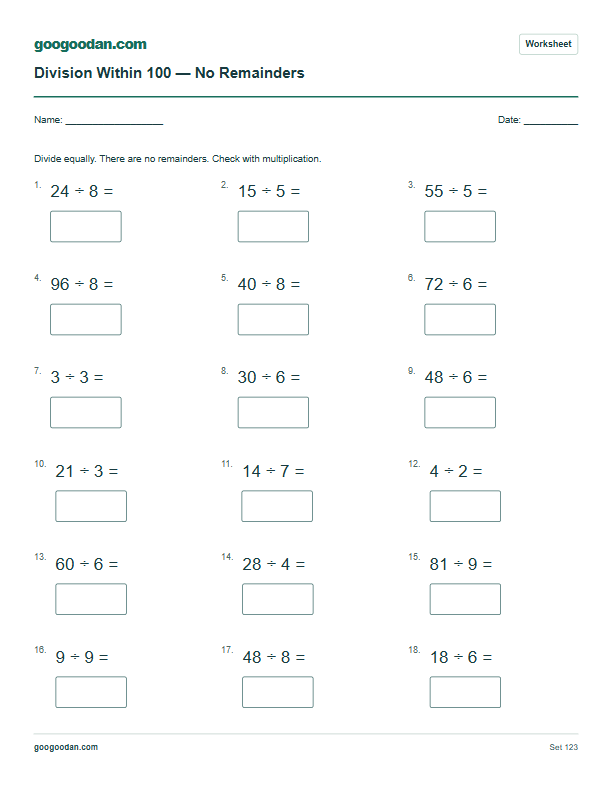
Division Without Remainders Worksheets
Share equally or make equal groups, then check each quotient with multiplication.
18 problems · Answer key included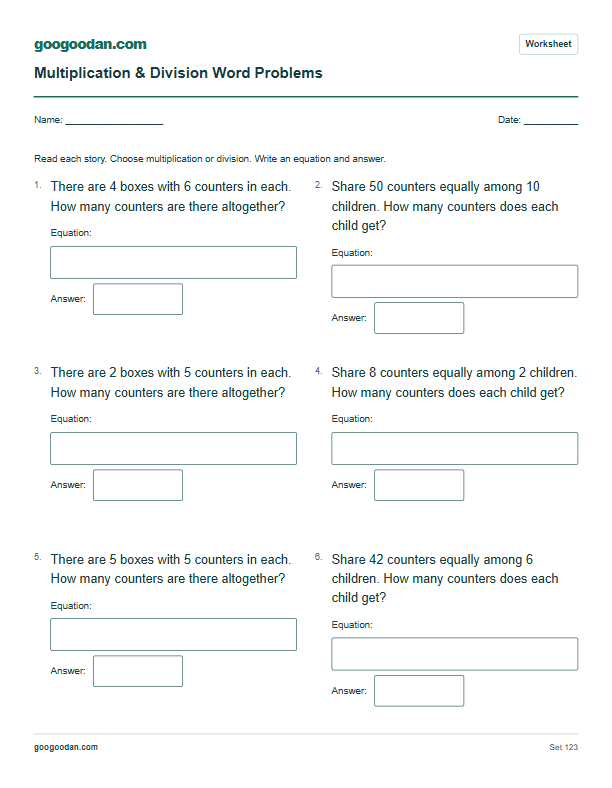 Word problems
3rd Grade Multiplication and Division Word Problems
Choose mixed facts, zero-and-one groups, or two- and three-digit group amounts. Explain what the answer counts.
6 mixed stories or 4 focused multiplication stories · Answer key included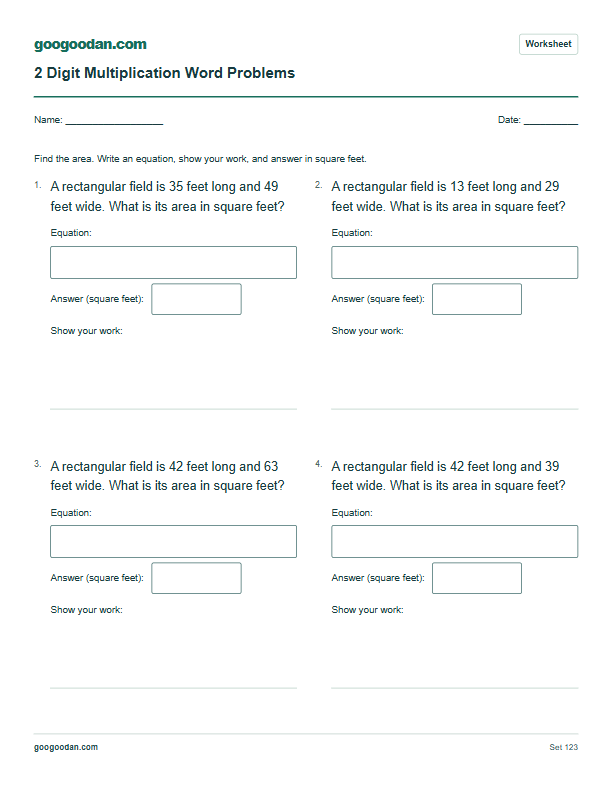 Word problems
2 Digit Multiplication Word Problems: Rectangle Area
Multiply two two-digit side lengths to find a rectangular field’s area in square feet.
4 problems · Answer key included
More about multiplication · Grade 4 worksheets
Grade 4 selected skill connection: Selected 4.OA.B.4: find factors and factor pairs for totals 2–100 through equal-row arrangements. See the Common Core grade guidance. This worksheet does not cover every requirement in the standard.