
Multiplying by Multiples of 10 Word Problems
Use familiar multiplication facts to count tens. Connect each factor to its role in the story and explain why 12 tens means 120 counters.
The fact is familiar; the counting unit changes
Noah is packing supplies for a class game. There are 4 boxes with 30 counters in each box. He knows 4 × 3 = 12, so he writes 12 counters as the total. The multiplication fact is right, but he has counted tens as if they were single counters.
Ask Noah to describe 30 in groups of ten. Each box has 3 tens. Four boxes therefore have 4 × 3 tens, or 12 tens. Since each ten contains 10 counters, those 12 tens represent 120 counters. The missing idea is the value of the unit he counted.
Four boxes. Three tens in every box.
4 × 3 tens = 12 tens
12 tens = 120 counters
Each small section represents one counter. Each complete rod represents ten counters.
Read the two factors in the story
In 4 × 30, the 4 tells how many equal groups there are. The 30 tells how many counters belong in each group. One useful first step is to sketch four boxes and write 30 inside each. The question asks for all the counters, so the groups must be combined.
Writing 4 + 30 = 34 adds the number of boxes to the number of counters in one box. Those numbers describe different roles; their sum does not count the collection. If the child is unsure, have them count the four groups aloud: 30, 60, 90, 120. Repeated addition, 30 + 30 + 30 + 30, shows the same total as multiplication.
Use a fact, then explain the tens
For 6 boxes with 70 counters in each, start with 6 × 7 = 42. Here that means 42 tens, not 42 counters. Convert the unit: 42 tens = 420 counters. The complete equation is 6 × 70 = 420.
This is why the written product ends in zero for these problems. Every group is made from complete tens, so the total also has no leftover ones. "Add a zero" can be a quick reminder after the child understands the place value, but it does not explain what changed. Ask, "Forty-two of what?" to bring the reasoning back to tens.
When the basic fact already ends in zero, keep both place values. For 5 × 40, the fact 5 × 4 = 20 represents 20 tens. That is 200, not 20 and not 2,000. A place-value chart or two groups of ten tens can show why 20 tens make 2 hundreds.
Keep the story and equation connected
The calculation 30 × 4 also equals 120. Switching the order of multiplication does not change the product, but four groups of thirty and thirty groups of four are different drawings. Accept either correct equation when the child can explain the relationship; the answer key follows the order in the printed story.
A set may include one box. One box with 80 counters still contains 80 counters: 1 × 80 = 80. Do not add another 80 just because the word "altogether" appears. Count the groups in the situation before choosing a strategy.
Build a larger fact from smaller facts
If Noah does not yet recall 7 × 6, he can work out 7 × 60 by splitting the seven boxes into five and two. Five boxes hold 300 counters; two boxes hold 120. Together they hold 420. In tens, the same thinking is 5 × 6 tens + 2 × 6 tens = 30 tens + 12 tens = 42 tens.
The worksheet leaves space for skip counting, a drawing, or this split calculation. A child does not need to count hundreds of individual dots. Labeling equal groups and explaining a few bundles makes the structure easier to see and reduces the chance of losing count.
Check the unit as well as the digits
For 7 × 60, compare the answer with 7 × 50 = 350 and 7 × 70 = 490. A total of 420 fits between those two benchmarks. A total of 42 is already smaller than the 60 counters in one box, so it cannot describe seven full boxes.
Finish by asking the child to read the answer as a complete quantity: "There are 420 counters altogether." These four-problem sets use 1–9 boxes and 10–90 counters per box, always in multiples of ten. They practice known multiplication facts with place value; they do not include zero groups, missing factors, or multiplying by hundreds.
Make a practice set
Choose what to print. Selecting both shows the answer key on screen and prints the questions followed by the answers.
After the practice
Ask how many tens the child found before converting the total to counters. Use a sketch or a second multiplication fact to check the answer.
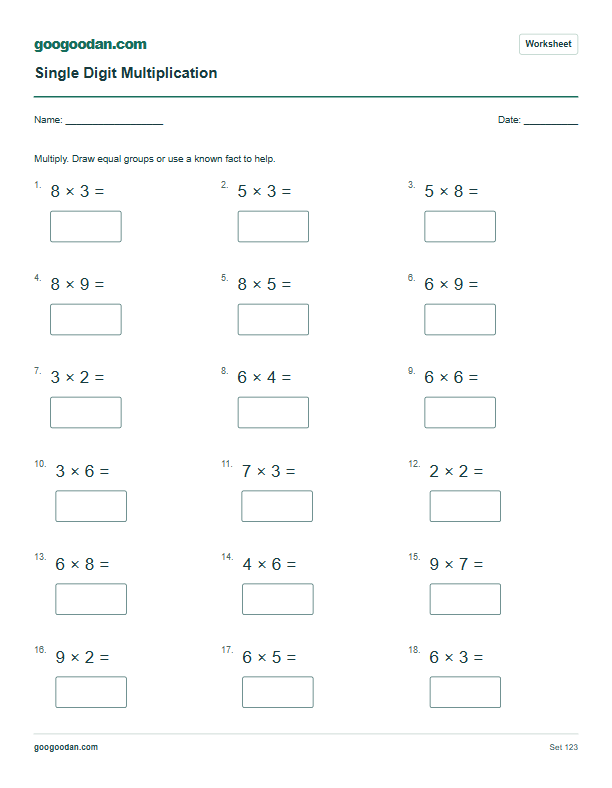 Calculation practice
Single Digit Multiplication Worksheets
Use equal groups and arrays to practise multiplication facts with factors from 2 to 9.
18 problems · Answer key included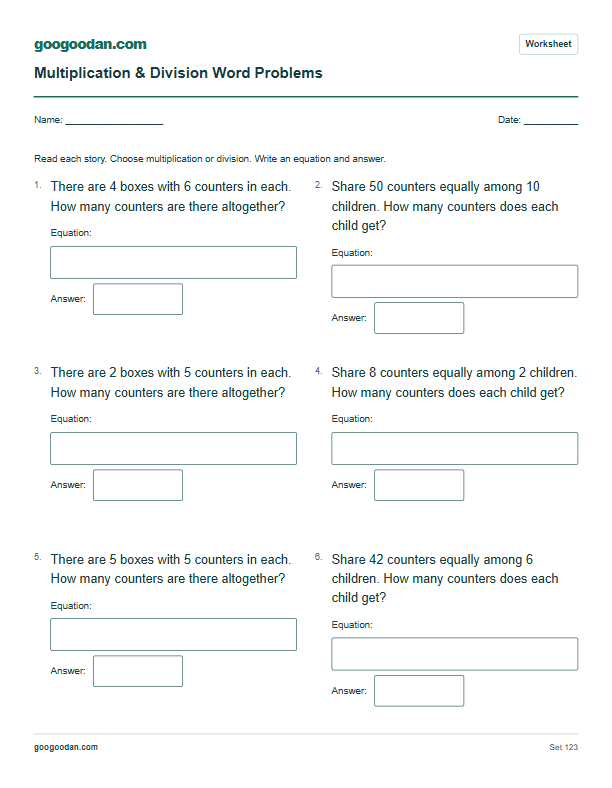 Word problems
3rd Grade Multiplication and Division Word Problems
Choose mixed facts, zero-and-one groups, or two- and three-digit group amounts. Explain what the answer counts.
6 mixed stories or 4 focused multiplication stories · Answer key included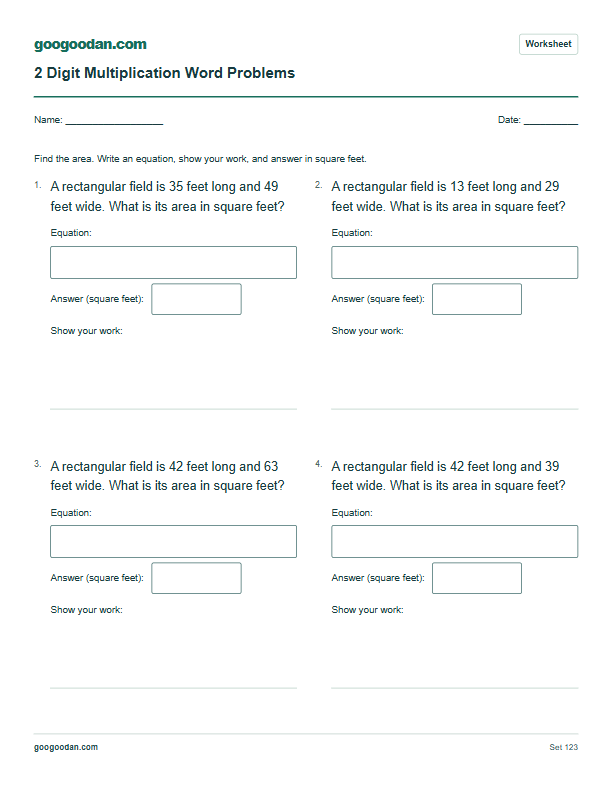 Word problems
2 Digit Multiplication Word Problems: Rectangle Area
Multiply two two-digit side lengths to find a rectangular field’s area in square feet.
4 problems · Answer key included
More about multiplication · Grade 3 worksheets
Grade 3 selected skill connection: 3.NBT.A.3 (positive one-digit factors and multiples of 10 from 10 to 90, in equal-group stories). See the Common Core grade guidance. This worksheet does not cover every requirement in the standard.