
Order of Operations Word Problems with Parentheses
Write and interpret an add-then-multiply expression. Use the contents of one complete box to explain why the sum belongs inside parentheses.
One complete box comes before the total
Liam is setting up four classroom games. Each supply box holds 3 red counters and 5 blue counters. He writes 3 + 5 × 4 and gets 23. He has used all three numbers, but his expression counts the red counters in only one box while counting the blue counters in all four.
Ask Liam to draw what is inside one box first. There are 3 + 5 = 8 counters in each box. All four boxes have that same content, so the complete calculation is (3 + 5) × 4 = 32. Parentheses tell the reader to treat the sum inside them as one grouped quantity.
Every box has the same two quantities.
(3 + 5) × 4 = 8 × 4 = 32 counters
The parentheses describe one complete box. The factor 4 repeats that whole box.
Explain the expression before calculating
Have the child point to each part of (3 + 5) × 4. The 3 and 5 are counts of counters in one box. The sum in parentheses is the total per box. The 4 is the number of identical boxes. The final product is a count of counters, not a count of boxes.
This interpretation is useful even before finding the numerical answer. Compared with one box, four boxes contain four times as many counters. If the child can say that clearly, the expression already communicates the relationship rather than just a sequence of button presses.
What changes when parentheses are missing?
In 3 + 5 × 4, standard operation order gives multiplication priority: 5 × 4 = 20, then 3 + 20 = 23. That expression could describe three loose red counters plus four groups of five blue counters. It does not describe four boxes that each contain both colors.
Do not simply tell the child that 23 is wrong and ask them to start again. Ask where the red counters from the other three boxes appear in their expression. Returning to the picture reveals the missing groups. Parentheses are needed here because the entire sum is multiplied, not just the number nearest the multiplication sign.
Keep the intermediate total visible
For boxes containing 7 red counters and 6 blue counters, with 3 boxes in all, write (7 + 6) × 3. First find 13 counters per box, then calculate 13 × 3 = 39 counters altogether. A helpful line of working is (7 + 6) × 3 = 13 × 3 = 39.
Writing 7 + 6 = 13 × 3 = 39 would incorrectly say that 13 and 39 are equal. Use a complete expression at each stage, or write two separate equations: 7 + 6 = 13 and 13 × 3 = 39. Labeling "per box" and "all boxes" helps the child distinguish the two totals.
A second correct method checks both colors
Return to Liam's four boxes. Count all the red counters first: 3 × 4 = 12. Then count all the blue counters: 5 × 4 = 20. Combining the color totals gives 12 + 20 = 32. The equivalent expression 3 × 4 + 5 × 4 checks the grouped calculation.
This is the distributive property in a visible setting. Both quantities inside the original parentheses must be multiplied by the number of boxes. An expression such as 3 × 4 + 5 still omits the blue counters from three boxes. Compare the two color totals with the drawing instead of treating distribution as a memorized symbol trick.
Accept equivalent ways to record the story
The expression 4 × (3 + 5) also represents four equal groups of the same total. The answer key displays (3 + 5) × 4, but multiplication allows those two factors to switch order. Repeated addition, 8 + 8 + 8 + 8, can also demonstrate the total after the child has explained where the 8 came from.
If both colors have the same count, they are still separate collections. For 6 red and 6 blue counters per box, three boxes contain (6 + 6) × 3 = 36 counters. Crossing out one 6 as a repeated number would remove a whole color from every box.
Use the scope of this set deliberately
These four-problem worksheets use 1–12 counters of each color and 2–9 equal boxes. The calculations are intentionally small enough to focus attention on grouping and meaning. Ask for an expression and an explanation before checking the total.
This set practices one add-then-multiply structure. It does not include subtraction, division, exponents, nested parentheses, brackets, or braces. When a child understands why one whole box is grouped, they have a concrete starting point for interpreting more varied numerical expressions later.
Make a practice set
Choose what to print. Selecting both shows the answer key on screen and prints the questions followed by the answers.
After the practice
Ask what the parentheses represent. Check the total by multiplying each color count by the number of boxes, then combining the two color totals.
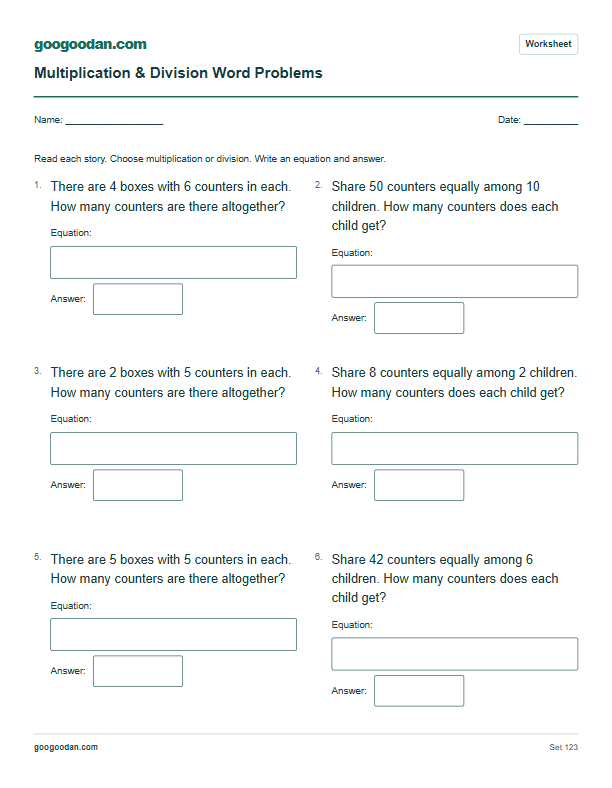 Word problems
3rd Grade Multiplication and Division Word Problems
Choose mixed facts, zero-and-one groups, or two- and three-digit group amounts. Explain what the answer counts.
6 mixed stories or 4 focused multiplication stories · Answer key included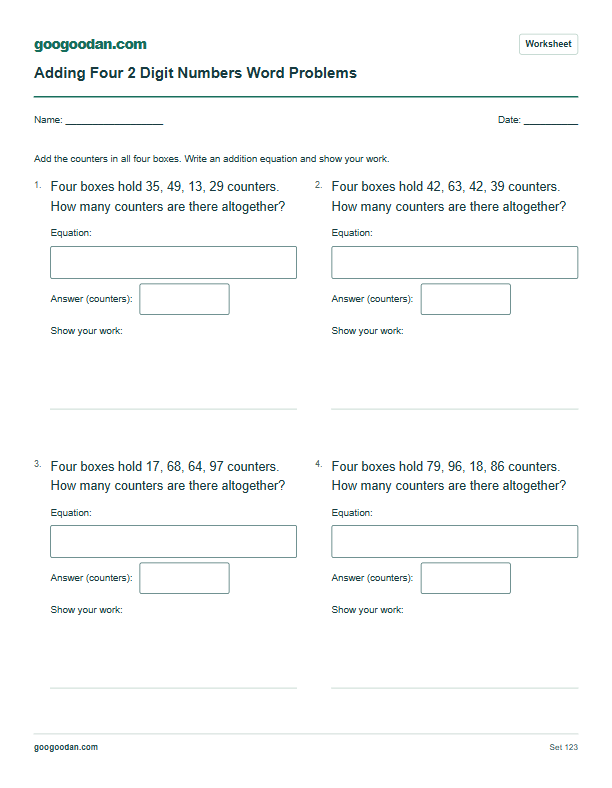 Word problems
Adding Four 2 Digit Numbers Word Problems
Combine four boxes of counters. Pair friendly sums or add tens and ones, keeping every box in the total.
4 problems · Answer key included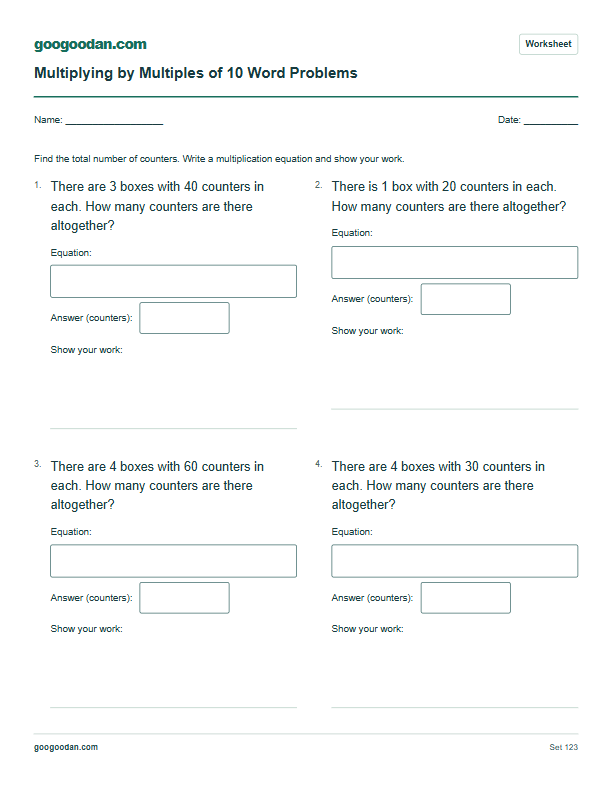 Word problems
Multiplying by Multiples of 10 Word Problems
Count equal boxes of 10–90 counters. Use a known multiplication fact to find the number of tens, then express the total in ones.
4 problems · Answer key included
More about multiplication · Grade 5 worksheets
Grade 5 selected skill connection: Selected 5.OA.A.1 and 5.OA.A.2: write, interpret and evaluate (a + b) × c in equal-box contexts; no nested grouping or other operations. See the Common Core grade guidance. This worksheet does not cover every requirement in the standard.