
Reading Vote Graphs Worksheets
Use the graph key to connect each block to one vote. Then decide whether the question asks for one group, the total, or a difference.
Read the key before counting
Each block represents one vote. The letters A, B, and C name the three groups. Count the blocks beside the requested letter, not the letters themselves or the gaps between blocks.
Find one group's count
If row A contains five blocks, A has five votes. Point to each block once as you count. Keeping a finger beside the row label helps avoid moving accidentally into row B.
Example counts: A = 5, B = 3, C = 4.
The total is 5 + 3 + 4 = 12 votes. The largest group has five votes and the smallest has three, so the difference is 5 − 3 = 2 votes.
Count the whole graph for a total
“Altogether” asks for every vote across all three rows. Record each row's count, then add the three amounts. Counting the three row labels would tell you how many groups there are, not how many votes.
Compare the largest and smallest groups
Count each group before choosing the largest and smallest. Subtract the smaller count from the larger count. You can also match their blocks in pairs: the unmatched blocks in the longer row show how many more votes it has.
Ties are possible
Two groups can have the same number of votes. If all three have four votes, the largest and smallest counts are both four and their difference is zero. A tie does not prevent you from finding the total or the difference.
About these six questions
Each sheet includes two questions about A, two questions about the total, and two questions about the difference between the largest and smallest counts. Every graph has three groups with one through eight votes per group.
The same group counts may appear with a different question. Not every set includes a tie. These original unit-block graphs do not include empty groups, scaled axes, or a task to draw a new graph. Use the working space to record the three counts or show the calculation.
Make a practice set
Choose what to print. Selecting both shows the answer key on screen and prints the questions followed by the answers.
After the practice
Ask which counts were needed and why. Check a difference by adding it to the smaller count.
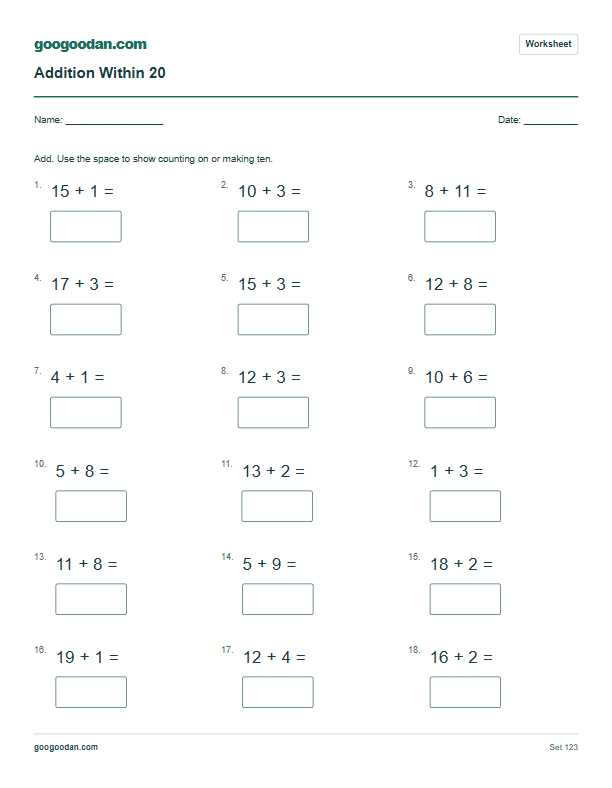 Calculation practice
Addition Within 20
Count on or make ten to add two numbers.
18 problems · Answer key included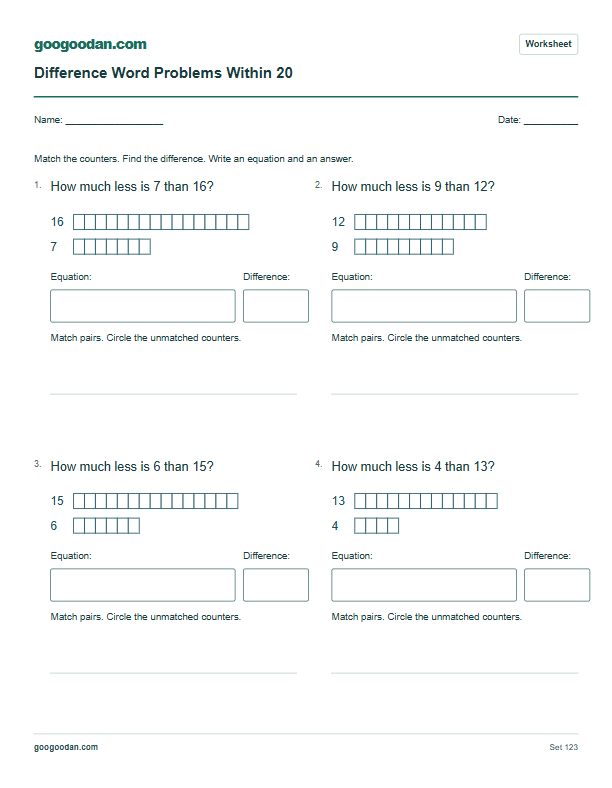 Word problems
Difference Word Problems Within 20
Match two rows of counters to find how much less one amount is than another.
4 problems · Answer key included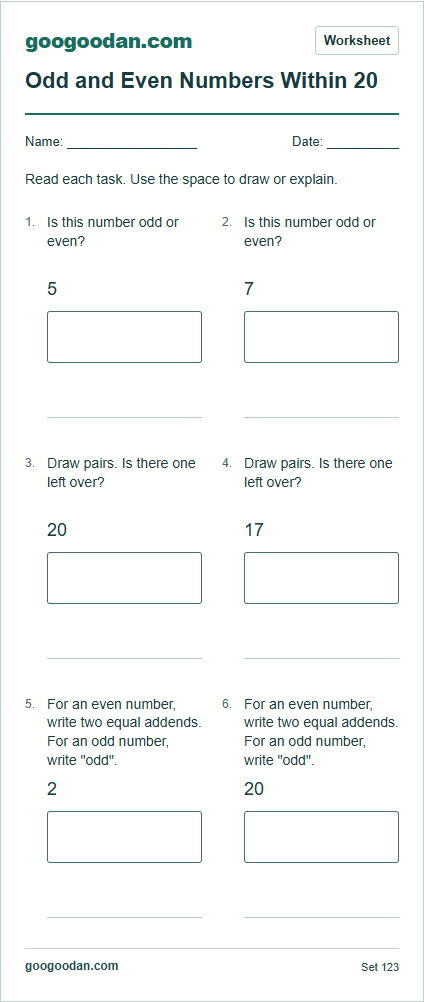 Drawing and number activity
Odd and Even Numbers Within 20
Classify numbers, draw pairs, and write equal addends.
6 problems · Answer key included
More about numbers · Grade 2 worksheets
Grade 2 selected skill connection: 2.MD.D.10. See the Common Core grade guidance. This worksheet does not cover every requirement in the standard.