
Telling Time Worksheets: Five-Minute Intervals
Count around the clock in fives, then check which hour the short hand has passed.
Each number marks five more minutes
Start at 12 with zero minutes. Moving clockwise, the long hand at 1 means five minutes, at 2 means ten minutes, and at 3 means fifteen minutes. Continue counting by fives to 55 at 11.
4:20: the long hand points to 4. Count 5, 10, 15, 20. The short hand is just past 4, so the time is 4:20.
The face numbers serve two jobs
The short hand uses the numbers to show hours. The long hand uses the same positions to show minutes. A long hand pointing to 4 does not mean four minutes. Ask which hand you are reading before writing a number.
Check the hour when the next hour is close
At 7:55, the long hand points to 11 and the short hand is almost at 8. It has not reached 8 yet, so write 7:55. When both hands reach the next hour position, it becomes 8:00.
Write a zero before a single minute digit
Five minutes past two is 2:05. Write two digits after the colon. At the hour, use :00. At half past, use :30.
Follow the hands across twelve
At 12:45, the hour hand is between 12 and 1. The hour is still 12. At 1:00, the long hand reaches 12 and the short hand reaches 1. The 12 position on the minute scale means zero minutes into the new hour, not :60.
Practice with a movable clock
Begin at an exact hour and move the long hand one numbered position at a time. Say the minutes in fives and watch the short hand move gradually. Then choose a printed clock and explain the minutes and hour separately before combining them.
About this practice
Each set contains six distinct times. Minutes range from :00 through :55 in five-minute steps, including hours and half hours when selected. The original drawings show twelve face numbers and two hands. Sets do not guarantee every minute value.
This activity covers reading an analog clock and recording a digital time. A clock face alone cannot determine AM or PM. Choosing AM or PM from a daily-life context, drawing hands, and calculating elapsed time are not assessed here.
Make a practice set
Choose what to print. Selecting both shows the answer key on screen and prints the questions followed by the answers.
After the practice
Ask the child to justify both parts of one answer: where the long hand points and which hour the short hand has passed.
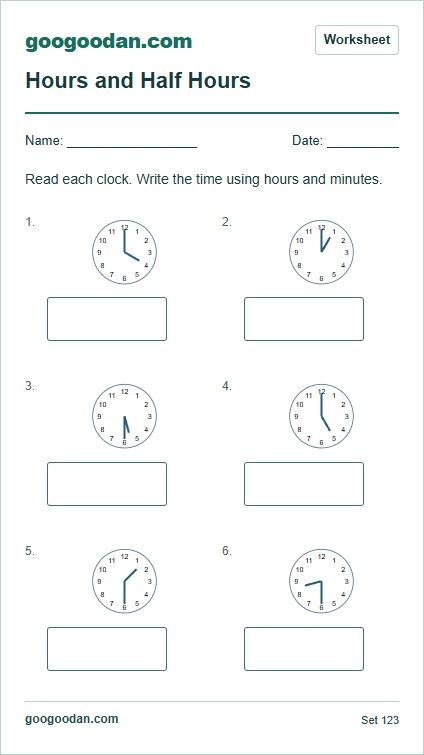 Picture activity
Telling Time: Hours and Half Hours
Read analog clocks and write the time to the hour or half hour.
6 problems · Answer key included
More about measurement · Grade 2 worksheets
Grade 2 selected skill connection: 2.MD.C.7. See the Common Core grade guidance. This worksheet does not cover every requirement in the standard.