
Comparing Fractions Worksheets With Like Denominators
When the parts are the same size, compare how many parts each fraction counts. Use greater than, less than, or equal to for six proper-fraction comparisons.
Same-sized parts: compare how many
Two identical paper strips are each divided into six equal parts. Mia shades two parts of one strip and five parts of the other. Each shaded piece is one sixth of the same-sized whole, so five pieces cover more than two pieces.
2/6 < 5/6
The denominator, 6, tells how many equal parts make one whole. The numerator tells how many parts are counted. When the denominators match and the wholes are the same size, the greater numerator names the greater fraction.
Choose the symbol, then read the statement
- Check that both fractions have the same denominator.
- Compare the numerators. More of the same-sized part means a greater amount.
- Write <, >, or = in the box. Read your comparison from left to right.
The open side of < or > faces the greater amount; the pointed end faces the smaller amount. Read 2/6 < 5/6 as “two sixths is less than five sixths.” Reversing the fractions gives 5/6 > 2/6: “five sixths is greater than two sixths.” The amounts have not changed, but the symbol must face the other way.
What if the amounts match?
For 3/4 and 3/4, both fractions count three fourths of the same-sized whole. Neither is greater. Write 3/4 = 3/4. Matching denominators alone do not make fractions equal; the numerators must match too in this practice.
Why the whole matters
Two sixths of a large poster and five sixths of a tiny card cannot be compared by counting shaded pieces alone. The pieces come from different-sized wholes. These numerical comparisons use the same whole; when drawing a model, begin with identical strips and divide each into equal parts.
What is on this worksheet?
Each worksheet has six comparisons of proper fractions with like denominators, selected from 2, 3, 4, 6, and 8. A proper fraction is less than one whole. Write a comparison symbol in each answer box and use the working space to draw equal-length strips or explain how the numerators helped you decide. Equal fractions are possible, but every set need not contain an equality question.
This practice addresses the same-denominator portion of Grade 3 standard 3.NF.A.3d. Comparing fractions with the same numerator and different denominators is a separate part of that standard and is not practiced here.
Make a practice set
Choose what to print. Selecting both shows the answer key on screen and prints the questions followed by the answers.
After the practice
Choose one comparison and explain why it is true without naming only the symbol. For example, five sixths is greater than two sixths because five of the same-sized pieces cover more than two. Try reversing the order and writing the new comparison.
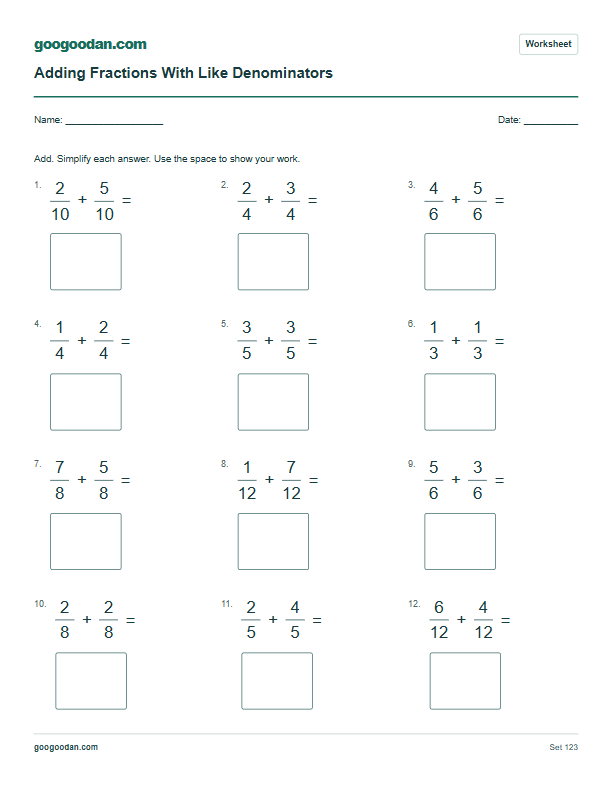 Calculation practice
Adding Fractions With Like Denominators
Add equal-sized parts; simplify sums that may be greater than one.
12 problems · Answer key included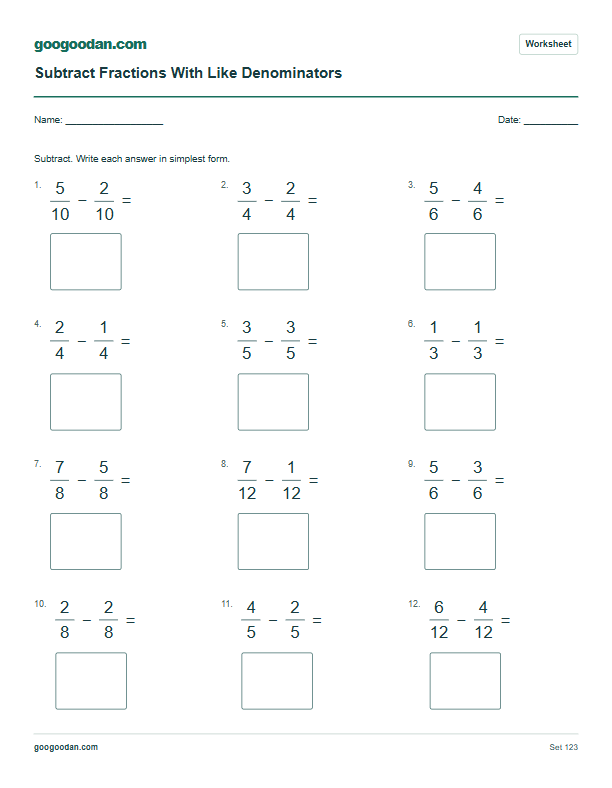 Calculation practice
Subtracting Fractions With Like Denominators
Take away equal-sized parts of the same whole and simplify the difference.
12 problems · Answer key included
More about fractions · Grade 3 worksheets
Grade 3 selected skill connection: 3.NF.A.3d. See the Common Core grade guidance. This worksheet does not cover every requirement in the standard.