
Length Word Problems in Centimeters for Grade 2
Follow a ribbon through two changes: join two lengths, then cut some off. Use a same-scale drawing to explain the length that remains.
Nora joins two ribbons, then trims the end
Nora is decorating a paper bookmark. She joins a 7-centimeter ribbon to a 5-centimeter ribbon, then cuts 3 centimeters off the joined ribbon. How many centimeters remain? Nora adds 7 and 5 and says, “Twelve!” Her addition is right, but twelve describes the ribbon before she trims it.
Ask her to show the moment when the ribbon is 12 centimeters long. Then read the cutting sentence again. The question asks for the length after both actions, so she needs to use the new total in a second step.
The green and orange lengths meet end to end. The dashed part is cut off and is not part of the remaining length. The drawing keeps the same scale in each row; it is not a ruler and is not printed at actual size.
Lengths add when their ends meet
Imagine sliding the second ribbon until its starting end meets the far end of the first. The joined ribbon includes all 7 centimeters of the first piece and all 5 centimeters of the second. It is 12 centimeters long. A centimeter is a unit of length: each centimeter represents the same distance, no matter which ribbon it belongs to.
These stories use an idealized join with no overlap, gap, or length lost in a knot. With real ribbons, an overlapping join would shorten the result. For a classroom model, use two paper strips, place their ends together, and tape across the join without overlapping them. The problem already gives the lengths, so children do not need to measure the illustration.
Cut from the joined length
After joining, treat the ribbon as one length of 12 centimeters. Mark a 3-centimeter section at one end and imagine removing it. The remaining section is 9 centimeters long. Cutting does not make the length increase, and the removed piece does not count as part of the answer.
7 + 5 = 12
The joined ribbon is 12 cm long.
12 − 3 = 9
The remaining ribbon is 9 cm long.
Use the first step box for the joined length and the second for the subtraction. Write 9 in the final box labeled “Answer (cm).” The label supplies the unit, so the number means nine centimeters. In a written sentence, use “9 cm” or “9 centimeters.”
A length is different from a number of pieces
A child may answer “two” because two ribbons were used. That counts pieces, but the question asks how long the remaining ribbon is. Point to the words “How many centimeters” and trace the remaining length with a finger. Ask, “Are we counting ribbons, or finding a distance from one end to the other?”
Keep both given lengths in the same unit before combining them. Seven centimeters plus five centimeters makes twelve centimeters. You cannot simply add a number of inches to a number of centimeters and call the result centimeters. These worksheets use centimeters throughout so children can concentrate on the two changes; mixed-unit conversion is not required.
Help a child explain a wrong answer
If Nora answers 12, ask what happened after she joined the ribbons. If she answers 15, she may have added the cut-off length instead of taking it away. Cover the dashed 3-centimeter part of the model and ask whether the remaining ribbon is longer or shorter than the joined ribbon.
If she answers 4 from 7 − 3, she has not yet included the second ribbon. Her subtraction can be the first step of another valid strategy: 7 − 3 = 4, then 4 + 5 = 9. Ask her to account for both original ribbons and the cut. The answer key follows the story order, but a different correct method is welcome when the child explains what every number means.
Write two separate equations rather than 7 + 5 = 12 − 3 = 9. That chain would incorrectly say twelve equals nine. Each equals sign must connect quantities with the same value.
Check the answer by rebuilding the ribbon
Put back the 3 centimeters that were cut off: 9 + 3 = 12. The restored length should match the joined length, 7 + 5 = 12. To finish checking, subtract the second ribbon's 5 centimeters from 12; the first ribbon's 7 centimeters remain.
The final ribbon does not always have to be longer than the first ribbon. Joining 2 centimeters and cutting off 6 centimeters makes the final length smaller than the original first piece. For example, 10 + 2 = 12 and 12 − 6 = 6. When the added and removed lengths are equal, the final length equals the first length: 8 + 4 = 12 and 12 − 4 = 8.
Use the worksheet after trying the model
Each printable set contains four different ribbon stories with room for two equations and a drawing or explanation. Ask the child to draw two lengths touching end to end, label them, and cross out the section that is removed. A simple sketch is enough; carefully drawn art is not the learning goal. Read the question aloud if needed, then let the child choose and explain the operations.
The first lengths range from 4 to 18 cm, the second from 1 to 8 cm, and the cut-off amounts from 2 to 9 cm. Joined lengths can reach 26 cm and remaining lengths range from 3 to 17 cm. These are selected Grade 2 same-unit length word problems with small numbers, not a complete set of problems within 100 or a ruler-reading assessment.
Make a practice set
Choose what to print. Selecting both shows the answer key on screen and prints the questions followed by the answers.
After the practice
Ask the child to point to the remaining length and explain why the answer uses centimeters rather than pieces.
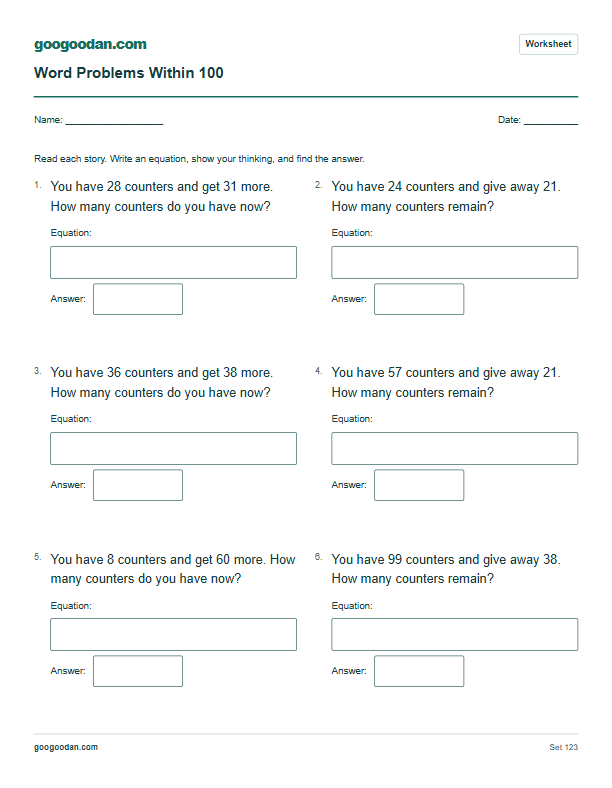 Word problems
Addition & Subtraction Word Problems Within 100
Choose an operation for a joining or taking-away story, then solve within 100.
6 problems · Answer key included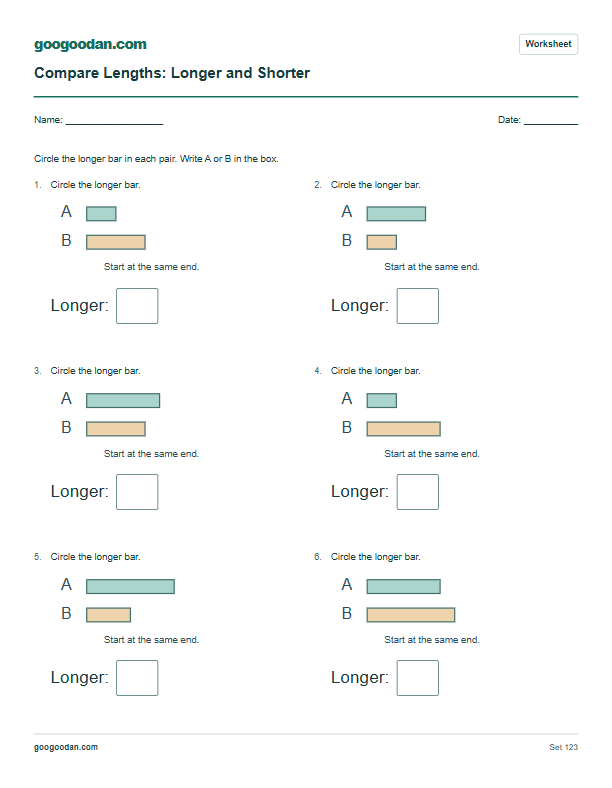 Compare and circle activity
Longer and Shorter Worksheets for Kindergarten
Compare two bars that start at the same point. Circle the longer one and write A or B without using a ruler.
6 problems · Answer key included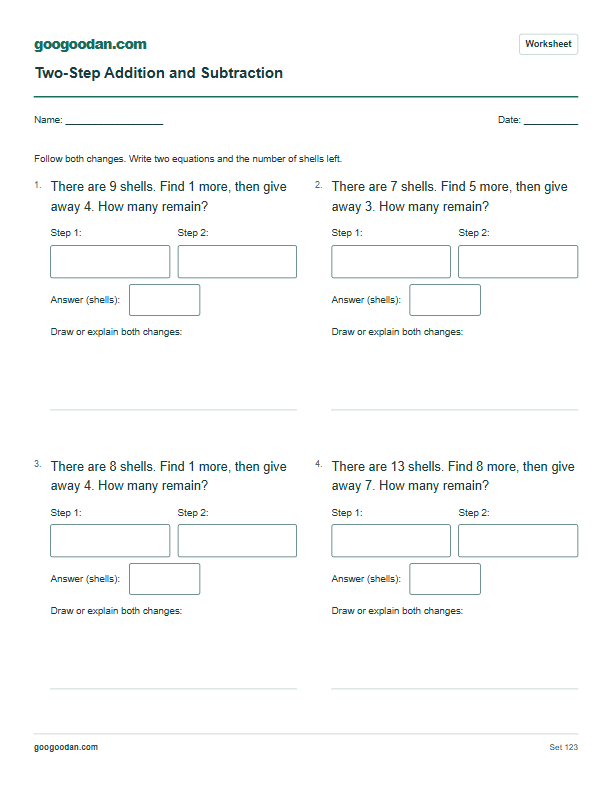 Word problems
Two-Step Addition and Subtraction Word Problems
Find a new total, then subtract what is given away. Follow both changes with small numbers.
4 problems · Answer key included
More about measurement · Grade 2 worksheets
Grade 2 selected skill connection: Selected 2.MD.B.5: adding and subtracting same-unit lengths in small-number two-step ribbon stories; not all problems within 100 or direct ruler measurement. See the Common Core grade guidance. This worksheet does not cover every requirement in the standard.