
Longer and Shorter Worksheets for Kindergarten
Compare the lengths of two bars with their starting points lined up. Circle the longer bar and record its label, A or B.
Line up the starts before comparing lengths
Ari wants to know which of two paper strips is longer. One strip sticks out farther to the right, but it also begins farther to the right. Looking only at the far ends can be misleading when the starting points do not match.
Slide the strips so their left ends line up. Keep both strips straight. Now look at the other ends: the strip that extends farther is longer, and the one that stops first is shorter.
On this worksheet the two bars already start at the same place. Trace each bar from left to right, circle the longer bar, and write its label, A or B, in the answer box.
Focus on the length
Length tells how far a bar reaches from one end to the other. It is different from color or position on the page. The top bar is not always the longer one, and choosing a favorite color does not answer the question.
The bars on this page have the same thickness and are both horizontal. That helps the child focus on just one attribute. Ask, “Which one reaches farther from the shared starting point?” Then point to the shorter bar and use the other comparison word.
Point, trace, and circle
Put a finger at the left end of A, then trace toward its right end. Do the same for B. Bring attention back to the starting ends before deciding. If it helps, place the edge of a piece of paper vertically beside those starts to show that they line up.
The child can circle the entire longer bar or draw an oval around its label. Writing A or B records the same choice. An adult may write the letter if the child can identify and explain the longer bar but is not yet comfortable forming letters.
Try the idea with real objects
Use two straight paper strips, ribbons laid flat, or pencils. Put their ends together on one side and compare the other ends. Invite the child to say, “This one is longer,” and then reverse the description: “That one is shorter.”
Move one strip away from the shared start and ask whether moving it changed its length. Bring it back to check. This small action helps distinguish the size of an object from where it happens to sit.
No ruler is needed
This is a direct visual comparison, not a measurement in inches or centimeters. The bars do not have numbered marks, and the answer is a label rather than a number of units. Do not ask the child to guess a numerical length from the drawing.
There are no equal-length pairs in this set. Each pair has one longer bar and one shorter bar. If the difference is hard to see, compare the endpoints again or demonstrate with two paper strips before returning to the picture.
Use the answer key to discuss the choice
Each page has six pairs. The answer key keeps the same bars and fills the correct letter in red. It also outlines the longer bar in red so an adult can connect the written answer to the picture quickly.
Ask the child to explain one choice by pointing to both ends, rather than asking for six repeated sentences. A gesture, a spoken comparison, or a demonstration with objects can show understanding. Change the numbers for another set of bar pairs while keeping the same comparison task.
This activity covers horizontal length comparison only. It does not teach area, weight, capacity, or reading a ruler. Keep those attributes separate when choosing the next worksheet.
Make a practice set
Choose what to print. Selecting both shows the answer key on screen and prints the questions followed by the answers.
After the practice
Check that the bars start at the same place. Point to the farther endpoint and explain which bar is longer and which is shorter.
 Picture activity
Compare Picture Groups Worksheets for Kindergarten
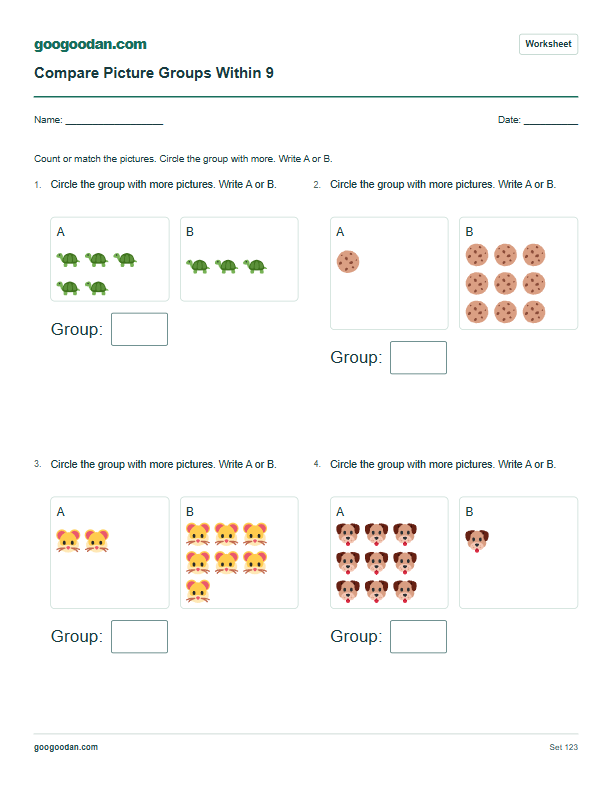
Match or count two groups and circle the group with more objects.
4 problems · Answer key included
More about measurement · Kindergarten worksheets
Kindergarten selected skill connection: Supporting K.MD.A.2: directly compare lengths of two aligned pictured bars; real-object comparison remains important. See the Common Core grade guidance. This worksheet does not cover every requirement in the standard.