
Common Denominator Worksheets
A common denominator lets two fractions use the same-sized parts. Rename each fraction while keeping its value, and write both results.
Give both fractions the same-sized parts
To rename 1/3 and 1/4 with a common denominator, use the same-sized whole for each fraction. Thirds and fourths are different-sized pieces. Twelfths can describe both amounts without changing either one.
Find the least common denominator
List multiples of each denominator: 3, 6, 9, 12, … and 4, 8, 12, …. The smallest shared multiple is 12, so 12 is the least common denominator.
- To change thirds into twelfths, multiply 3 by 4. Multiply the numerator by 4 too: 1/3 = (1 × 4)/(3 × 4) = 4/12.
- To change fourths into twelfths, multiply 4 by 3. Multiply that numerator by 3 too: 1/4 = (1 × 3)/(4 × 3) = 3/12.
- Write both equivalent fractions, in the original order: 4/12 and 3/12.
Two fractions, two answers
This activity asks you to rename each fraction. It does not ask you to add them. Writing 7/12 gives their sum and leaves the two requested answers missing. Writing only 12 gives the denominator but neither complete fraction.
Common does not always mean least
The fractions 8/24 and 6/24 also equal 1/3 and 1/4, but 24 is not the least common denominator. Use 4/12 and 3/12 for this instruction. Check each answer separately: its value must match its original fraction, and the two answer denominators must match.
What these six questions practice
Each question pairs a proper fraction with denominator 2 through 9 and a unit fraction whose denominator is one greater. For example, a denominator of 5 is paired with a denominator of 6. The least common denominators range from 6 through 90. These consecutive denominators have no shared factor greater than one, so their product is the least common denominator. Do not assume that multiplying the denominators always gives the least one: for 4 and 6, the product is 24 but the least common denominator is 12.
This Grade 5 activity builds a prerequisite for adding and subtracting fractions with unlike denominators in 5.NF.A.1. It practices renaming only, with this limited pattern of pairs; it does not cover the full standard, mixed numbers, or all unlike-denominator combinations.
Make a practice set
Choose what to print. Selecting both shows the answer key on screen and prints the questions followed by the answers.
After the practice
Before adding fractions with unlike denominators, ask the child to explain why both fractions keep their value when renamed. Check both answers, then use like-denominator addition to practice combining equal-sized parts.
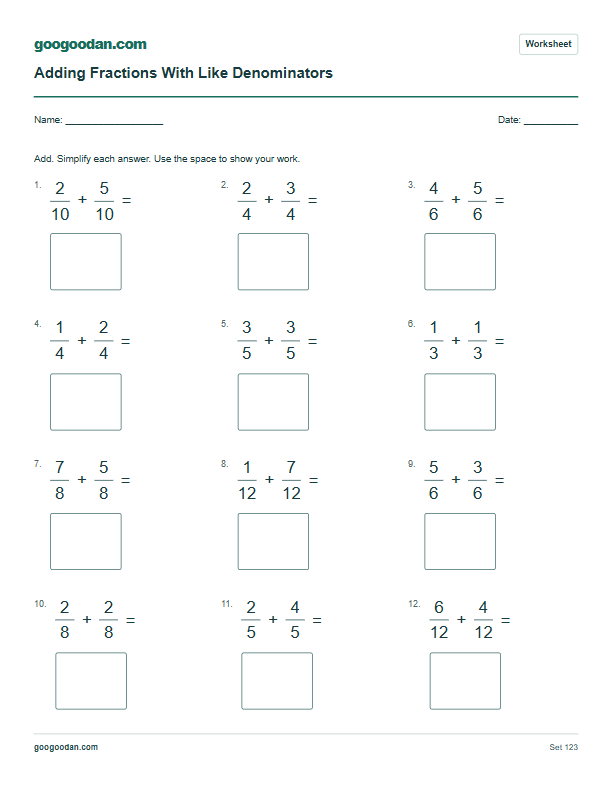 Calculation practice
Adding Fractions With Like Denominators
Add equal-sized parts; simplify sums that may be greater than one.
12 problems · Answer key included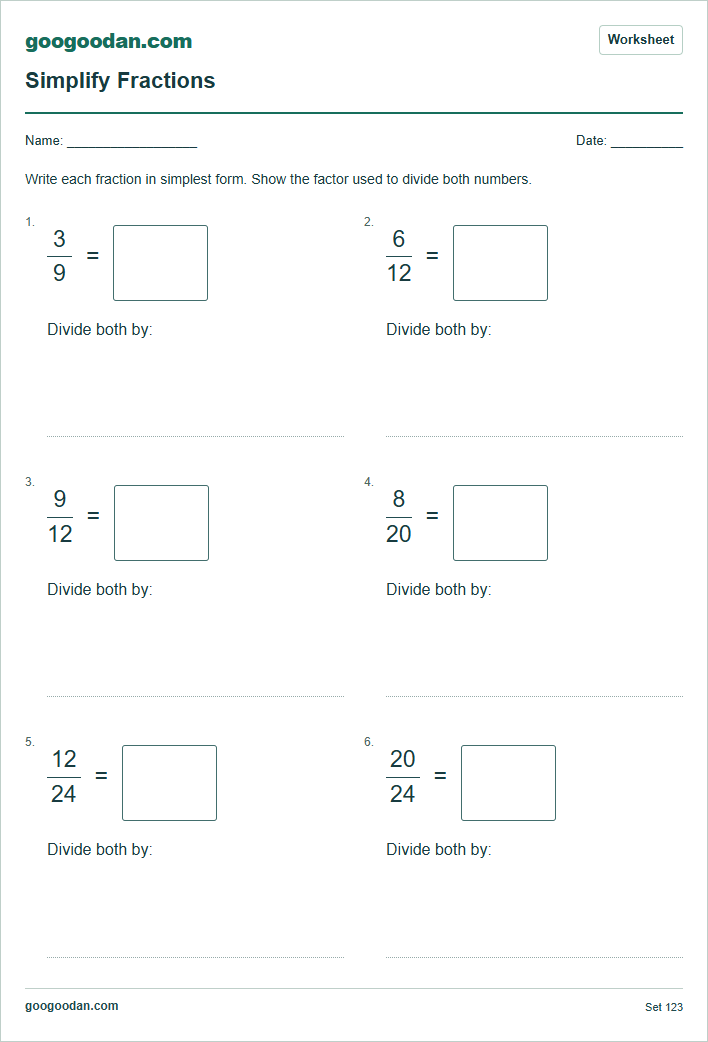 Calculation practice
Simplifying Fractions
Divide both numbers by a common factor while keeping the fraction value unchanged.
6 problems · Answer key included
More about fractions · Grade 5 worksheets
Grade 5 selected skill connection: 5.NF.A.1 prerequisite: common denominators. See the Common Core grade guidance. This worksheet does not cover every requirement in the standard.