
Liters and Grams Word Problems
Help children distinguish a container count from the amount inside. Use equal groups for totals and subtraction for what remains.
Eli counts containers, then reads the labels
Eli is helping prepare water for a school garden. There are 3 containers with 4 liters in each. He says, “There are three, so the answer is three.” He has counted the containers correctly. Now ask, “Does the question ask for the number of containers or the amount of water altogether?” Each container contributes four liters, so the total is twelve liters.
Each label gives the amount inside one container. These are schematic containers, not measuring scales: use the labels rather than estimating a volume from the drawing.
Separate the number of groups from the amount in each
The number 3 tells how many equal groups there are. The number 4 tells the liquid volume in each group. Write 4 + 4 + 4 = 12, then connect it to 3 × 4 = 12. Multiplication is useful because the same amount is repeated in every container.
Three plus four would mix a count of containers with the amount in one container. Ask the child to point to all three groups of four in the drawing. Also check the word “each”: without equal amounts, multiplying the number of containers by one amount would not necessarily give the total.
Liters and grams describe different things
Liters measure liquid volume, the amount of space a liquid occupies. Grams measure mass, how much matter an object or material contains. For these worksheets, a container holding 4 grams means that its contents have a mass of 4 grams; the empty container's mass is not included. It does not mean the container is four grams tall or that four grams is its liquid capacity.
For example, 3 small containers of craft material with 4 grams in each contain 12 grams of material altogether. The arithmetic 3 × 4 = 12 matches the water example, but the meaning and unit of the answer change. Write 12 liters for the water and 12 grams for the craft material.
Do not combine liters and grams in one sum or convert between them from these questions. A liquid's mass depends on the material as well as its volume. Every worksheet question uses just one unit, and the answer box repeats that unit. The abbreviations L and g mean liters and grams; the worksheet writes out the unit names for beginning readers.
When some is used, find what remains
In a different story, a container holds 12 grams of material and Eli uses 5 grams. How much remains? Sketch one bar for the original 12 grams, mark off a part worth 5 grams, and label the part left with a question mark. Subtract 12 − 5 = 7, so the answer is 7 grams.
12 g = 5 g used + 7 g left
The short wording “Use 5” means use five of the same units named at the start of that question. Children can say the full unit aloud before calculating. A liters question asks for liters left; a grams question asks for grams left. Using material makes the remaining amount smaller or, if all of it is used, zero.
Choose the operation from the situation
A child may multiply every pair of numbers because the first question used multiplication. Reread the situation before writing an equation: equal containers ask for a total, while a single container with some amount used asks for a remainder. The four questions deliberately include both situations so children have to interpret the story.
Do not teach “altogether always means multiply.” Equal groups allow multiplication; unequal amounts may require addition instead. Similarly, these particular “use some” stories have the remaining amount unknown. If a different story asks for the starting amount, the child must reason differently.
Check the unit as well as the number
For 3 × 4 = 12, check by adding three fours or dividing 12 liters among three equal containers to recover 4 liters in each. For 12 − 5 = 7, check 7 + 5 = 12. An equation can be arithmetically right but still answer the wrong question if the child writes a container count instead of a liquid volume or mass.
A zero answer can also be correct: a container holds 6 liters and all 6 liters are used, leaving 0 liters. Keep the unit even when nothing remains. In a subtraction story the answer cannot exceed the starting amount; in an equal-container story with at least two containers, the total must exceed the amount in just one.
Practice one step at a time
Each printable set has one liters multiplication story, one liters subtraction story, one grams multiplication story, and one grams subtraction story. Write an equation and the number in the labeled answer box, then draw equal groups or a part-whole bar in the work area. These are four separate problems, not four stages of one story.
Multiplication uses 2–9 containers with 2–9 liters or grams in each, for totals from 4 to 81. Subtraction starts with a total formed from those factors and removes 1–8 units without going below zero. This is selected Grade 3 same-unit problem-solving practice. It does not teach conversions, kilogram problems, decimal or fraction measurements, or how to read a real measuring scale.
Make a practice set
Choose what to print. Selecting both shows the answer key on screen and prints the questions followed by the answers.
After the practice
Ask what the answer measures and why the unit is liters or grams. Check each story separately.
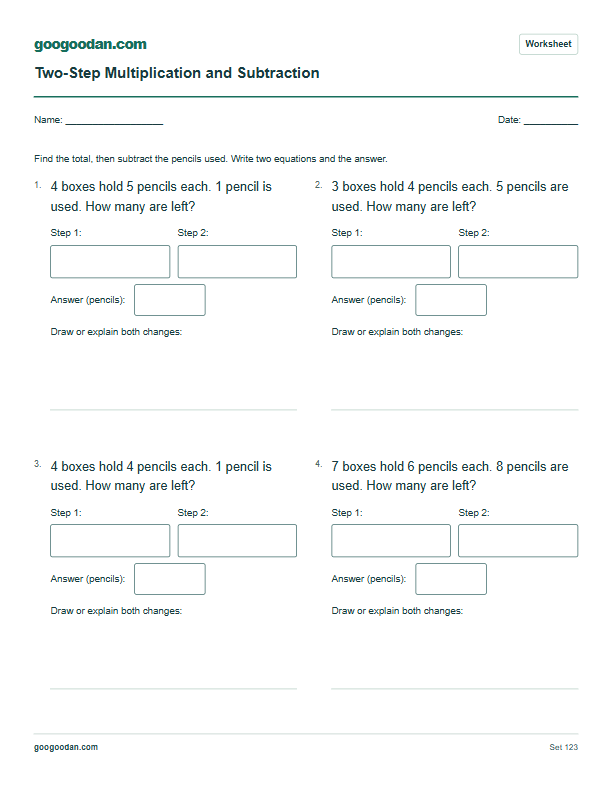 Word problems
Two-Step Multiplication and Subtraction Word Problems
Find the number of pencils in equal boxes, then subtract the pencils used. Explain both steps.
4 problems · Answer key included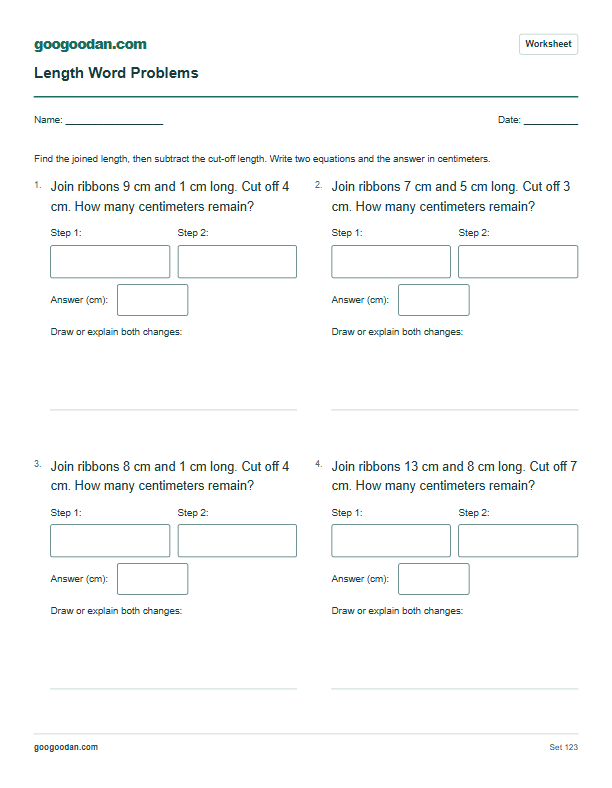 Word problems
Length Word Problems in Centimeters
Join two ribbon lengths, then cut some off. Model both steps and label the remaining length in centimeters.
4 problems · Answer key included
More about measurement · Grade 3 worksheets
Grade 3 selected skill connection: Selected 3.MD.A.2: one-step same-unit liquid-volume and mass word problems using multiplication or subtraction. No conversion, estimation, kilograms, addition or division in this set. See the Common Core grade guidance. This worksheet does not cover every requirement in the standard.