
Tens and Ones Expanded Form Worksheets
A ten is one group of ten ones. Use that group to explain why the two digits in a number have different values.
One ten is ten ones
Count 23 small objects. Move ten into one group, then ten into another group. Three objects remain. You still have 23 objects: two tens and three ones.
23 = 20 + 3
Two groups of ten have a value of 20. The three remaining ones have a value of 3.
Connect the groups to the digits
The 2 in 23 tells how many tens there are. It does not mean two individual objects. The 3 tells how many ones remain. Ask the child to point to the two groups and then the three loose objects while saying “two tens and three ones.”
Teen numbers have one ten
For 16, make one group of ten and leave six ones. Write 16 = 10 + 6. Keep the group intact while counting the remaining six. Then open the group and recount to check that grouping did not add or remove objects.
A zero means no loose ones
For 40, make four groups of ten with no objects left over. You can write 40 + 0. The answer key omits zero terms, so it shows 40. Both represent four tens and no ones. Keep the zero when writing the ordinary numeral 40; writing 4 describes a different quantity.
Read the sum back into a number
After writing 50 + 7 for 57, cover the original number. Ask how many tens and ones the sum describes. Five tens and seven ones rebuild 57. Do not count the groups as if each group were only one object.
Use this page after grouping practice
Each set shows six distinct numerals from 10 through 99. Children write the tens value plus the ones value. The printable uses numerals rather than pictures of bundles; provide objects or base-ten blocks when the child still needs a physical model. A set does not guarantee a teen number or a zero ones digit.
The answer key gives expanded forms such as 60 + 4. An explicit zero term and a reversed sum such as 4 + 60 are mathematically valid. Ask the child to explain which term represents the tens.
Make a practice set
Choose what to print. Selecting both shows the answer key on screen and prints the questions followed by the answers.
After the practice
Choose one answer and build it with groups of ten and loose ones. Ask whether rearranging the groups changes the total and let the child check by counting.
 Word problems
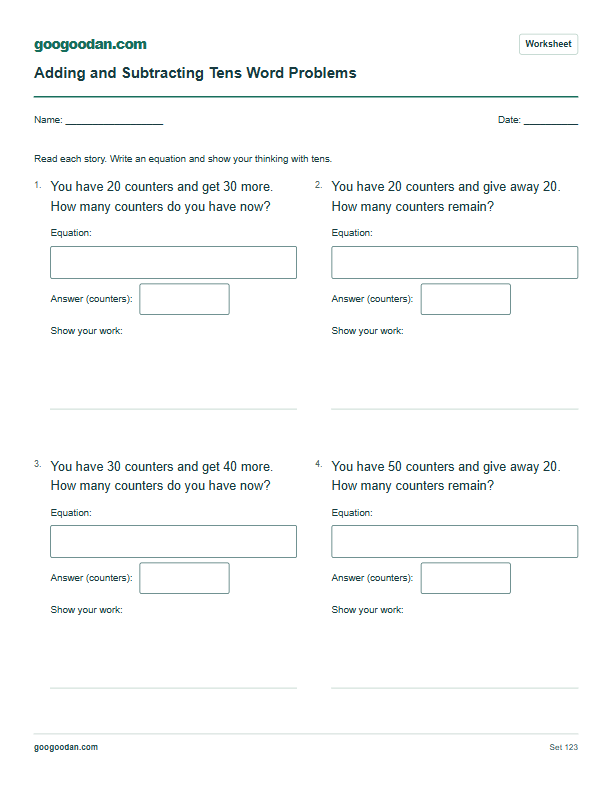
Adding and Subtracting Tens Word Problems
Combine or remove whole tens of counters. Explain the place value, including stories where zero counters change or remain.
4 problems · Answer key included
More about numbers · Grade 1 worksheets
Grade 1 selected skill connection: 1.NBT.B.2. See the Common Core grade guidance. This worksheet does not cover every requirement in the standard.