
Dividing by Decimals Word Problems
Find how many full and partial groups fit when the group size is a decimal. Rename both quantities together and check the quotient using the original units.
A smaller group can fit more times
Leo has a total amount of 2.25. Each full group holds 0.9. He expects division to give a number smaller than 2.25, so an answer of 2.5 seems wrong. Ask what the answer counts: the total is measured in units, while the answer measures groups that each hold less than one unit.
Two groups use 0.9 + 0.9 = 1.8 units. The remaining 0.45 is half of 0.9, so it contributes another half-group. The answer is 2.5 groups. The empty dashed half shows the size of a complete third group; it is not part of the given total.
Rename both quantities in the same smaller unit
One hundredth is a hundredth of the original unit. The total 2.25 is 225 hundredths, and a full group of 0.9 is 90 hundredths. Asking how many groups of 0.9 fit into 2.25 is therefore the same as asking how many groups of 90 hundredths fit into 225 hundredths.
This is why 2.25 ÷ 0.9 = 225 ÷ 90. Both numbers were multiplied by 100. The numerical labels changed because we used smaller measuring units; the relative size of the total and one group did not change.
Multiplying both numbers by 10 also gives an equivalent calculation, 22.5 ÷ 9. It makes the divisor a whole number while leaving a decimal in the dividend. Choose a common scale that makes the calculation manageable, and explain why it is applied to both quantities.
Changing only one number changes the question
Leo changes 0.9 to 9 but leaves 2.25 unchanged. That creates 2.25 ÷ 9, whose answer is 0.25. A group of nine is ten times as large as a group of nine tenths, so fewer of those groups fit. This is a different problem.
The correction is not merely “move the decimal point.” Multiply both dividend and divisor by the same power of ten. A divisor with two decimal places may need a factor of 100 to become a whole number; the dividend must be multiplied by that same factor.
Connect the model to written division
Using 225 ÷ 90, two complete groups of 90 account for 180. Subtracting gives a remainder of 45. Since 45 is half of 90, that remainder is 0.5 of one group, not 0.45 of a group.
In written division, continue into the tenths place: the remainder 45 becomes 450 tenths. Dividing by 90 gives 5 tenths in the quotient. Together with the 2 ones, the quotient is 2.5. The place-value steps record the same two full groups and half-group shown in the model.
If a later problem needs hundredths, continue using equal place-value units. The selected answers end exactly within hundredths; no rounding is needed.
Compare divisors below and above one
For positive quantities, dividing by a positive number below one gives a numerical quotient larger than the dividend. In the model, 0.9-unit groups are smaller than a whole unit, so 2.25 units make 2.5 groups. This does not create more material: the numbers refer to different units.
A group size above one has the opposite numerical effect. In another original problem, 9.42 ÷ 1.2 = 7.85. Each group holds more than one unit, so the number of groups is smaller than 9.42. Multiplying both quantities by 100 gives the equivalent calculation 942 ÷ 120.
Each set includes two divisors below one and two above one. Predict whether the quotient will be numerically larger or smaller than the dividend before calculating. This prediction compares the quotient with the dividend; it does not say whether the quotient itself is above or below one.
Check by multiplying the groups by their size
Use the original group size for the check: 2.5 × 0.9 = 2.25. Using the scaled divisor 90 with the original total would mix units. If you check with 90, the matching total is 225.
For the second example, 7.85 × 1.2 = 9.42. The check confirms the exact amount, including the partial group. An answer of 7 would leave some of the total unaccounted for.
Partial groups are not rounded container counts
The question measures groups' worth of a quantity and explicitly includes part of a group. It does not ask for a number of complete objects or the number of containers to buy. Do not round up, drop the partial group, or treat the remaining amount as decimal digits to attach to the whole-number quotient.
Accept equivalent answers such as 2.5, 2.50, and 5/2 when their meaning is clear. The answer key displays exact decimals. A group here is a measuring amount, not a person or another indivisible object.
What this printable includes
Each page has four short quantity word problems. The total is positive and below 20. The full group size is positive, below 10, and not a whole number. Inputs and answers are exactly representable through hundredths. Quotients are positive, non-whole, and no greater than 100.
The two below-one and two above-one categories refer to the divisor. Whole-number divisors, whole-number quotients, repeating decimals, and equal sharing among a given number of people are outside this selected set. The guide supplies the model; the printable leaves room for a drawing, scaled equation, or written division.
Have the child identify the group size, rename both quantities together, divide, and check using multiplication. This is selected practice with decimal divisors, not every kind of decimal division story.
Make a practice set
Choose what to print. Selecting both shows the answer key on screen and prints the questions followed by the answers.
After the practice
Ask why both quantities must use the same scale. Multiply the answer by the original group size to check the total.
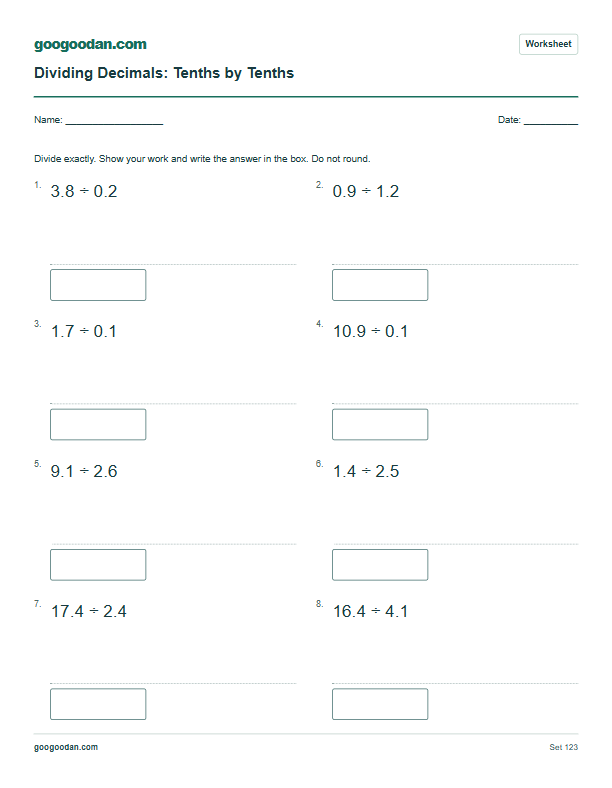 Calculation practice
Dividing Decimals Worksheets – Tenths by Tenths
Scale both numbers together, divide exactly, and check with multiplication.
8 problems · Answer key included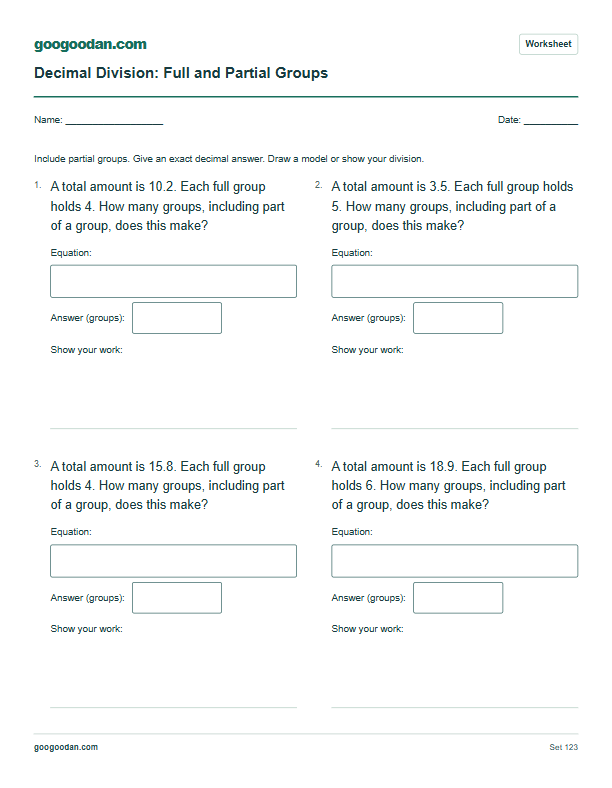 Word problems
Dividing Decimals by Whole Numbers Word Problems
Measure how many full and partial groups fit in a decimal amount. Use exact decimal quotients and a multiplication check.
4 problems · Answer key included
More about division · Grade 5 worksheets
Grade 5 selected skill connection: 5.NBT.B.7 (selected measuring-group division through hundredths; non-whole decimal divisors below and above one; exact non-whole quotients). See the Common Core grade guidance. This worksheet does not cover every requirement in the standard.