
Counting Square Units Area Worksheets
Area tells how much surface a shape covers. Count the equal squares inside the shape, not the lines around it.
One square is one square unit
Imagine covering a tabletop with equal square tiles. If the tiles leave no gaps and do not overlap, their total number tells how many square units the surface covers. In these grids, every small tile represents one square unit.
3 rows of 4 squares cover 12 square units.
Count each square once, or add the rows: 4 + 4 + 4 = 12.
Count spaces, not grid lines
Point inside a square as you count it. The boundary lines separate tiles; they are not extra tiles. Work across one row, then move to the next row so you do not skip or count a square twice.
Use equal rows
Each row of a rectangular grid has the same number of squares. Once you know there are four squares in one row and three rows, you can use 3 × 4 = 12. Explain what each factor counts before relying on the multiplication fact.
One row still has area
A single row of five square tiles covers five square units. A single tile covers one square unit. A grid does not need several rows to have area.
Keep the unit with the answer
Write “12 square units” for the three-by-four grid. The worksheet supplies the unit beside the answer box. A length around the outside would be a perimeter in units, which answers a different question.
Changing the arrangement
Arrange twelve physical square tiles in three rows of four, then in two rows of six. Both arrangements cover twelve square units when there are no gaps or overlaps. The boundary can change even though the number of tiles stays the same.
About this practice
Each set has six distinct rectangular grids with one to five rows and one to five columns. All tiles are whole squares. Count them or use equal rows; the answer key gives the total area. Use the working space to show a repeated sum or multiplication equation.
The drawings may appear at different sizes on different screens. Each displayed tile still represents one square unit; do not measure it with a ruler. Partial squares, irregular shapes, and unknown side lengths are not included.
Make a practice set
Choose what to print. Selecting both shows the answer key on screen and prints the questions followed by the answers.
After the practice
Ask the child to explain one answer by counting and then by equal rows. Have them name what the rows and squares per row represent in their equation.
 Picture activity
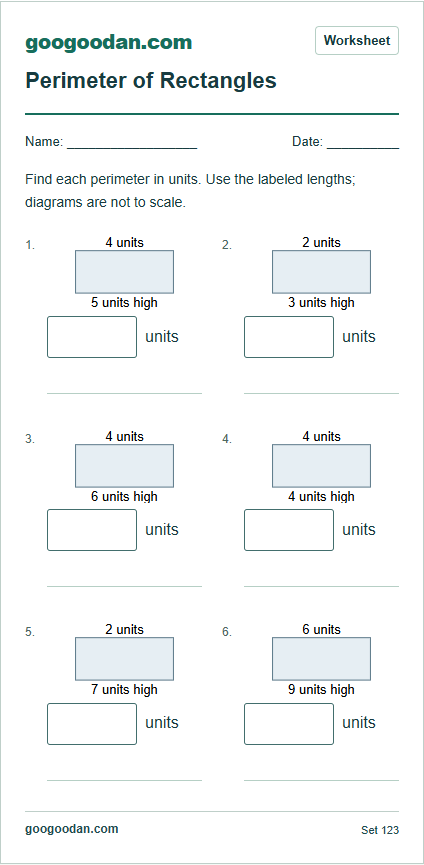
Rectangle Perimeter Worksheets
Use labeled side lengths to find the distance around a rectangle.
6 problems · Answer key included
More about measurement · Grade 3 worksheets
Grade 3 selected skill connection: 3.MD.C.5–6. See the Common Core grade guidance. This worksheet does not cover every requirement in the standard.