
Unit Conversion Worksheets: Smaller to Larger Units
Explain why a larger unit requires a smaller count for the same measurement.
Teaching notes for parents and teachers
How to teach it
Compare the given unit sizes before converting. Use a concrete example to show the measured quantity staying fixed.
Ask your student
How many of the smaller units fit in one larger unit?
If your student needs help
If the answer grows when it should shrink, return to the unit relationship and estimate its size.
Choosing and using the worksheet
Each set has one question for each of the four unit pairs. The original problems have whole-number answers from 2 to 9. They do not include decimal answers such as 5 cm = 0.05 m, mixed units, or multi-step stories.
Make a practice set
Select the worksheet, answer key, or both. When both are selected, the answer key prints after the questions. Keep it separate if you want your student to work independently.
After your student finishes
Reverse one answer to recover the starting amount. Explain why the number changes while the measured quantity stays the same.
 Calculation practice
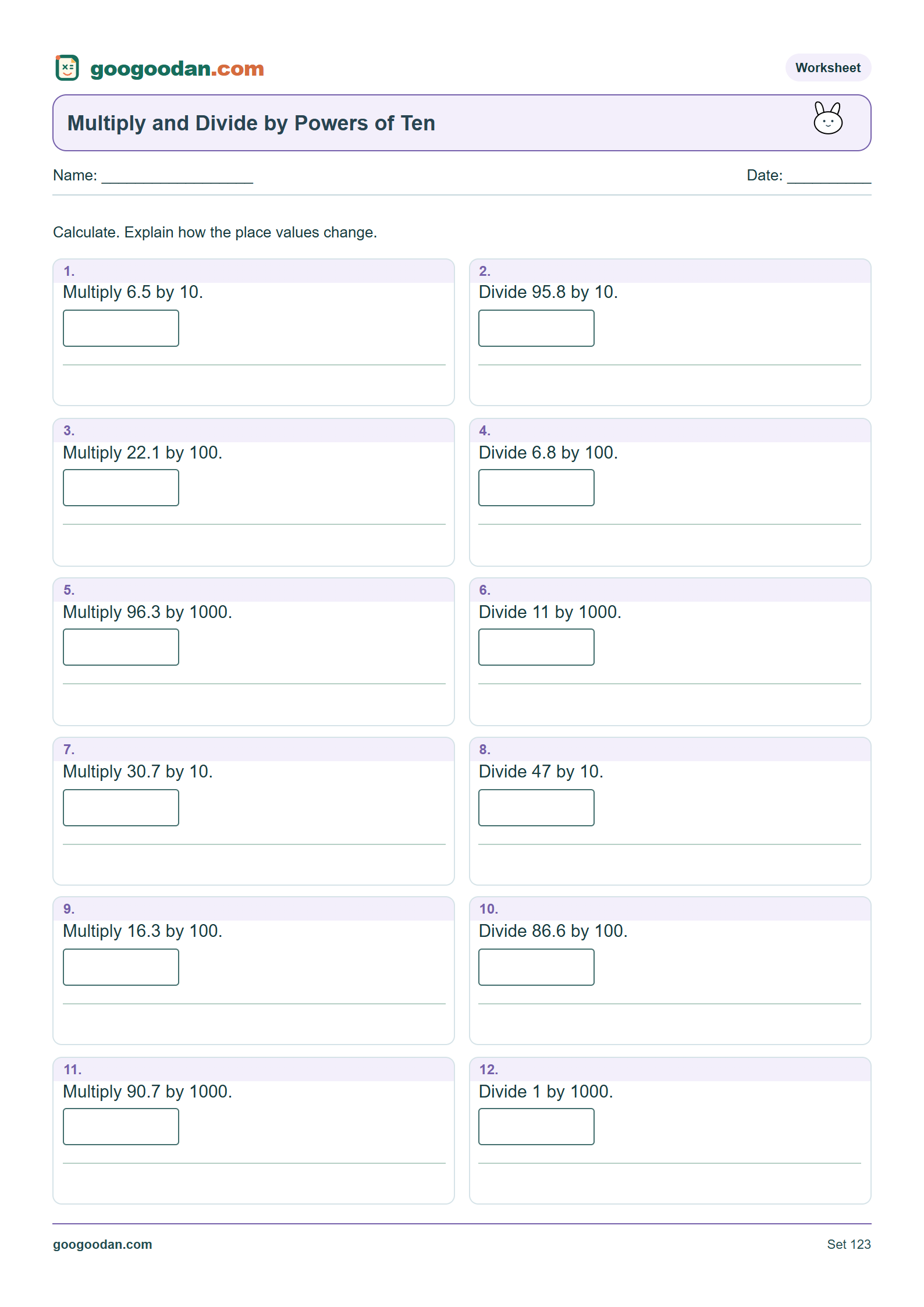
Multiply and Divide by 10, 100, and 1,000
Explain place-value changes when multiplying and dividing by powers of ten.
6 problems · Answer key included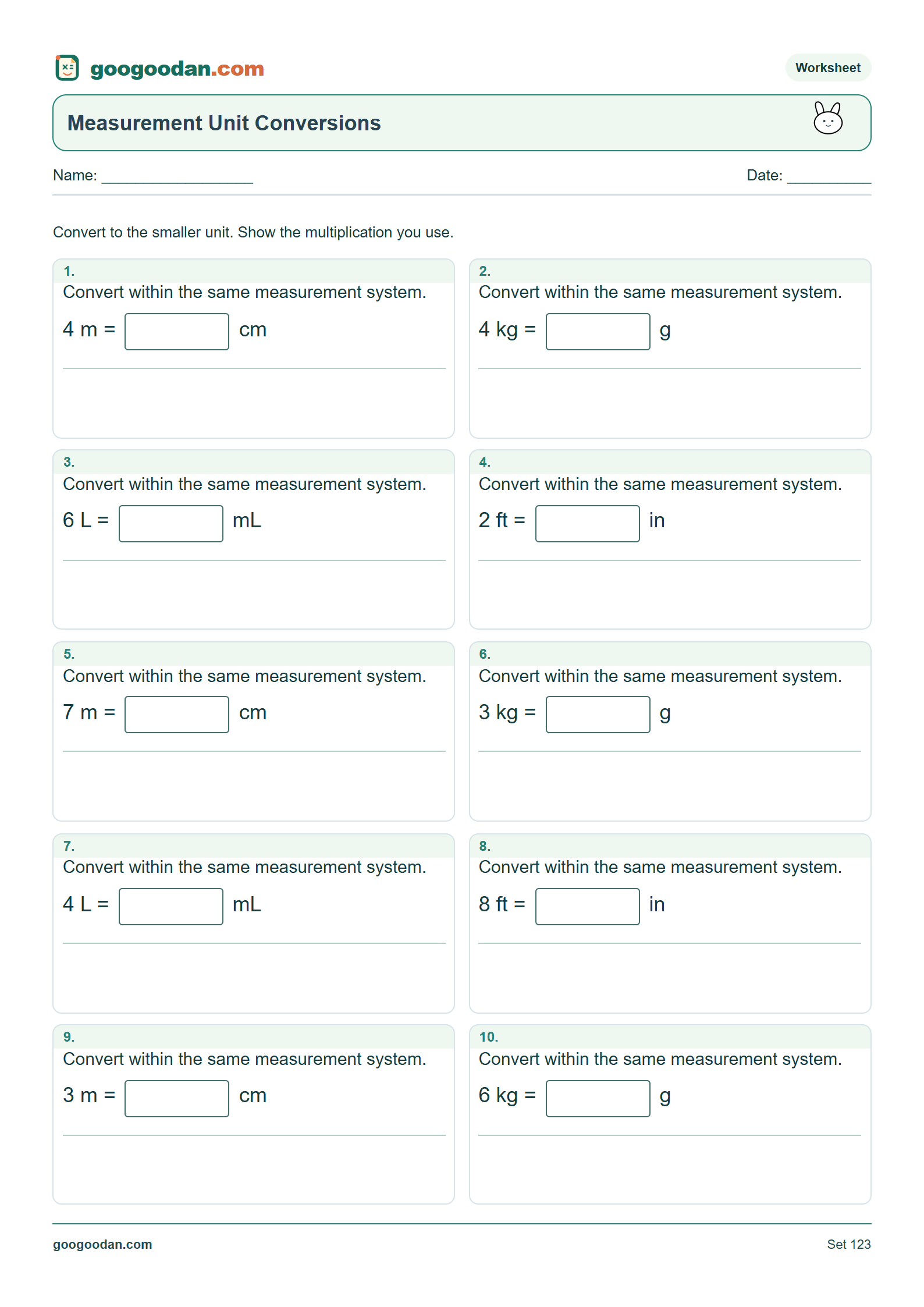 Calculation practice
Measurement Unit Conversions
Convert four larger units to smaller units within the same system.
4 problems · Answer key included
More about measurement · Grade 5 worksheets
Grade 5 selected skill connection: 5.MD.A.1. See the Common Core standards for this grade. This worksheet does not cover every requirement in the standard.