
Comparing Decimals Worksheets Through Thousandths
Compare the values of decimals, even when they have different numbers of digits. Use matching place values to decide which number is greater.
Compare matching places, not the number of digits
When decimals describe amounts, the amounts must refer to the same-sized whole. Eight tenths of one whole and seventy-five hundredths of an equal-sized whole can be compared directly. Writing more decimal digits does not automatically make an amount larger.
Why 0.8 is greater than 0.75
Write 0.8 as 0.800 and 0.75 as 0.750. Adding zeros at the end of a decimal does not change its value. Both numbers have 0 ones, so compare the tenths first.
| Place | 0.800 | 0.750 |
|---|---|---|
| Ones | 0 | 0 |
| Tenths | 8 | 7 |
| Hundredths | 0 | 5 |
| Thousandths | 0 | 0 |
The first different place is tenths: 8 tenths is greater than 7 tenths. Therefore, 0.8 > 0.75. The 5 hundredths cannot make up the difference of 1 tenth.
A comparison routine
- Align the decimal points. You may add trailing zeros to make matching places easier to see.
- Compare the whole-number parts first.
- If those are equal, move right through tenths, hundredths, and thousandths. Stop at the first different place.
- Write the comparison symbol. If every matching place is equal, use =.
For 0.406 < 0.46, think of 0.406 and 0.460. The ones match, and both have 4 tenths. At the hundredths place, 0 is less than 6. You can decide there; the 6 thousandths in 0.406 does not reverse the comparison.
Equal values can look different
0.5 = 0.500: 5 tenths and 500 thousandths describe the same amount. A trailing zero changes the way a decimal is written, not its value. A zero between digits is different: removing the zero in 0.406 gives 0.46 and changes the value.
Read the symbol aloud
The open side faces the greater number. Read 0.8 > 0.75 as “eight tenths is greater than seventy-five hundredths.” Read 0.406 < 0.46 as “four hundred six thousandths is less than forty-six hundredths.” The equals sign means the two values are the same.
What is in this set?
The six numerical comparisons use values from 0.001 through 3, with up to three decimal places. The original problem bank supplies the numbers and answers; trailing zeros are omitted from the displayed numbers. An individual set does not guarantee an equal pair. The examples above teach comparison and equivalent decimal notation; they are explanations, not additional generated worksheet questions.
This Grade 5 practice supports comparing decimals through thousandths in 5.NBT.A.3b. Ask the child to explain a comparison using place value. The six symbol answers alone do not assess every part of the standard.
Make a practice set
Choose what to print. Selecting both shows the answer key on screen and prints the questions followed by the answers.
After the practice
Choose one comparison and explain the first place where the numbers differ. For an equal pair, explain why adding trailing zeros leaves the value unchanged. Return to identifying decimal places if matching columns is difficult.
 Calculation practice
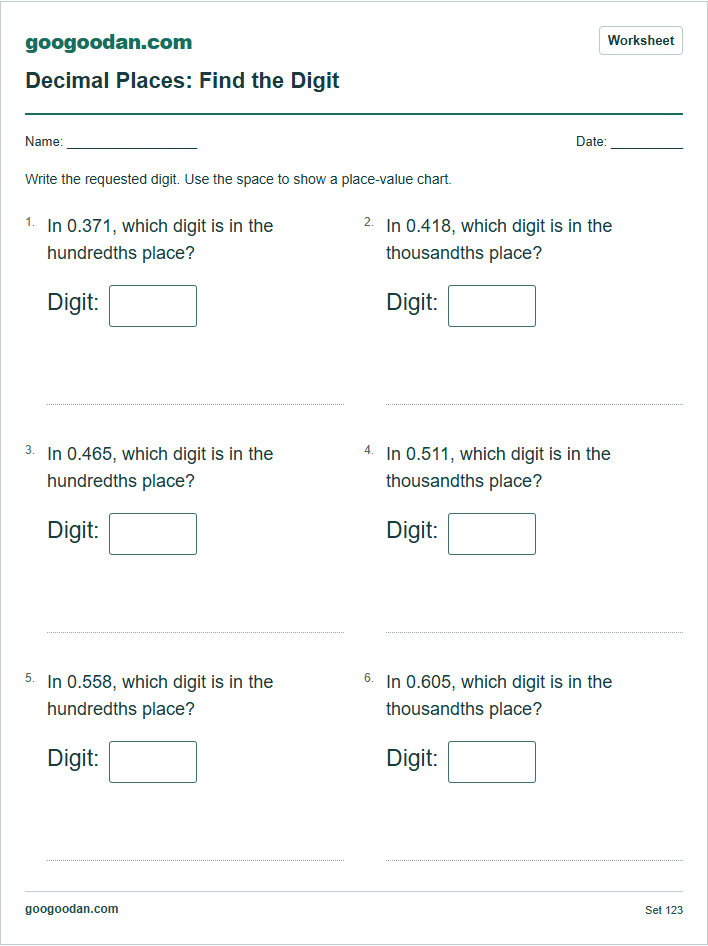
Decimal Place Value: Find the Digit
Identify the tenths, hundredths, or thousandths digit, including zero.
6 problems · Answer key included
More about numbers · Grade 5 worksheets
Grade 5 selected skill connection: 5.NBT.A.3b. See the Common Core grade guidance. This worksheet does not cover every requirement in the standard.