
Halves, Thirds, and Fourths Rectangle Worksheets
Make equal-area parts, then shade one. A fraction label and a correctly partitioned drawing should tell the same story.
Equal parts must have equal area
A rectangle cut into two pieces does not always show halves. Each piece must cover the same amount of the rectangle. Draw a line halfway across a paper rectangle, fold to compare the pieces, and discuss whether they match.
Name one part
Two equal parts make halves: one part is one half, written 1/2. Three equal parts make thirds: one is one third, written 1/3. Four equal parts make fourths, also called quarters: one is one fourth, written 1/4. Read these names aloud before writing the fraction.
Three equal parts need two dividing lines.
To make three equal strips, mark about one third and two thirds of the rectangle's width. Draw a straight line at each mark, then shade one strip. Count the spaces, not the lines.
Try different partitions
Four equal strips can show fourths. A line through the middle in each direction can also make four equal smaller rectangles. The worksheet does not require one particular arrangement. Check equal area and the requested number of parts.
Shade exactly one part
After checking the partition, shade one entire region. Shading two of four regions does not show the one fourth requested here. Keep the shading inside the selected region so the boundaries remain clear.
Check the drawing, not just the fraction
A written 1/3 does not prove that three equal parts were drawn. Check that the parts fill the original rectangle without gaps or overlaps, have equal areas, and that exactly one is shaded. Small drawing inaccuracies are an opportunity to compare and adjust, rather than to dismiss the child's understanding.
About these three activities
Each sheet asks for halves, thirds, and fourths once, using the same original rectangle shape. The answer key gives checking guidance rather than a single completed drawing, because more than one partition can be correct. New numbers does not change these three fixed tasks.
This practice uses rectangles only. It does not assess circles or all ways that differently shaped pieces can have equal area. The fraction labels support naming the parts; fraction arithmetic is not required.
Make a practice set
Choose what to print. Selecting both shows the answer key on screen and prints the questions followed by the answers.
After the practice
Ask how the child checked equal areas. Accept different valid partitions and read each fraction name aloud.
 Picture activity
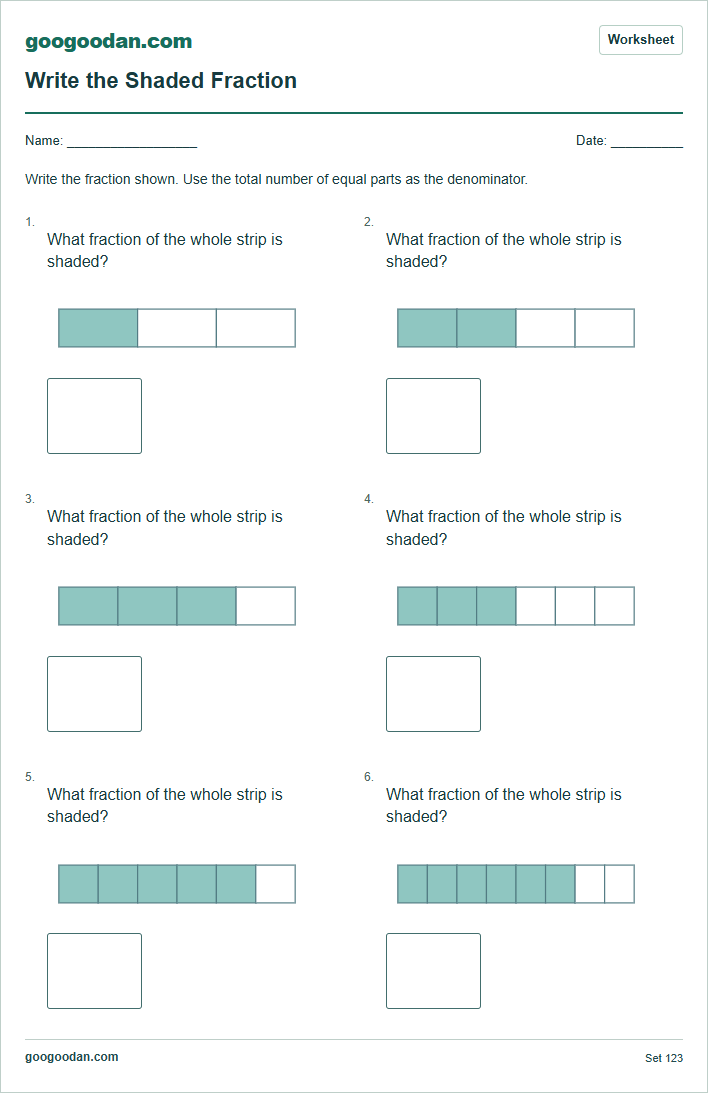
Write Fractions From Shaded Parts
Count all equal parts, then the shaded parts, to name the fraction shown.
6 problems · Answer key included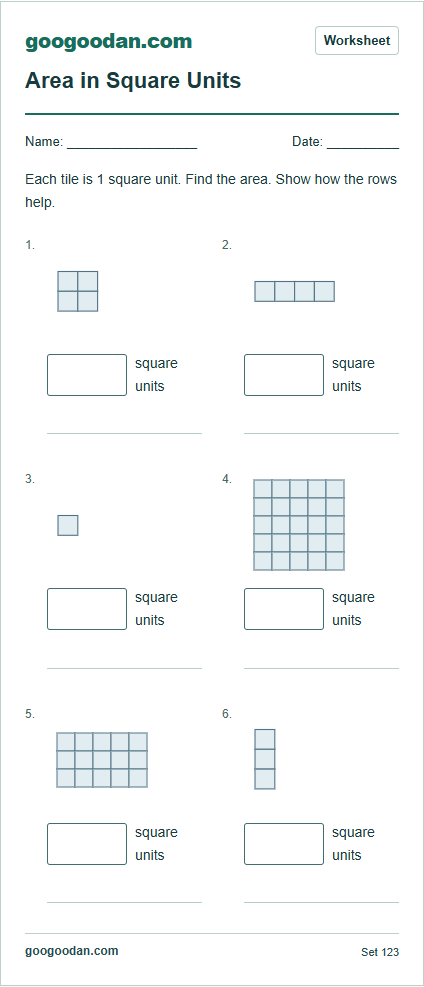 Picture activity
Counting Square Units: Area
Count equal square tiles and use rows to find area.
6 problems · Answer key included
More about shapes · Grade 2 worksheets
Grade 2 selected skill connection: 2.G.A.3. See the Common Core grade guidance. This worksheet does not cover every requirement in the standard.