
Ordinal Number Worksheets for Kindergarten — First to Eighth
An ordinal number tells where an object is in a line. Start at the left edge and circle just the picture in the requested position.
Third means a place in line, not three pictures
Maya lines up six toy animals. Her dad asks her to point to the third animal from the left. She puts a finger on three animals together. She has counted three objects correctly, but the question is asking for one animal in a particular place.
Touch the leftmost animal and say “first.” Move to the next and say “second,” then to the next and say “third.” Leave a finger on that one animal. It is the third animal even though six animals are in the whole line.
On this worksheet, “Circle the third picture” means draw one circle around the picture in position 3. It does not mean circle any three pictures.
Choose the starting end before you count
Every printed direction says “from the left.” The Start here cue and right-pointing arrow mark the beginning. Have the child point to the first picture before trying to find the requested place. Then move one picture at a time toward the right.
If an adult sits across the table, turn the page so you both look at it in the same direction. Point to the page’s left edge instead of assuming you are using the same viewpoint. The worksheet does not ask the child to switch between counting from the left and from the right.
Use ordinal words with one movement per picture
Read the direction aloud when needed. First, second, and third sound quite different from one, two, and three. A child who understands the counting may still need help learning those words. You can say “third means the picture in place three” and demonstrate with counters.
Continue with fourth, fifth, sixth, seventh, and eighth as the rows get longer. Say each word while touching one picture, rather than saying several words while a finger stays in one place. Stop at the requested position and circle that picture only.
The end of the row is not always the answer
Some questions ask for the first picture, others for a middle position, and some for the last picture. Do not teach the child to look only at the two ends. A row of four has a fourth picture at the end; in a row of eight, the fourth picture has four more pictures after it.
The pictures within each row have the same appearance so that color or character does not give away the answer. What matters is the place, not which animal or object the child likes best. Keep the printed row in its original order while checking.
Practice with a short line of real objects
Put four blocks in a line. Choose the same starting end each time and ask for the first, second, or fourth block. Let the child point before drawing any marks. Once that feels comfortable, add more blocks and ask for a position in the middle.
Take turns giving directions. When the child asks you to point to the second block, choose a wrong place on purpose and invite them to explain how to find the correct one. Keep the explanation about the starting end and the order of objects, rather than treating a mistaken word as a failure to count.
Print, circle, and check the position
Each free worksheet has four rows with four to eight pictures per row. The requested positions range from first through eighth across generated sets; a position never goes beyond the end of its row. Repeated position words can occur with different pictures or different row lengths.
The matching answer key circles exactly one picture in red in each row. Unlike a task that says to circle any three objects, this activity has one correct position for each direction. A spoken answer or a finger placed on the correct picture is also a useful way to check understanding if drawing a circle is difficult.
On a narrow screen, slide the picture row sideways to see its far end. The row stays on one line so its left-to-right order remains clear. Printing shows the full row on the page. This is a supporting position activity, not a complete kindergarten counting curriculum.
Make a practice set
Choose what to print. Selecting both shows the answer key on screen and prints the questions followed by the answers.
After the practice
Check where the child started and which one picture was selected. Read the direction aloud when ordinal words are new.
 Picture activity
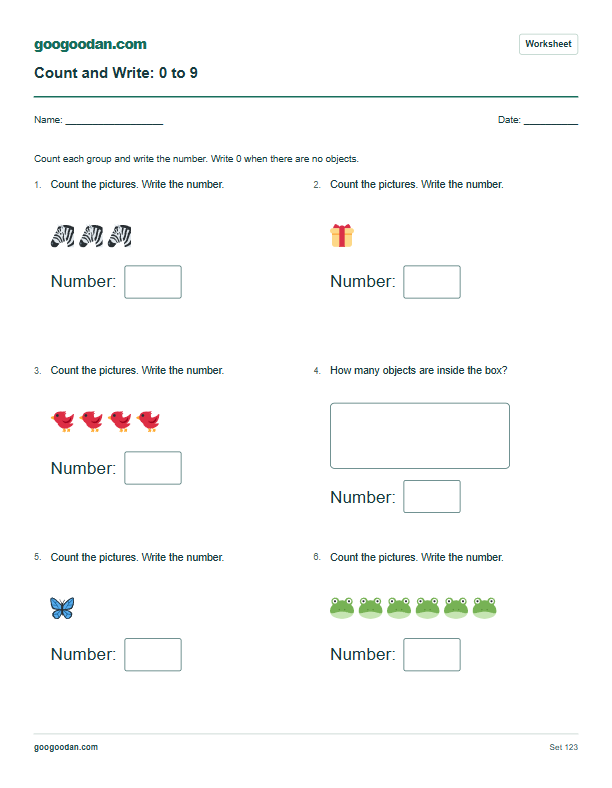
Count and Write Worksheets for Kindergarten
Count picture groups from 1 to 9 and write 0 for an empty group. Touch each object once and record the total.
6 problems · Answer key included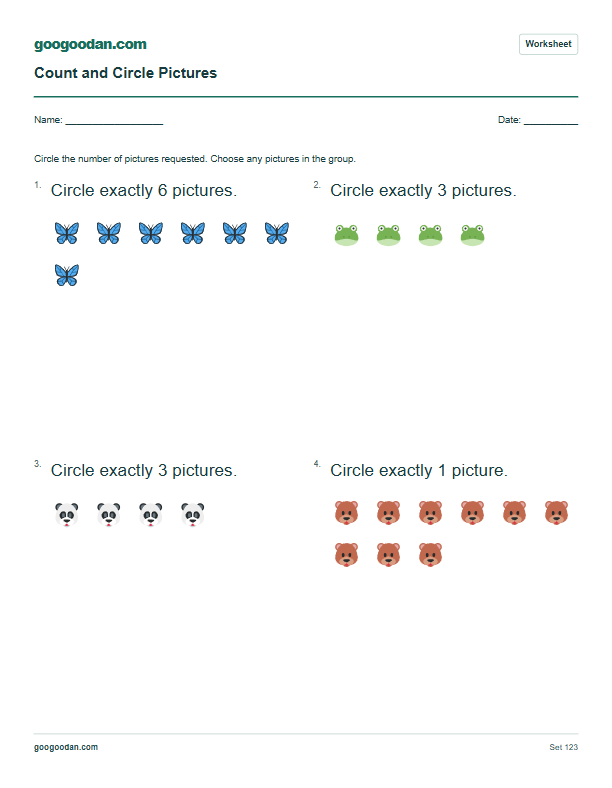 Picture activity
Count and Circle Worksheets for Kindergarten
Circle a requested number of pictures. Any selection with the right count is correct.
4 problems · Answer key included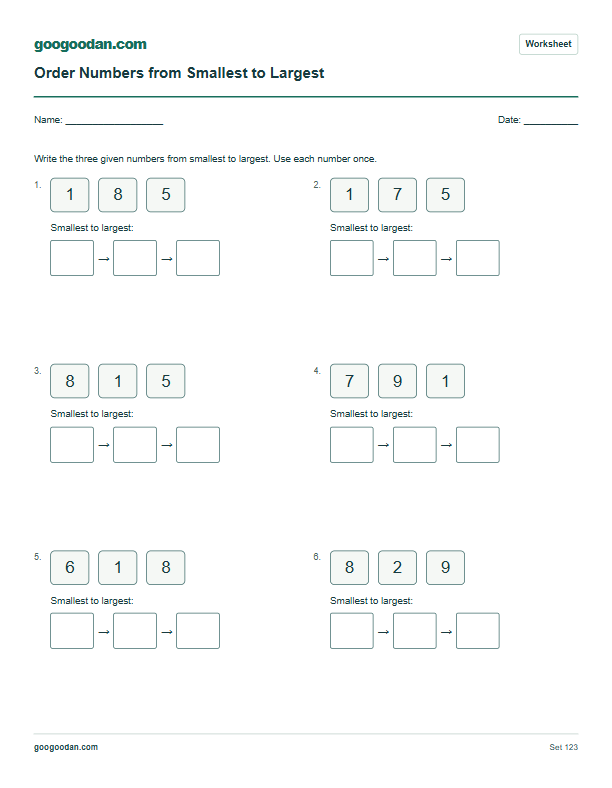 Number card activity
Ordering Numbers Worksheets for Kindergarten
Put three different numbers from 1–9 in order from smallest to largest. Use counters or number cards for support.
6 problems · Answer key included
More about numbers · Kindergarten worksheets
Kindergarten selected skill connection: Enrichment: ordinal position from the left (first through eighth); not a separate Common Core Kindergarten requirement. See the Common Core grade guidance. This worksheet does not cover every requirement in the standard.