
Comparing Fractions Worksheets With Unlike Denominators
Different denominators name different-sized parts. Use equivalent fractions or a benchmark to compare the amounts fairly.
Compare parts of the same-sized whole
Before comparing fractions, make sure the wholes are the same size. Half of a large sheet and half of a small sheet are not equal areas, even though each is one half of its own whole. On this worksheet, compare every pair as fractions of the same-sized whole.
Rename the fractions in equal-sized parts
Compare 2/3 and 3/4 by using twelfths. Divide each third into four equal parts to get 2/3 = 8/12. Divide each fourth into three equal parts to get 3/4 = 9/12. Nine twelfths is greater than eight twelfths, so 2/3 < 3/4.
2/3 = 8/12 and 3/4 = 9/12
Renaming changes the number and size of the pieces together. It does not change the amount of the whole represented by either fraction.
Use one half when it helps
For 1/3 and 5/8, one third is less than one half and five eighths is greater than one half. That places 1/3 below 5/8 without first finding a common denominator. Explain why each fraction is on its side of the benchmark.
Different names can mean equal amounts
Two fourths and three sixths both equal one half, so 2/4 = 3/6. Do not assume different denominators always mean different values. Fractions such as 3/3 and 8/8 also match because each represents one whole.
Record and explain the comparison
Write >, <, or = in the box. Then use the space below for equivalent fractions, a benchmark explanation, or a drawing of equal-sized wholes. Read the comparison from left to right to check the symbol.
About these six questions
Every pair has different denominators chosen from 2, 3, 4, 6, and 8. Fractions are greater than zero and no greater than one. Original fraction forms are retained, so an amount may appear as an unreduced fraction or as a fraction equal to one.
Each set has six distinct ordered pairs. Equality is possible but not guaranteed in every set. Mixed numbers, zero, and fractions greater than one are outside this practice. The answer key supplies the comparison sign; an adult can review the child's explanation separately.
Make a practice set
Choose what to print. Selecting both shows the answer key on screen and prints the questions followed by the answers.
After the practice
Ask how the explanation shows equal-sized parts or uses a benchmark. For equal fractions, explain why the names differ but the amounts match.
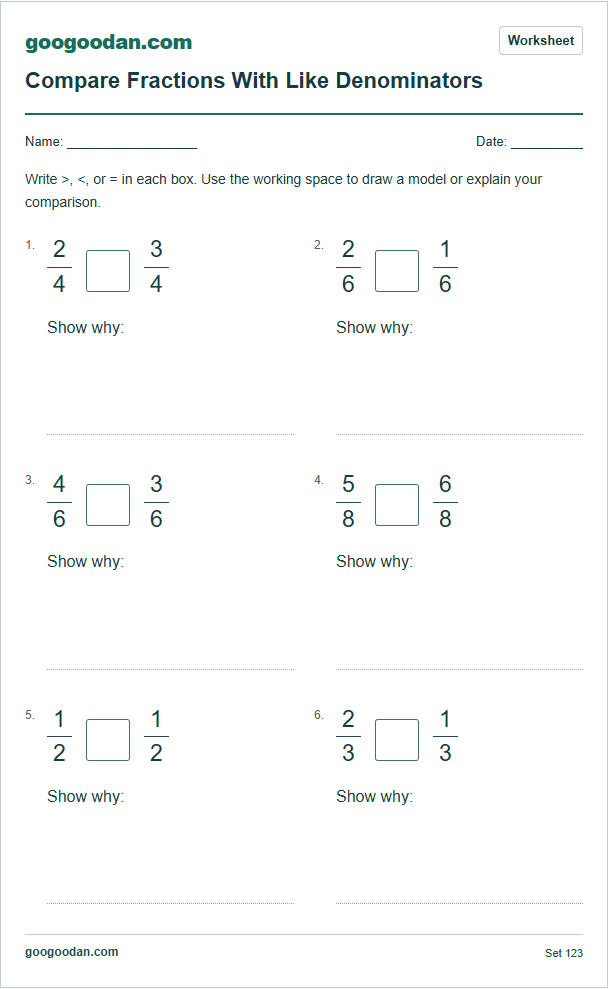 Calculation practice
Comparing Fractions With the Same Denominator
Compare equal-sized parts using >, <, or = and explain your choice.
6 problems · Answer key included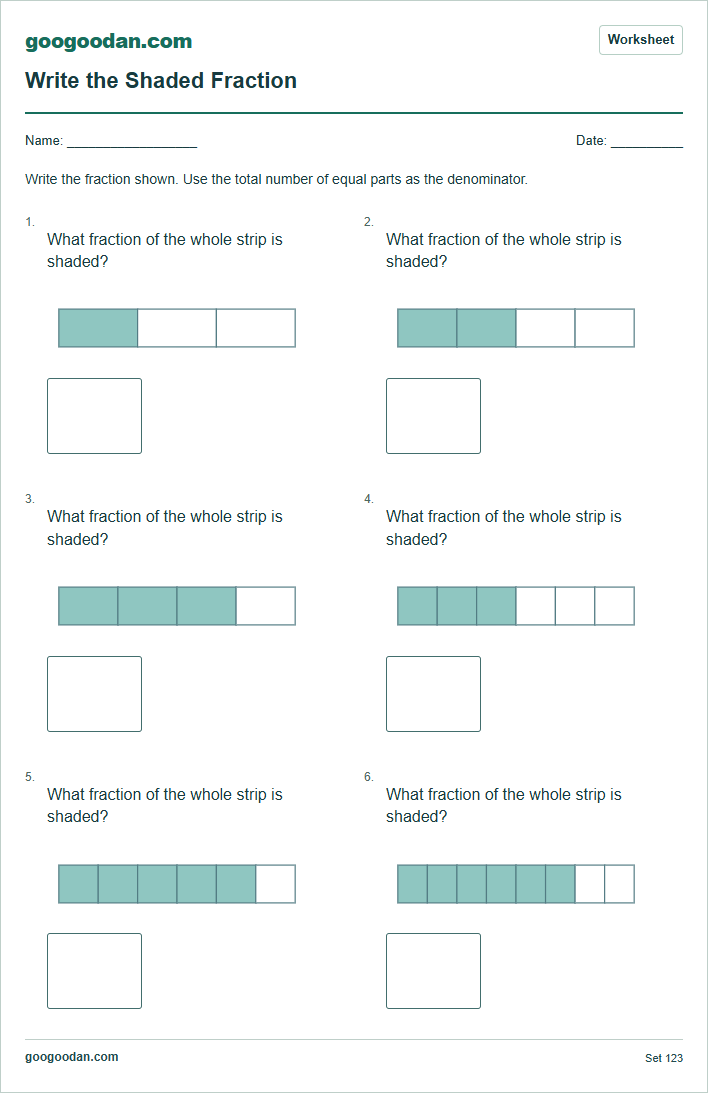 Picture activity
Write Fractions From Shaded Parts
Count all equal parts, then the shaded parts, to name the fraction shown.
6 problems · Answer key included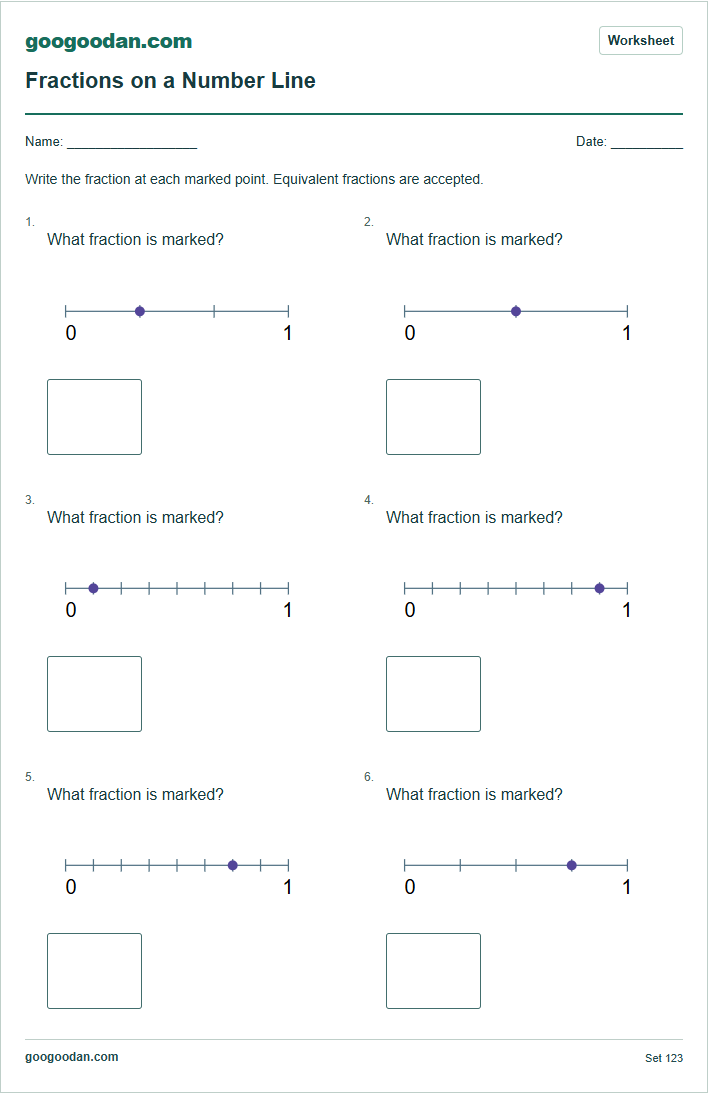 Picture activity
Fractions on a Number Line
Count equal intervals from zero to name the fraction at a marked point.
6 problems · Answer key included
More about fractions · Grade 4 worksheets
Grade 4 selected skill connection: 4.NF.A.2. See the Common Core grade guidance. This worksheet does not cover every requirement in the standard.