
Repeating Shape Patterns Worksheets for Kindergarten
Circle the first group of three shapes. Keep repeating that group in the same order, then draw the next shape in the box.
Find the small group that repeats
Mia is drawing a border for a handmade card. She draws a circle, another circle, and a triangle, then repeats the same three shapes. Near the end of the row, she wants to add a square because she likes squares. Her father asks, “Would that keep the same group going?” Mia looks back at the beginning and traces the group she has been repeating.
Read this group aloud: circle, circle, triangle. Repeat it: circle, circle, triangle. After those two complete groups, the next shape is a circle because a new copy of the group begins.
The other pattern on these pages repeats circle, triangle, square. After a circle and triangle at the end of a row, the square completes that group. Always check where the row stops before choosing the next shape.
What ABC and AAB mean
The letters describe positions in a repeating group. ABC uses three different items in order. AAB uses the first kind twice, then a different kind. The letters are a teaching shorthand; the child does not have to write them to solve the worksheet.
For this activity, the first three pictures are the group to repeat. Every row shows that group at least twice. Circle the first three shapes together with one loop, then say them aloud while pointing to the next group. The missing picture belongs at the end of the row.
Keep the order, not just the collection
A circle, triangle, and square arranged in a different order do not continue the ABC pattern shown here. Repeating means copying the whole group in the same order. Ask the child to point to the first, second, and third places, then start again at the first place.
In an AAB pattern, two circles next to one another are intentional. Do not turn the rule into simple alternation. Chant “circle, circle, triangle” with a short pause after triangle. The pause helps make the group audible without changing any pictures.
Use movement before drawing
Try two claps and a tap, then repeat two claps and a tap. This is a physical example of the same AAB structure. Let the child say what action would come next if you pause after just one clap.
Return to the pictures and point to each shape as you speak. If the row wraps onto a new line on a small screen, continue reading left to right on the following line. The pattern does not restart because the display has wrapped.
Make room for a developing pencil grip
The answer box is large enough to sketch the next shape. A recognizable outline is enough; the child does not have to copy the solid fill of the printed symbol. Accept a spoken shape name or let an adult draw the child's choice when drawing is still difficult.
If the child gives the correct shape but draws it unevenly, ask for an explanation before marking it wrong. Pattern reasoning and drawing control are different skills. A circle can be wobbly and still represent the circle the child correctly chose.
Check the group and the stopping point
Each free printable page contains four rows: two ABC patterns and two AAB patterns. The rows use six to eight printed shapes before the answer box. The matching answer key fills only the missing shape in red, leaving the original sequence unchanged.
Read one complete row together after checking. A useful explanation is “The group repeats, and this place needs a triangle,” with a finger showing the corresponding position in an earlier group. There is no need for a long written explanation.
These are repeating-pattern enrichment activities for early learners. They are not growing number patterns, open-ended sequence puzzles, or a claim to cover a specific Common Core standard. The instruction to repeat the first three shapes makes the intended rule clear. Choose the related shape-naming activity first if the child needs help distinguishing the symbols.
Make a practice set
Choose what to print. Selecting both shows the answer key on screen and prints the questions followed by the answers.
After the practice
Ask the child to point to the repeating group and explain the next shape. Accept a recognizable drawing or a spoken shape name.
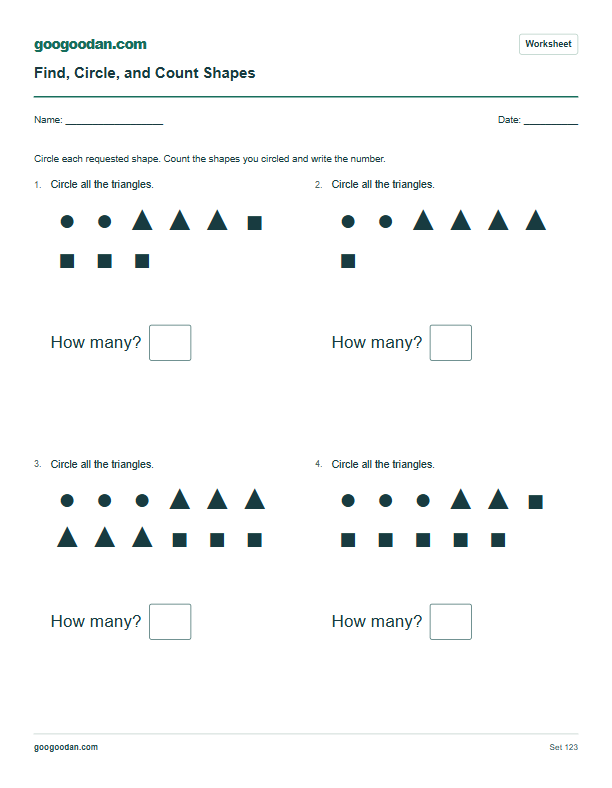 Find, circle, and count activity
Sort and Count Shapes Worksheets for Kindergarten
Circle every shape of the requested kind, then count the circles, triangles, or squares you selected.
4 problems · Answer key included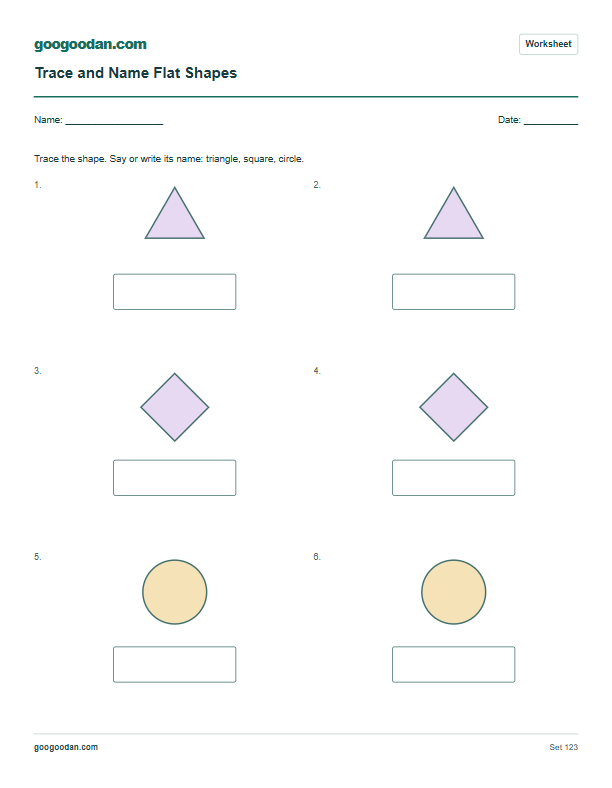 Trace and name shapes activity
2D Shape Recognition Worksheets for Kindergarten
Trace and name a triangle, square, or circle. Notice that a square is still a square when it rests on a corner.
6 problems · Answer key included
More about shapes · Kindergarten worksheets
Kindergarten selected skill connection: Enrichment: extend ABC and AAB repeating shape patterns. No specific Common Core standard claimed. See the Common Core grade guidance. This worksheet does not cover every requirement in the standard.