
Quadrilateral, Rectangle, and Square Worksheets
A shape can have more than one correct name. Use its sides and corners to explain which families it belongs to.
One shape can belong to several families
A quadrilateral is a closed, flat shape with four straight sides. A rectangle is a quadrilateral with four right angles. A square has four right angles and four equal sides, so it is both a rectangle and a quadrilateral.
Check properties instead of appearance
Trace the boundary once and count the four sides. Then compare each corner with the corner of a sheet of paper. Turning a rectangle does not change its sides or angles. A square resting on a corner is still a square.
Square → rectangle → quadrilateral
Each name in this chain includes the properties needed by the next family. A square has four right angles, which makes it a rectangle. A rectangle has four straight sides and is closed, which makes it a quadrilateral.
Explain why, not just yes
For the rectangle question, ask the child to name the property shared by all quadrilaterals: four straight sides enclosing a shape. For the square question, ask which property makes a shape a rectangle: four right angles. Equal side lengths are allowed in a rectangle; they are not a reason to exclude a square.
Draw a quadrilateral outside the rectangle family
Draw four straight sides that join to make a simple closed shape, with at least one corner that is not a right angle. An ordinary slanted parallelogram is one possible answer. Trace and count the sides, check that they meet, and explain why the shape does not have four right angles.
Accept other valid drawings. An open chain of four segments is not a quadrilateral, and a triangle does not become one by turning it. Small pencil inaccuracies should lead to a conversation about intended sides and corners.
Use the answer key as checking guidance
The key gives sample explanations and an example description for the drawing. It does not show the only possible answer or automatically grade a child's drawing. Ask the child to point to the property used in each explanation.
About these three activities
This sheet reuses three fixed original tasks: two explanations and one drawing. New numbers does not create different questions; the same tasks remain. It supports selected quadrilateral-family reasoning, not a complete shape-classification unit. Rhombus classification and sorting a varied collection of pictured shapes are not assessed here.
Make a practice set
Choose what to print. Selecting both shows the answer key on screen and prints the questions followed by the answers.
After the practice
Ask the child to give every correct family name for a square, then explain how their own drawing differs from a rectangle.
 Picture activity
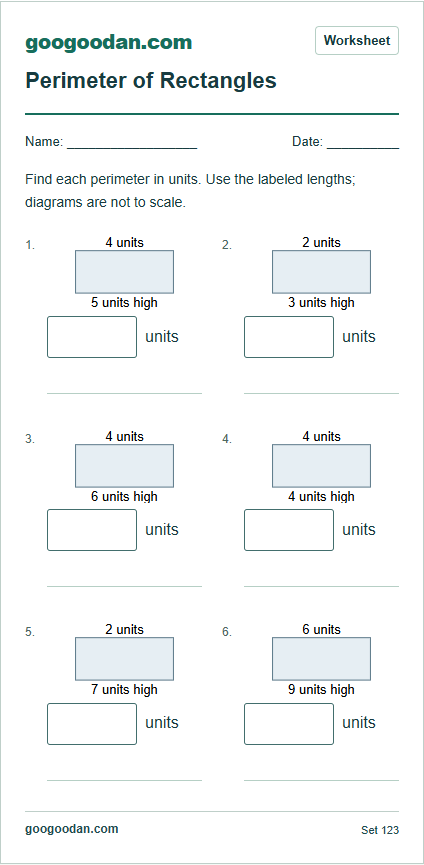
Rectangle Perimeter Worksheets
Use labeled side lengths to find the distance around a rectangle.
6 problems · Answer key included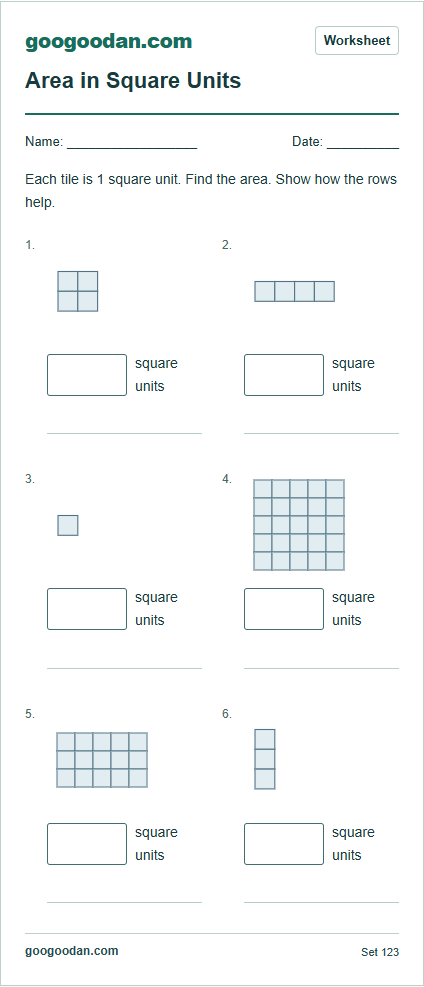 Picture activity
Counting Square Units: Area
Count equal square tiles and use rows to find area.
6 problems · Answer key included
More about shapes · Grade 3 worksheets
Grade 3 selected skill connection: 3.G.A.1. See the Common Core grade guidance. This worksheet does not cover every requirement in the standard.