
Build and Draw Shapes Worksheets
Put smaller shapes together, then show how they make a larger shape. Build first and sketch what you made.
Prepare pieces before drawing
Have two matching right triangles, two equal paper squares, and several small cube blocks ready. These worksheets provide drawing space, not cutout pieces. An adult can cut a paper rectangle along a diagonal to make two triangles that fit back together.
Two triangles can make a rectangle
Move and turn the two triangle pieces until their long diagonal edges meet. The outside boundary should form a rectangle, with no gap or overlap. Trace the outside and draw the shared diagonal so someone can see the two original parts.
Not every pair of triangles can form a rectangle. Start with the suitable pieces described above. Ask the child to show where one triangle ends and the other begins.
Join two squares
Place two equal squares edge to edge. One possible result is a longer rectangle. Draw the outside and keep the shared edge visible. Turning the pieces is allowed; check the arrangement the child actually made rather than requiring one orientation.
Build a solid with cubes
Join small cubes face to face to make a larger solid. Start with a simple row or stack that stays together. Let the child turn the model, then sketch it and explain where the cubes are.
A sketch on paper is flat, while the model is three-dimensional. Hidden cube edges do not have to appear in the sketch, and lines in a perspective drawing can overlap. Check the physical model and the child's explanation rather than treating imperfect perspective as a mathematical error.
Ask about the parts and the whole
Which pieces did you use? Where do they meet? What changed when you turned one piece? Invite the child to take the model apart and rebuild it. This connects the larger shape to its component pieces.
Check by looking and listening
The answer key gives general guidance because valid models can differ. For the first task, confirm that two triangles make a rectangle. For the second, check that two squares form the drawn shape. For the last, inspect a solid built from small cubes and ask the child to connect the sketch to the model.
About these three activities
These are three fixed original tasks. New numbers does not change them. An adult may read the directions aloud and write the child's explanation. Answers require manual review; the key is not a completed model or a single required drawing.
This practice supports selected shape-composition work. It does not provide a complete collection of plane or solid shapes, cutout templates, or an assessment of drawing skill.
Make a practice set
Choose what to print. Selecting both shows the answer key on screen and prints the questions followed by the answers.
After the practice
Take one model apart and rebuild it. Ask the child to name or point to the pieces used.
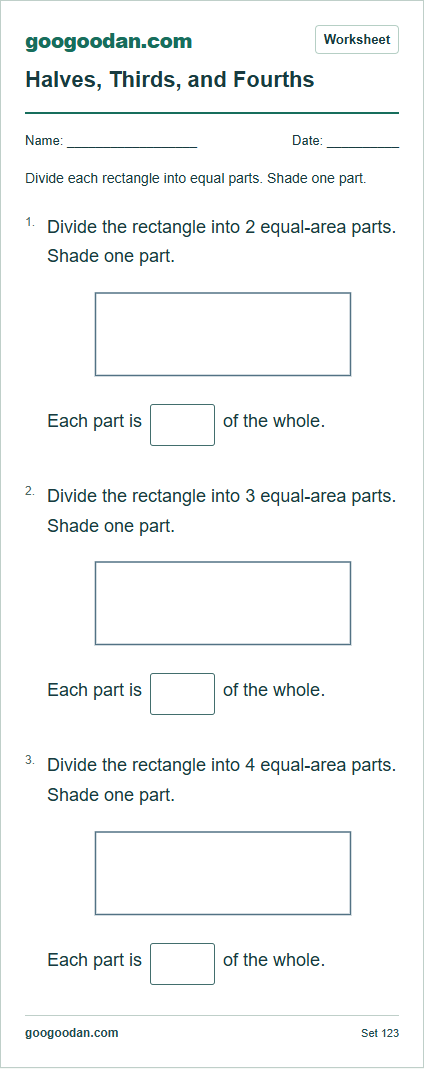 Drawing activity
Halves, Thirds, and Fourths
Divide rectangles into equal parts and shade one part.
3 problems · Answer key included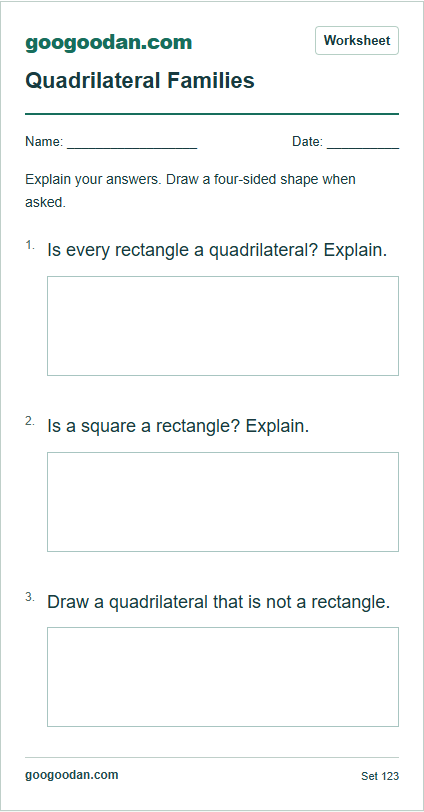 Drawing activity
Quadrilateral Families
Explain rectangle and square families, then draw a different quadrilateral.
3 problems · Answer key included
More about shapes · Grade 1 worksheets
Grade 1 selected skill connection: 1.G.A.2. See the Common Core grade guidance. This worksheet does not cover every requirement in the standard.