
Volume Worksheets: Layers of Unit Cubes
Count the cubes in one layer, then use the number of equal layers to find the whole solid’s volume.
Start with one layer
A layer has three rows of four unit cubes. That layer contains 3 × 4 = 12 cubes. If the solid has two identical layers, there are 12 + 12 = 24 cubes altogether.
3 × 4 × 2 = 24 cubic units
Rows × cubes in each row × layers counts every unit cube once.
What the flat grid represents
Each square shows the top face of one unit cube in a single layer. The grid does not show every layer stacked in perspective. Read the stated number of layers before answering. A grid with twelve squares and two layers represents twenty-four cubes, not twelve.
Why the units are cubic
A unit cube occupies space in three dimensions. Counting its top face helps locate the cube, but the answer describes the solid’s volume. Use cubic units, not square units. Square units measure a flat surface.
One layer still has volume
When the solid has one layer, the total cube count equals the count in that layer. Multiplying by one keeps the count unchanged. The answer is still in cubic units because the layer is made of cubes, not flat tiles.
Connect layers to length, width, and height
For a rectangular solid packed with unit cubes, the cubes across a row and the number of rows describe the base. The number of layers describes its height in unit-cube lengths. Multiplying the base count by the layers gives the same result as length × width × height.
Check with a repeated sum
For three layers of ten cubes, write 10 + 10 + 10 = 30. Compare that with 10 × 3 = 30. This check shows what the layer multiplier counts instead of treating the formula as a rule to memorize.
About this practice
Each worksheet contains four original problems. Every prompt states the number of layers and the rows and cubes per row; its grid shows one matching layer. Solids have one to four equal layers. Use the working space to show cubes in one layer and the total across all layers.
The answer key gives total volume. These are fully filled rectangular layers with no gaps. The activity does not ask children to infer hidden cubes from a three-dimensional drawing, calculate surface area, or combine different prisms.
Make a practice set
Choose what to print. Selecting both shows the answer key on screen and prints the questions followed by the answers.
After the practice
Ask the child what each factor counts and why the answer uses cubic units. Compare a one-layer model with a model made from two identical layers.
 Picture activity
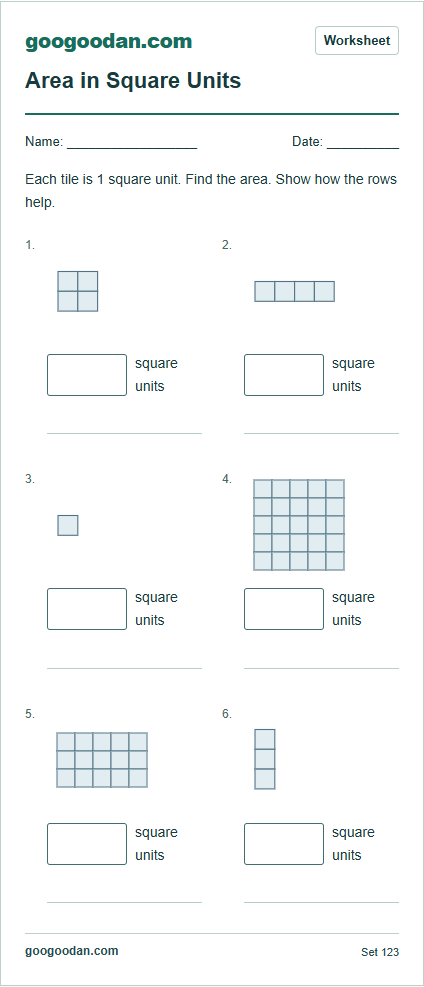
Counting Square Units: Area
Count equal square tiles and use rows to find area.
6 problems · Answer key included
More about measurement · Grade 5 worksheets
Grade 5 selected skill connection: 5.MD.C.3–5. See the Common Core grade guidance. This worksheet does not cover every requirement in the standard.