
Lines, Rays, and Line Segments Worksheets
Look at direction and endpoints. A drawn stroke can represent part of a line that continues beyond the page.
Use endpoints and arrows to show what continues
A line continues in both directions. Draw a straight stroke with an arrow at each end to represent it. A ray has one endpoint and continues in one direction, so give it one endpoint and one arrow. A line segment has two endpoints and does not continue beyond them.
Line: two arrows.
Ray: one endpoint and one arrow.
Segment: two endpoints.
The arrows mean the figure continues. They do not mean that the line stops at the arrow tip. Label each of your three drawings with its name.
Parallel lines never meet
Two distinct lines in the same plane are parallel when they remain the same distance apart and never meet, even if extended. The first original diagram shows two horizontal portions of such lines.
Perpendicular lines meet at right angles
The second diagram shows a horizontal line meeting a vertical line. They form four right angles. Compare one angle with the corner of a sheet of paper. Lines that cross are not always perpendicular; the right angle is the deciding property.
Read the original diagrams carefully
The two supplied diagrams use finite strokes without arrowheads. In these questions the strokes represent visible portions of lines. Imagine extending them in both directions. When drawing your own line and ray in the final task, include the arrows requested by the definitions.
Check all three drawings
Check that each stroke is straight and that the arrows and endpoints match the label. A ray should have exactly one endpoint. A segment needs two endpoints. Allow any direction or reasonable length; a vertical or slanted segment is still a segment.
About these three activities
This sheet reuses three fixed tasks: a parallel example, a perpendicular example, and a drawing task. Both example answers are Yes. New numbers does not supply different examples or negative cases.
The answer key gives drawing guidance rather than completed figures. An adult must check the child's drawings and labels. These selected tasks do not establish mastery across varied or rotated line pairs and do not assess angle measurement.
Make a practice set
Choose what to print. Selecting both shows the answer key on screen and prints the questions followed by the answers.
After the practice
Ask the child to point to an endpoint and explain how an arrow changes the meaning of a drawing.
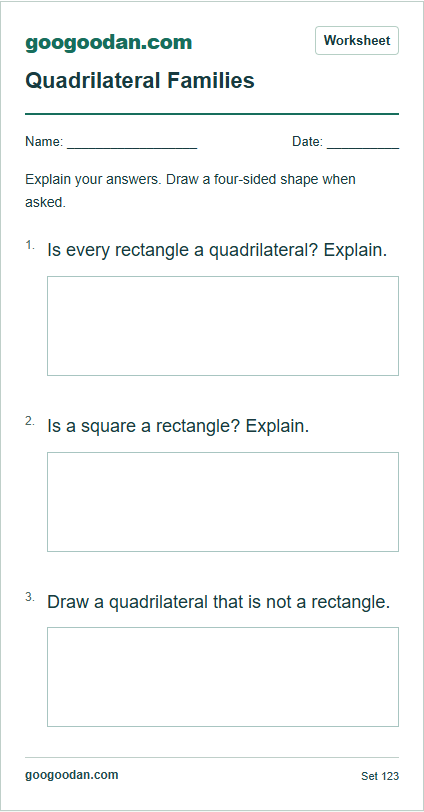 Drawing activity
Quadrilateral Families
Explain rectangle and square families, then draw a different quadrilateral.
3 problems · Answer key included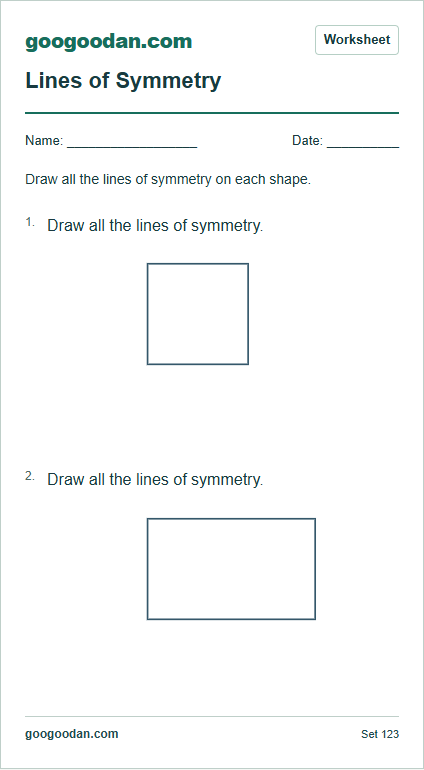 Drawing activity
Square and Rectangle Symmetry
Draw all symmetry lines on two original shapes.
2 problems · Answer key included
More about shapes · Grade 4 worksheets
Grade 4 selected skill connection: 4.G.A.1. See the Common Core grade guidance. This worksheet does not cover every requirement in the standard.