Times Tables: 1 to 10 Practice Worksheets
Pick one table to practice or choose the mixed sheet. Each section below links to a printable sheet for that table, with a short tip for learning it. New Numbers shuffles the questions, so the same table can be practiced many times.
Open a sheet, choose Worksheet or Answer Key, then print on Letter paper. Short daily sessions work better than one long one: ten minutes on a single table is plenty.
Jump to a table: 1× · 2× · 3× · 4× · 5× · 6× · 7× · 8× · 9× · 10×
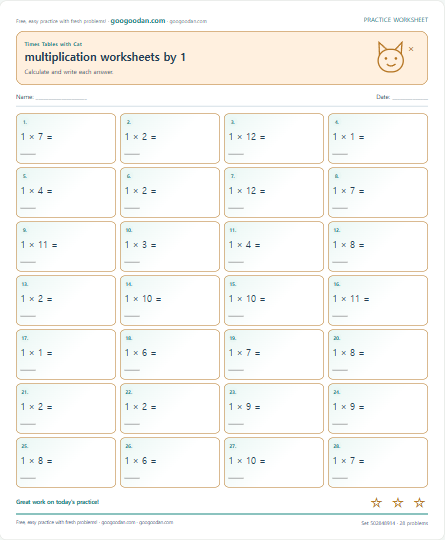
1 Times Table Worksheets
Every answer matches the number you multiply by, so this is a gentle first table.
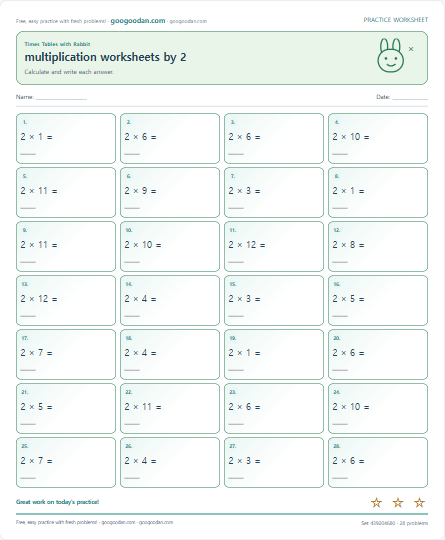
2 Times Table Worksheets
Doubling: each answer is 2 more than the one before, and every answer is even.
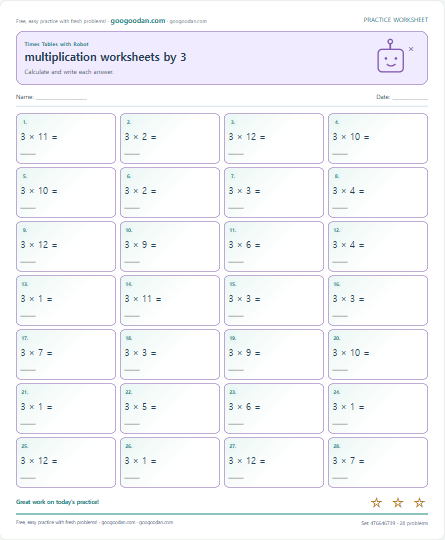
3 Times Table Worksheets
Count in threes: 3, 6, 9, 12. For answers up to 30, the digits add up to 3, 6 or 9.
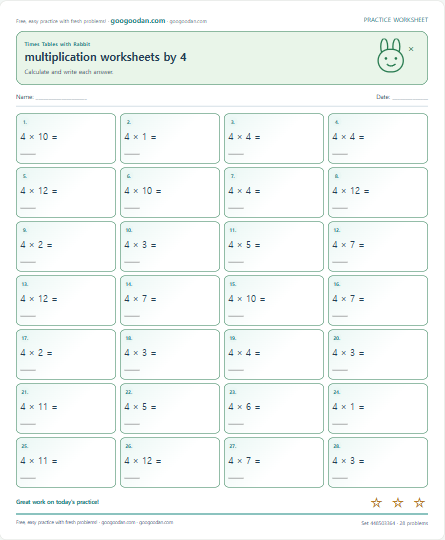
4 Times Table Worksheets
Double the 2 times table, or double a number and then double it again.
5 Times Table Worksheets
Answers end in 5 or 0, so skip counting 5, 10, 15, 20 helps.
6 Times Table Worksheets
Start from the 5 times table and add one more group: 6 × 7 is 5 × 7 plus 7.
7 Times Table Worksheets
Often the hardest table. Practice in short bursts and build from facts you know, such as 7 × 5 = 35.
8 Times Table Worksheets
Double the 4 times table, then double again: 8 × n is the same as 2 × (4 × n). This sheet covers the 8 and 9 times tables together.
9 Times Table Worksheets
For 9 × 1 to 9 × 10, the digits of each answer add up to 9 and the tens digit is one less than the number you multiply by. This sheet covers the 8 and 9 times tables together.
10 Times Table Worksheets
Add a zero to the number you multiply by.
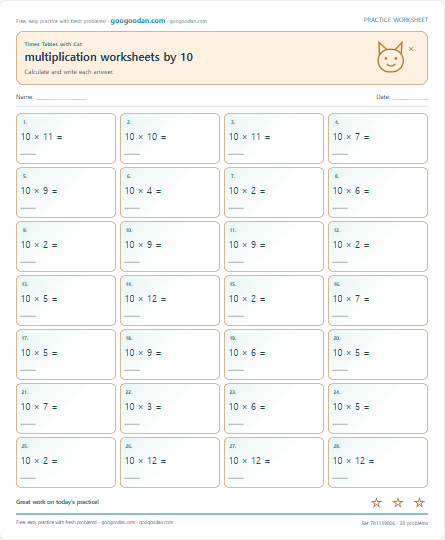
Supplementary: Mixed Times Tables Worksheets (1 to 12)
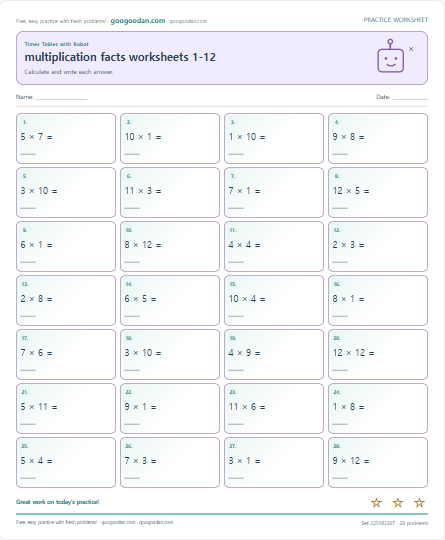
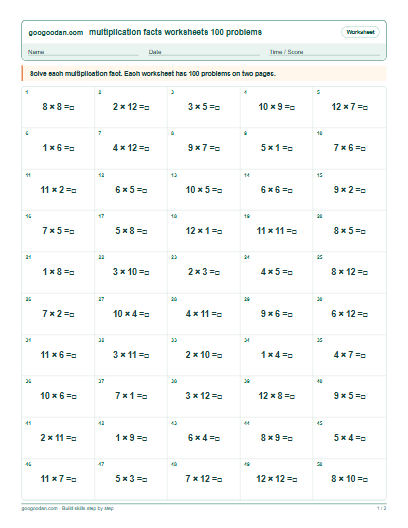
Optional mixed practice from tables 1 to 12, for an extra challenge after practicing individual tables from 1 to 10. The 100-question sheet gives a longer test.
More worksheet collections
- Free Printable Math Worksheets
- Addition and Subtraction Worksheets
- Multiplication and Division Worksheets
- Fractions and Decimals Worksheets
- Grade 3 Math Worksheets
- Shape Worksheets for Elementary Math Practice
- Measurement Worksheets for Elementary Math Practice
- Kindergarten Math Worksheets: Counting and Number Facts
Choosing multiplication table practice
Use a table worksheet to build a small, dependable set of facts before mixing many tables together. Choose a single table when the learner is still finding the products, or select a mixed page for review after several groups of facts are familiar. The worksheet title and preview show whether the task asks for a product, a missing factor or a longer sequence. Begin with a handful of questions and let the learner say how a fact connects to another one; recall becomes more reliable when there is a reason behind it.
Build a fact from a nearby one
Open a sheet and check whether the factors are presented in the expected order. Select Worksheet for practice and Answer Key for checking. New Numbers can refresh the same task once the method is clear. A learner who knows 6 x 5 = 30 can find 6 x 6 by adding one more group of six, giving 36. They can also use 3 x 6 = 18 and double it to get 6 x 6. Ask for the related fact before looking at the key. Use Letter paper for a printed practice sheet.
Connect products to division
If 7 x 8 = 56, then 56 divided by 7 is 8 and 56 divided by 8 is 7. A small array with seven rows of eight marks shows all 56 objects and can be read by rows or columns. The 9 table can be checked by noting that 9 x 6 is one less group of 10 than 60, so it equals 54. These are ways to verify a fact, not substitutes for understanding what the factors describe.
Common errors to notice
A skipped count can shift every later answer, so return to the last known product and count forward one group at a time. Multiplication is commutative, which means reversing the two factors keeps the product, but the factors still describe different roles in a story. Do not use speed as the only measure of progress. Check doubtful answers with a related division fact, and keep the answer key covered for the first attempt. Stop once attention fades and return to the same table later with a fresh set.