
5 Digit by 2 Digit Long Division Word Problems
Use written long division to track each place in a five-digit total. Keep zero digits in the quotient and explain what the full groups and leftover amount mean.
Every quotient digit has a place
Sofia is organizing 24,085 counters into full groups of 24. She notices that 24 goes into the first two digits once and later goes into 85 three times. Writing just 13 groups would lose the value of the digits between those steps. Long division keeps track of thousands, hundreds, tens, and ones, even when a quotient digit is zero.
24,085 ÷ 24 = 1,003 R 13
| Quotient place | Amount to divide | Digit | Multiply and subtract |
|---|---|---|---|
| Thousands | 24 thousands | 1 | 24 − 24 = 0 thousands |
| Hundreds | 0 hundreds | 0 | 0 − 0 = 0 hundreds |
| Tens | 8 tens | 0 | 8 − 0 = 8 tens |
| Ones | 85 ones | 3 | 85 − 72 = 13 ones |
The quotient digits are 1, 0, 0, 3. There are 1,003 full groups and 13 counters left.
How to do long division: divide, multiply, subtract, bring down
- Divide: 24 does not fit into the leading 2, so start with the first two digits, 24. Write 1 above the thousands digit, the 4 in 24,085.
- Multiply and subtract: 1 × 24 = 24. Subtract to leave zero at this place.
- Bring down: the next digit is 0. There are no hundreds left to divide, so write 0 in the hundreds place of the quotient.
- Continue in order: bring down the 8. Eight tens cannot make a full group of 24 tens, so write 0 in the tens place. Keep those eight tens and bring down the final 5 ones: 8 tens and 5 ones make 85 ones.
- Finish the last place: 24 fits into 85 three times. Multiply 3 × 24 = 72 and subtract 85 − 72 = 13. No dividend digits remain, and 13 is smaller than 24, so the calculation is finished.
The reminder DMSB stands for Divide, Multiply, Subtract, Bring down. Repeat it while digits remain. Do not bring down an extra zero after the last digit when the question asks for full groups and leftover counters; that would change the calculation to decimal division.
Why the two zeros matter
The first quotient digit represents one thousand groups, not one group. The zeros show that no additional hundreds or tens of groups fit. Omitting them gives 13 instead of 1,003. Check the size: 24 × 13 is only 312, far smaller than 24,085. In contrast, 24 × 1,000 = 24,000 is already close to the starting total.
Adjust a trial digit before moving on
For the final amount 85, a trial digit of 4 would use 24 × 4 = 96, more than the amount available. Reduce it to 3. A trial digit of 2 leaves 37, which still contains another group of 24. Increase it to 3. Multiplication provides the check; the estimate alone is not the quotient.
Work one place at a time. Align each subtraction under the amount currently being divided, then bring down only the next digit. The large space on this two-problem worksheet is for the complete written algorithm, including crossed-out trial digits and corrections.
Check both the total and the remainder
Rebuild the starting amount: 24 × 1,003 + 13 = 24,072 + 13 = 24,085. Then check 0 ≤ 13 < 24. Both checks matter. The expression 24 × 1,002 + 37 also rebuilds the total, but 37 is large enough to make another group, so 1,002 R 37 is unfinished.
Let the story decide what the quotient counts
With counters, the quotient is the number of full groups and the remainder counts individual counters. The question does not ask how many containers are needed to hold all the counters, so do not round up automatically.
For an exact division, the original bank uses cable: 24,072 feet cut into 24-foot pieces makes 1,003 pieces with 0 feet left. The printed labels change from full groups and counters left to pieces and feet left. Keep those units when explaining the answer.
Every sheet has two original stories with dividends from 10,000 to 99,999 and divisors from 10 to 99. Exact division and division with remainders are both possible. The answer key shows the equation, quotient, and remainder; it does not generate each intermediate long-division step. This selected range supports Grade 6 practice without claiming to cover every multi-digit division case.
Make a practice set
Select the worksheet, answer key, or both. When both are selected, the answer key prints after the questions. Keep it separate if you want your student to work independently.
After your student finishes
Ask the child to explain one zero in the quotient. Check divisor × quotient + remainder, then verify that the remainder is smaller than the divisor and that both answers use the story’s units.
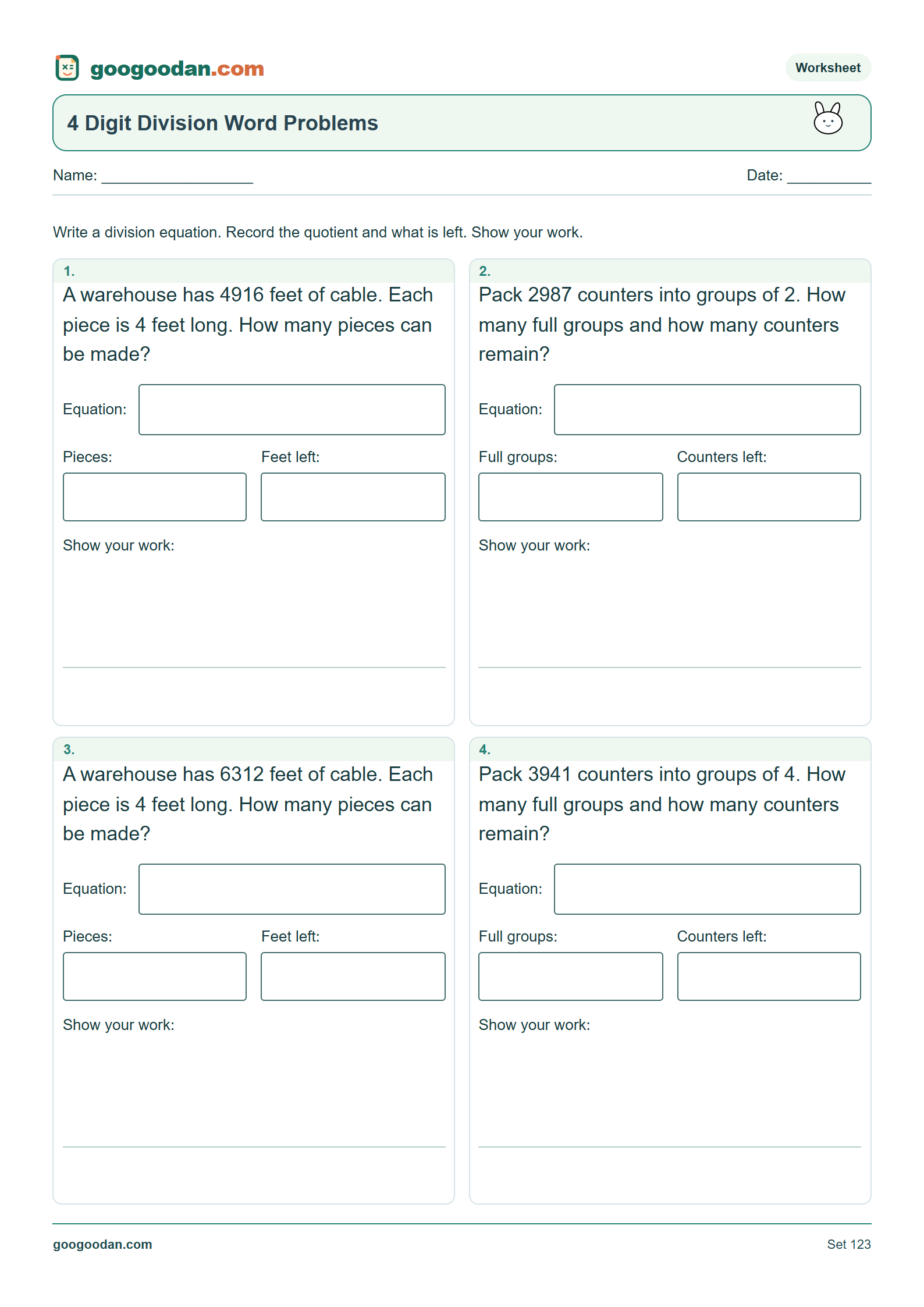 Word problems
4 Digit Division Word Problems With and Without Remainders
Find complete groups or cable pieces, and record what is left separately from the quotient.
4 problems · Answer key included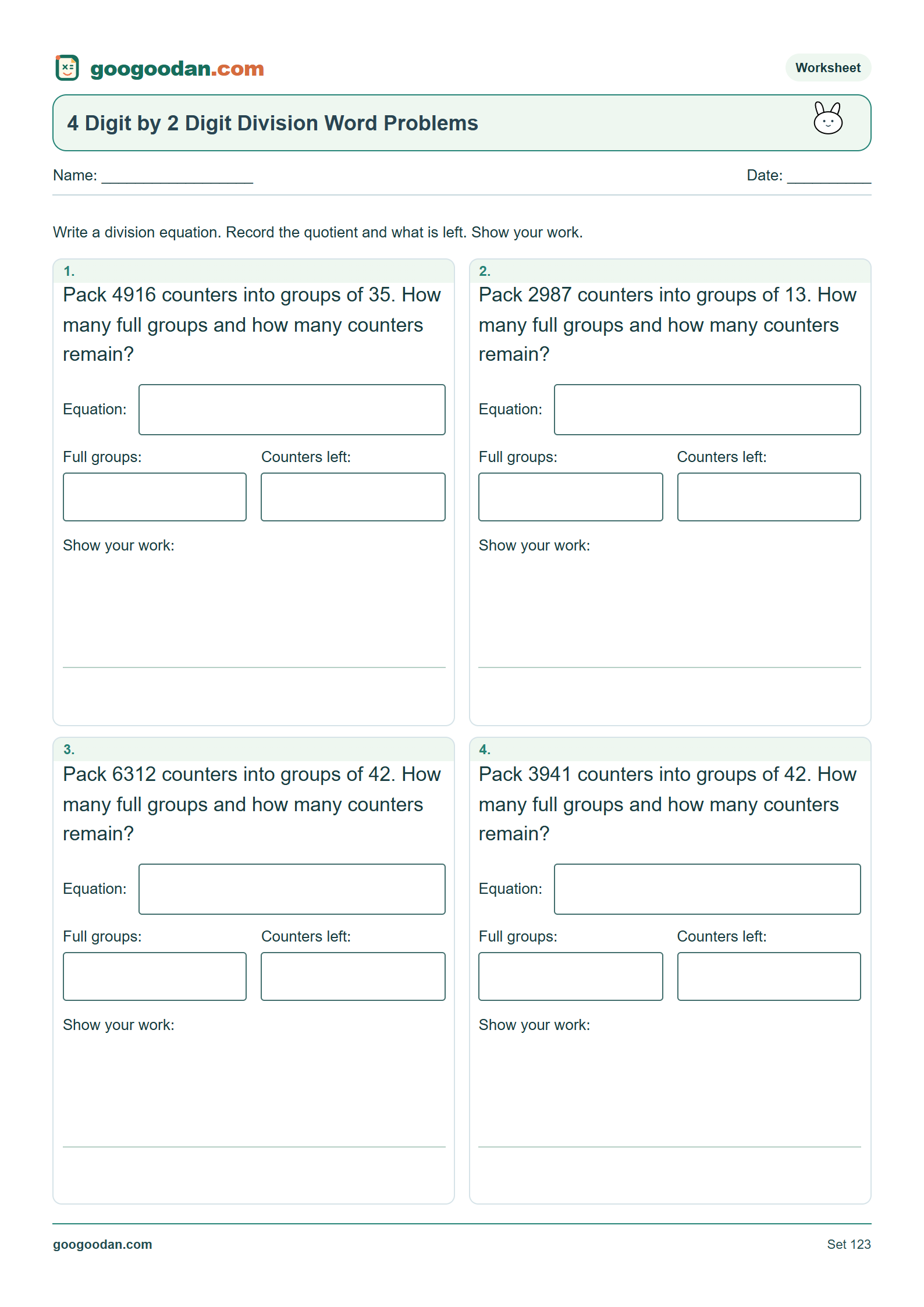 Word problems
4 Digit by 2 Digit Division Word Problems
Use estimates and partial quotients to find complete groups with two-digit divisors, then interpret any remainder. Choose a smaller exact-group activity before four-digit totals.
4 problems · Answer key included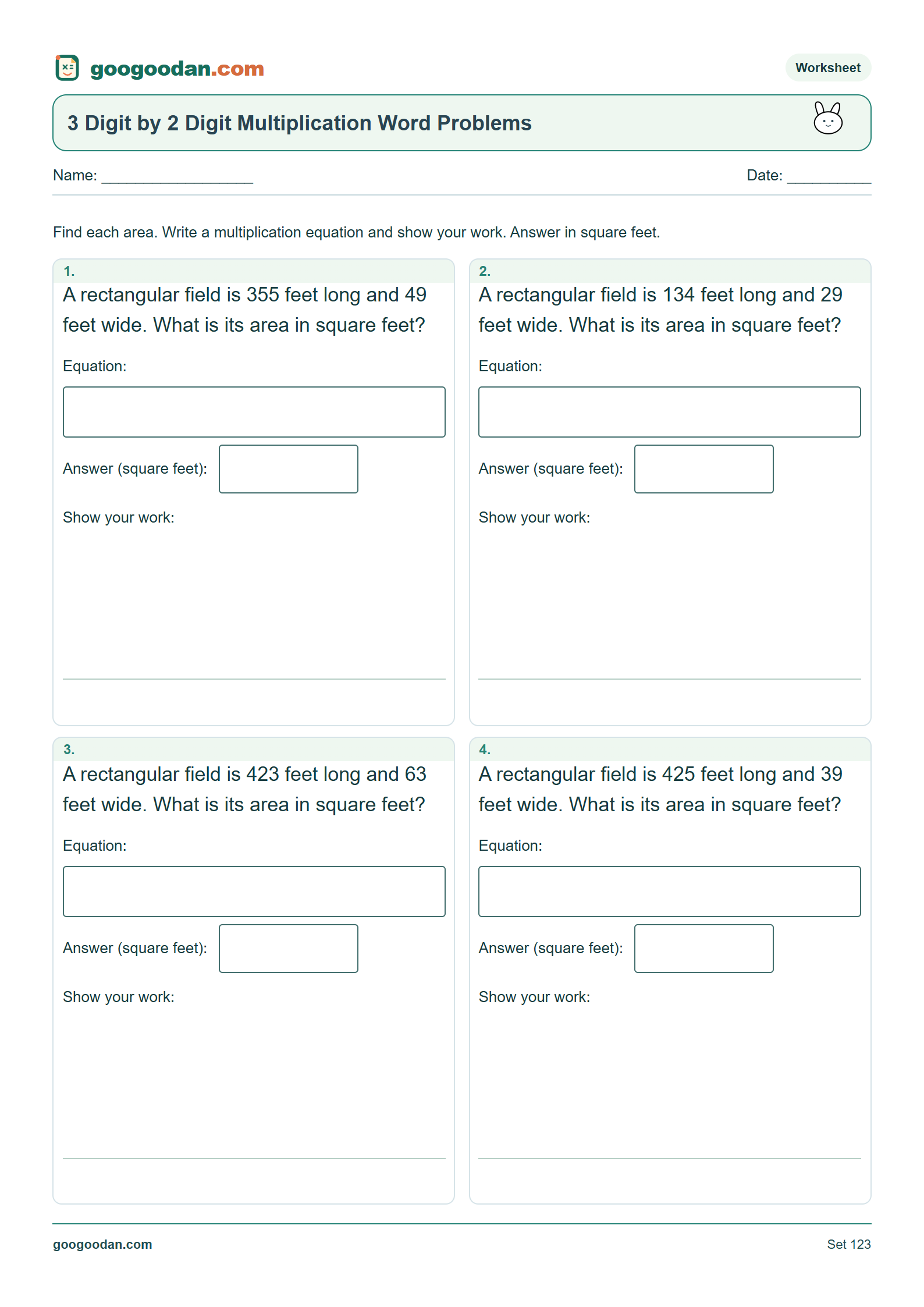 Word problems
3 Digit by 2 Digit Multiplication Word Problems
Find rectangle area using a three-digit length and two-digit width; connect partial products to the written multiplication method.
4 problems · Answer key included
More about division · Grade 6 worksheets
Grade 6 selected skill connection: Selected 6.NS.B.2: divide five-digit whole numbers by two-digit divisors with the standard algorithm and interpret whole-number quotients and remainders. See the Common Core standards for this grade. This worksheet does not cover every requirement in the standard.