
Open-Ended Math Word Problem Worksheets
A correct number is only part of the work. These three activities ask children to create a question, explain why an equation fits, or help a friend correct a mistake. The current sets use whole-number stories within 20 so the attention can stay on reasoning.
Choose a reasoning activity
 Word problems
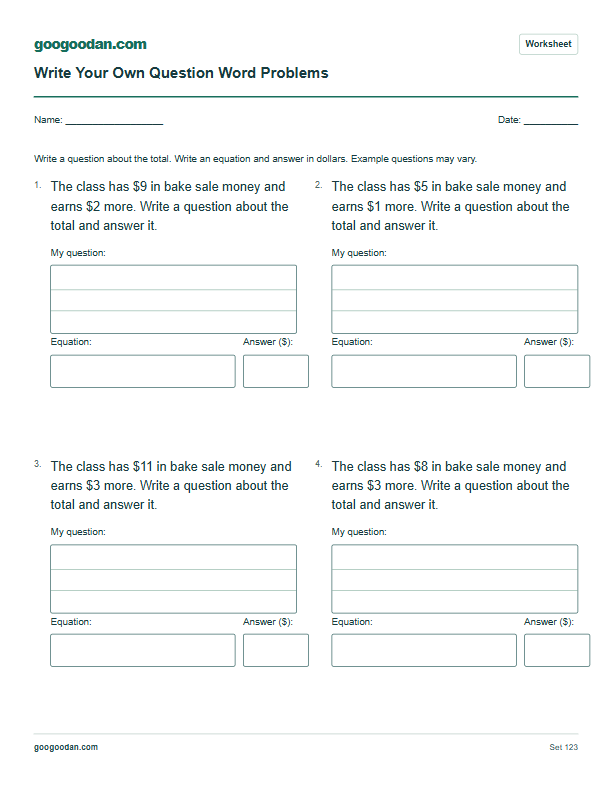
Write Your Own Question Word Problems
Write a question about the total, then answer it with an addition equation using whole dollars.
4 problems · Answer key included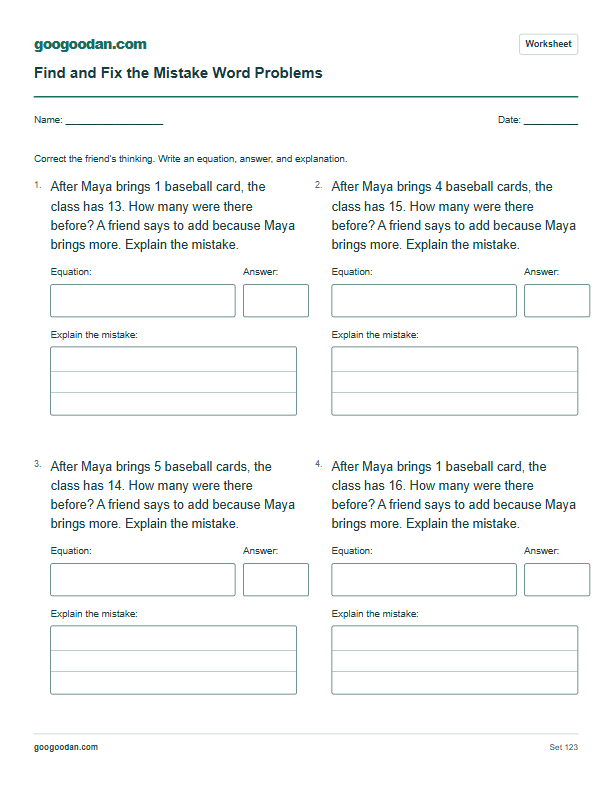 Word problems
Error Analysis Word Problems: Find and Fix the Mistake
Correct a friend who chooses addition just because more items arrive.
4 problems · Answer key included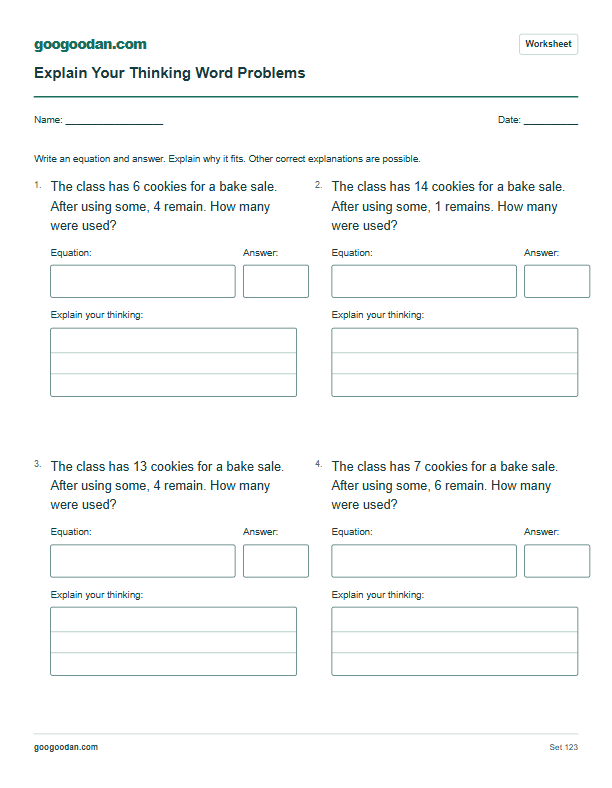 Word problems
Explain Your Thinking Word Problems
Explain why the equation fits a taking-away story.
4 problems · Answer key included
Three ways to make thinking visible
Leo reads that the class has $8 and earns $5 more. He writes 13, but cannot say what it means. Asking him to write a question turns the calculation into a statement about the story: “How much money does the class have now?” He can then say that the thirteen counts dollars, not children or items sold.
Write a question
Use the question-writing set when a child calculates before identifying what is unknown. In the current activity, the question should ask for the combined amount. “How much money is there altogether?” and “How many dollars do we have now?” can both work. The equation and answer must match the question, even when the wording differs from the example answer.
Check a claim
Use error analysis when a child follows a familiar word without checking the relationship. Ask what the mistaken answer actually counts, then compare it with the quantity being asked for. Correcting the number alone is not enough: the child should explain which relationship the friend overlooked.
Explain the equation
Use explanation practice when the answer is correct but the method is unclear. Suppose there were 12 books and 5 are left. Finding how many were used means finding the missing part: 12 − 5 = 7. A useful explanation names the whole and the remaining part, rather than simply saying “I subtracted.” A drawing or a spoken explanation can come before a written sentence.
Use example answers without requiring copied sentences
Check whether the child identifies the requested quantity, uses a valid relationship, and names the unit. A different sentence can show the same understanding. Help record a spoken explanation if handwriting is the obstacle. Spelling and sentence length are different from mathematical reasoning.
Start with one of the three sets. Each contains four prompts and room for the relevant question, equation, or explanation. These activities allow different wording and strategies; they are not unrestricted investigations with many possible numerical answers.
Browse all word-problem worksheets or compare stories with the same numbers and different questions.
What does the child’s response show?
Use these three examples to decide what to ask next. A correct calculation, a clear question, and an explanation of the relationship are separate things to notice. These are sample responses for an adult to discuss, not automatic scores.
Question writing: the right total, but the wrong question
The class has $9 in bake sale money and earns $2 more. Write a question about the total and answer it.
Leo writes: “How much new money did we earn? 9 + 2 = 11 dollars.”
The addition is correct, but the question asks about the new $2. Ask Leo to point to the money his question names. He can repair the response by asking “How much money do we have now?” The equation 9 + 2 = 11 then answers that question. Different wording is fine when it asks for the combined amount.
Error analysis: the right answer still needs a reason
After Maya brings 1 baseball card, the class has 13. How many were there before? A friend says to add because Maya brings more. Explain the mistake.
Leo writes: “13 − 1 = 12.”
The number of cards is correct; the explanation is not written yet. Ask “Does thirteen mean before or after the new card arrived?” A useful explanation is “Thirteen already includes the new card, so take that one out to find the twelve cards there before.” Let Leo explain aloud or draw the groups before writing. Do not call the calculation wrong simply because the explanation is unfinished.
Explain thinking: a sound idea with an arithmetic slip
The class has 6 cookies for a bake sale. After using some, 4 remain. How many were used?
Leo writes: “6 − 4 = 3. I subtract the four left from the six we started with.”
The relationship is right, but the subtraction needs checking. Ask Leo to put four counters in the “left” group and count the other counters in a group of six. Two were used: 6 − 4 = 2. Adding the parts back, 4 + 2 = 6, checks the answer. Keep his explanation and help him correct the arithmetic.
Give feedback on the specific part that needs attention. A drawing, spoken explanation, or different valid equation can show understanding; copying the answer key’s sentence is not the goal.