
Greatest Common Factor Word Problems
Use equal sharing to make greatest common factors meaningful. Find the largest possible number of matching bags, then show that both colors divide evenly with none left.
The goal is more identical bags, not bigger bags
Emma has 12 red counters and 18 blue counters for a class activity. She wants each bag to contain the same number of red counters and the same number of blue counters as every other bag. No counters can be left over. She first makes 3 bags with 4 red and 6 blue counters in each. That works, but is three the greatest possible number of bags?
She tries 6 bags. Each now holds 2 red and 3 blue counters, and every counter is used. Six bags are more than three. The question asks for the greatest bag count, so a valid arrangement is only the first part of the answer. Emma must also show why no larger count works.
12 red + 18 blue → 6 identical bags
2 red counters
3 blue counters
2 red counters
3 blue counters
2 red counters
3 blue counters
2 red counters
3 blue counters
2 red counters
3 blue counters
2 red counters
3 blue counters
Check each color separately: 6 × 2 = 12 red and 6 × 3 = 18 blue. Every bag has five counters, but five is not the number of bags.
Find a number that divides both collections
A possible bag count must divide 12 evenly and divide 18 evenly. The factors of 12 are 1, 2, 3, 4, 6, and 12. The factors of 18 are 1, 2, 3, 6, 9, and 18. The numbers on both lists are the common factors: 1, 2, 3, and 6. The largest is 6, so the greatest common factor, or GCF, is 6.
| Bags | Red per bag | Blue per bag | Works? |
|---|---|---|---|
| 3 | 4 | 6 | Yes |
| 4 | 3 | Not whole | No |
| 6 | 2 | 3 | Yes, greatest |
Four bags use the red counters evenly but leave two blue counters after putting four blue counters in each bag. Testing just one color is not enough. Twelve bags also fail: there are not enough blue counters to give each bag the same whole-number amount with none left.
Explain why the answer is greatest
Checking 12 ÷ 6 = 2 and 18 ÷ 6 = 3 proves that six bags work. Those equations alone do not prove that six is the greatest choice. The complete factor lists show that no larger factor is shared. Alternatively, test the larger factors of the smaller collection: the only factor of 12 above 6 is 12, and 12 does not divide 18 evenly.
For larger collections, organize factors in pairs instead of guessing. With 36 red counters and 60 blue counters, record the factor pairs for each number. The common factors are 1, 2, 3, 4, 6, and 12. The greatest is 12, giving 3 red and 5 blue counters in each bag. Checking only the factors 2 or 3 would miss a larger valid answer.
Keep the three quantities separate
For the 12-and-18 example, there are 6 bags, 2 red counters per bag, and 3 blue counters per bag. The total per bag is 5. Children sometimes write 5 because that describes the group they drew. Ask, “What is the question counting?” Then label the drawing with both the number of bags and the contents of one bag.
One bag can be the correct answer
Suppose Emma has 8 red counters and 15 blue counters. The factors of 8 are 1, 2, 4, and 8; the factors of 15 are 1, 3, 5, and 15. Their only common factor is 1. She can put all 8 red and all 15 blue counters into one bag, but she cannot split both colors evenly into more identical bags.
This does not mean that the numbers have no common factor. One is a factor of every positive whole number. Such a pair is called relatively prime, or coprime, even though neither 8 nor 15 is itself a prime number. If there is only one red counter to begin with, a greatest bag count of 1 follows for the same reason.
When both collections are equal
With 9 red and 9 blue counters, make 9 bags containing one of each color. The greatest common factor of equal positive numbers is that number itself. More than nine bags would require splitting a counter or leaving a bag without the same contents. This case helps separate finding a common factor from automatically choosing a small familiar factor.
Connect the drawing to the distributive property
The same arrangement can be written as 12 + 18 = 6 × (2 + 3). On the left are the two whole collections. On the right are six identical bags, each containing two red and three blue counters. This explains the common factor as an actual grouping, rather than as a number produced by a rule. The two remaining amounts, 2 and 3, share no factor greater than 1; otherwise the groups could be split again.
For this worksheet, give the greatest number of bags in the answer box. Use the working area for factor lists, a drawing, or equal-sharing equations. The answer key gives the bag count; it does not automatically generate the complete factor lists or bag diagram for each new problem.
What this set covers
Each sheet reuses four original stories with 1–100 red counters and 1–100 blue counters. Equal counts, an input of one, and pairs whose GCF is one are all retained. This is selected Grade 6 greatest-common-factor practice. Least common multiples and the full range of distributive-property exercises are separate learning goals.
Make a practice set
Select the worksheet, answer key, or both. When both are selected, the answer key prints after the questions. Keep it separate if you want your student to work independently.
After your student finishes
Check both colors and ask why no larger number of bags works. Keep the bag count separate from the number of counters inside one bag.
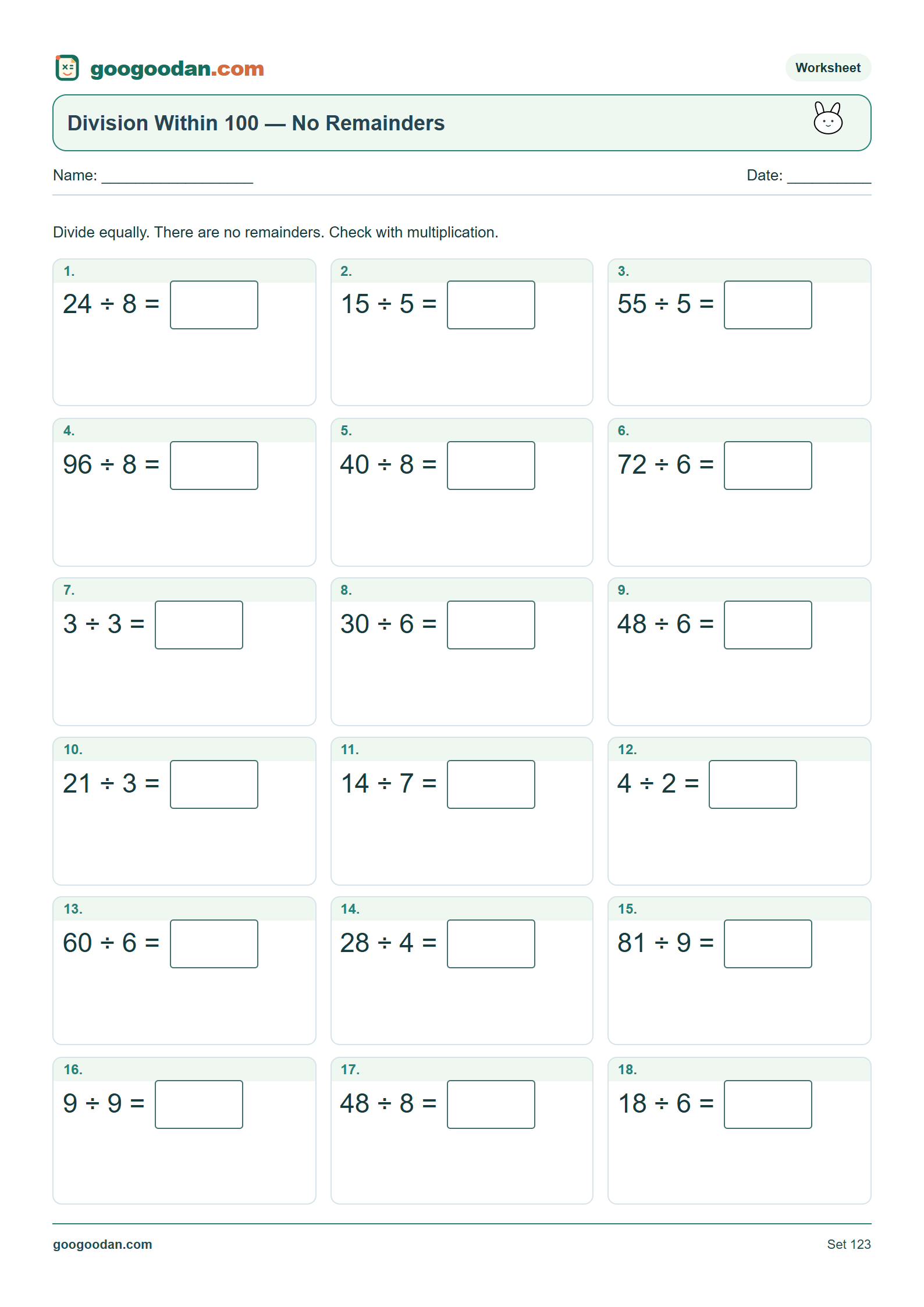 Calculation practice
Division Without Remainders Worksheets
Share equally or make equal groups, then check each quotient with multiplication.
18 problems · Answer key included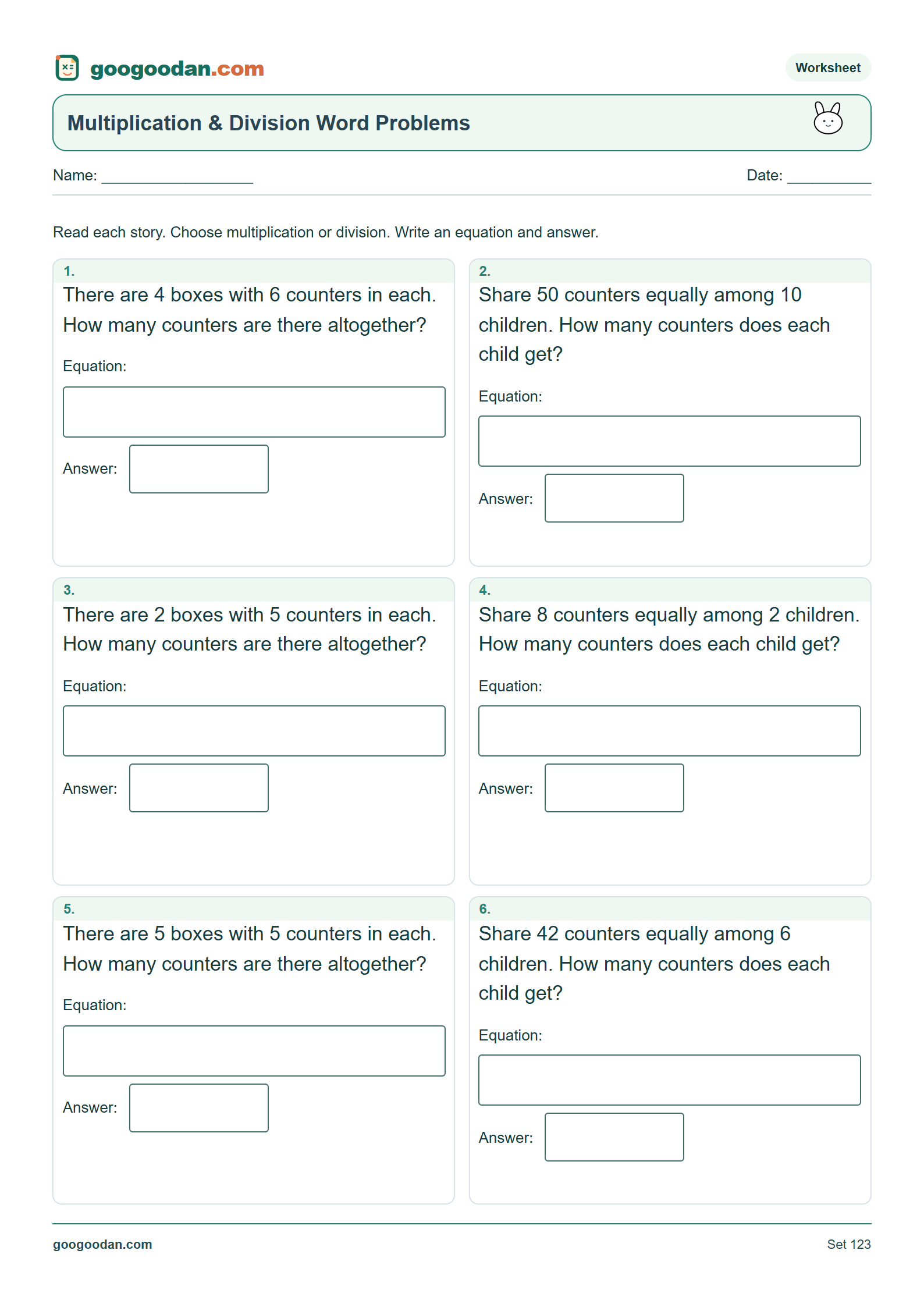 Word problems
3rd Grade Multiplication and Division Word Problems
Choose mixed facts, zero-and-one groups, or two- and three-digit group amounts. Explain what the answer counts.
6 mixed stories or 4 focused multiplication stories · Answer key included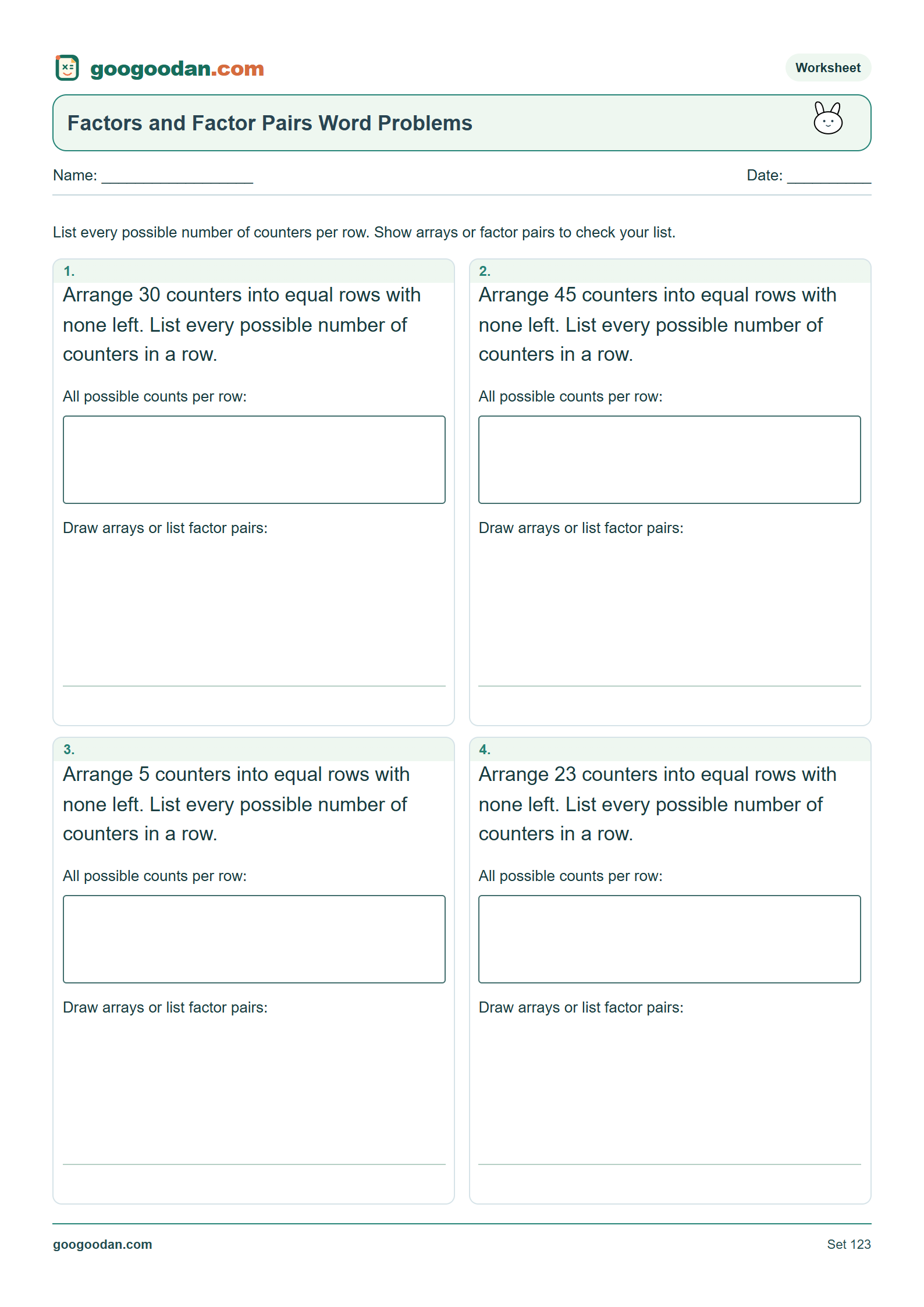 Word problems
Factors and Factor Pairs Word Problems
Arrange counters into equal rows with none left. Find every possible count per row and check that the factor list is complete.
4 problems · Answer key included
More about division · Grade 6 worksheets
Grade 6 selected skill connection: Selected 6.NS.B.4: find the greatest common factor of two positive whole numbers from 1 through 100 in equal-sharing stories; least common multiples are not assessed in this set. See the Common Core standards for this grade. This worksheet does not cover every requirement in the standard.