
Dividing Fractions Word Problems: Whole Pieces
Find how many fractional-length pieces fit into a fractional cable length. Use a model, connect it to the reciprocal rule, and check that the pieces rebuild the total.
Count how many equal pieces fit in the length
Leo has 6/5 feet of cable and needs pieces that are each 2/5 of a foot long. He sees two fractions and is tempted to multiply their numerators and denominators immediately. First, ask what the story is counting. The cable length is already known, and so is the length of one piece. The unknown is the number of pieces.
Draw six fifth-foot sections. Each complete piece uses two of those sections. Circle the first pair, then the second pair, then the third. Three complete pieces use all the cable. The equation is 6/5 ÷ 2/5 = 3, and the answer is three pieces.
6/5 ÷ 2/5 = 3 pieces
3 × 2/5 = 6/5 feet, with none left.
Use a common-sized measuring part
In the drawing, both lengths are measured in fifths. Asking how many 2/5-foot pieces fit into 6/5 feet becomes asking how many groups of two fifths fit into six fifths. Six divided by two is three. The common denominator tells us that every small section has the same length.
This reasoning also works when the original denominators differ. For 9/4 ÷ 3/8, rewrite 9/4 as 18/8. Now count how many three-eighth-foot pieces fit into eighteen eighths: 18 ÷ 3 = 6. Changing the representation did not change the cable length. It made the counting units match.
Explain the reciprocal instead of only memorizing it
Dividing by 3/8 means counting groups of size 3/8. Multiplying both the total and the group size by 8 measures them in eighths: (9/4 × 8) ÷ (3/8 × 8) = 18 ÷ 3. The factor 8 changes the measuring unit, and dividing by 3 counts the three-eighth groups.
Combine those operations to get 9/4 × 8/3 = 72/12 = 6. The reciprocal rule keeps the dividend, changes division to multiplication, and replaces only the divisor by its reciprocal. The picture explains why the rule works. Flipping both fractions or flipping the first fraction would describe a different calculation.
A fraction greater than one can still describe a piece
Suppose the total is 15/2 feet and each piece is 15/6 feet long. Both fractions are greater than one. Simplify the piece length to 5/2 feet, then compare: three pieces at 5/2 feet each use 15/2 feet. The original equation 15/2 ÷ 15/6 has answer 3.
A fraction does not have to be less than one. An improper fraction can record several whole feet and part of another foot. Students may rewrite 15/2 as 7 1/2 and 15/6 as 2 1/2 while reasoning, but the quantities must stay equal to the original measurements.
Equivalent fractions may give exactly one piece
For 6/10 feet cut into pieces of 3/5 of a foot, the two measurements are equal. Six tenths equals three fifths, so one complete piece uses the whole length. An answer of one is meaningful, even though the printed numerators and denominators look different.
When simplifying, divide the numerator and denominator of a fraction by the same nonzero common factor. Changing only one part changes the length. Keeping 6/10 as written is also valid if the child can compare it with 3/5 using an equivalent-fraction model.
Division does not always make the numerical answer smaller
In 6/5 ÷ 2/5 = 3, the numerical answer three is larger than 6/5. That is reasonable: a small piece length allows several pieces to fit into a larger total. We have not made extra cable. The answer counts pieces, while the dividend measures feet.
When the divisor is larger than one, division may instead produce a smaller numerical value, as in 15/2 ÷ 15/6 = 3. Always compare quantities with their meanings, not just with a rule that division must shrink numbers.
Check by rebuilding the cable
Multiply the proposed number of pieces by the given length of one piece. For six pieces at 3/8 foot each, 6 × 3/8 = 18/8 = 9/4 feet. This returns the original total. The check verifies the arithmetic and confirms that the pieces leave no unused cable.
Write the final answer in pieces. Writing six feet would confuse a count with a length. These are idealized measurements with no material lost in cutting; the problem is about equal groups, not practical cutting allowances.
What is included in these practice sets
Each sheet contains four existing fraction-division stories selected because the original answer is a whole number of complete pieces. The total length is genuinely fractional, and the piece length does not simplify to a unit fraction such as 1/2. This makes the practice different from whole numbers divided by unit fractions.
The source writes numerators from 1 to 20 and denominators from 2 to 12. Some fractions are improper or can be simplified. Original values and exact answers are preserved. At most one question on each sheet has an answer of one, leaving room to practice counting several pieces too. Cases with a fractional piece count are excluded rather than rounded down or silently treated as full pieces.
Use the working area for an equal-length diagram, equivalent fractions, or a justified reciprocal calculation. The answer key provides the equation and piece count; it does not draw a separate model for every question. This is selected Grade 6 fraction division, not a complete treatment of fractional quotients, leftover lengths, or every fraction-division context.
Make a practice set
Select the worksheet, answer key, or both. When both are selected, the answer key prints after the questions. Keep it separate if you want your student to work independently.
After your student finishes
Ask what the quotient counts, then multiply it by the piece length to recover the original cable. Accept equivalent fractions in the working, but keep the exact whole-piece answer.
 Word problems
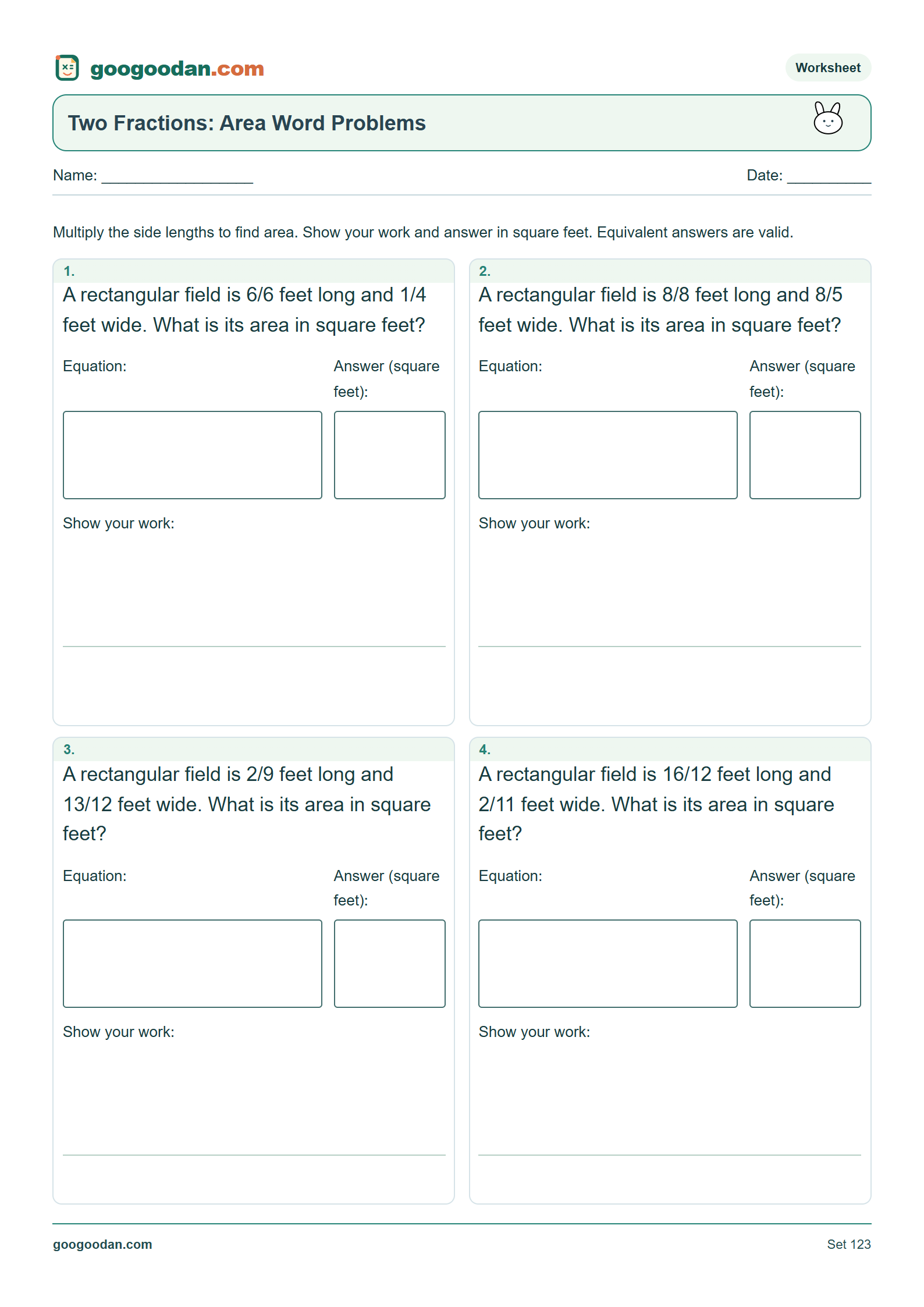
Multiplying Two Fractions Word Problems: Area
Find rectangle area when both side lengths are written as fractions; include lengths greater than one foot.
4 problems · Answer key included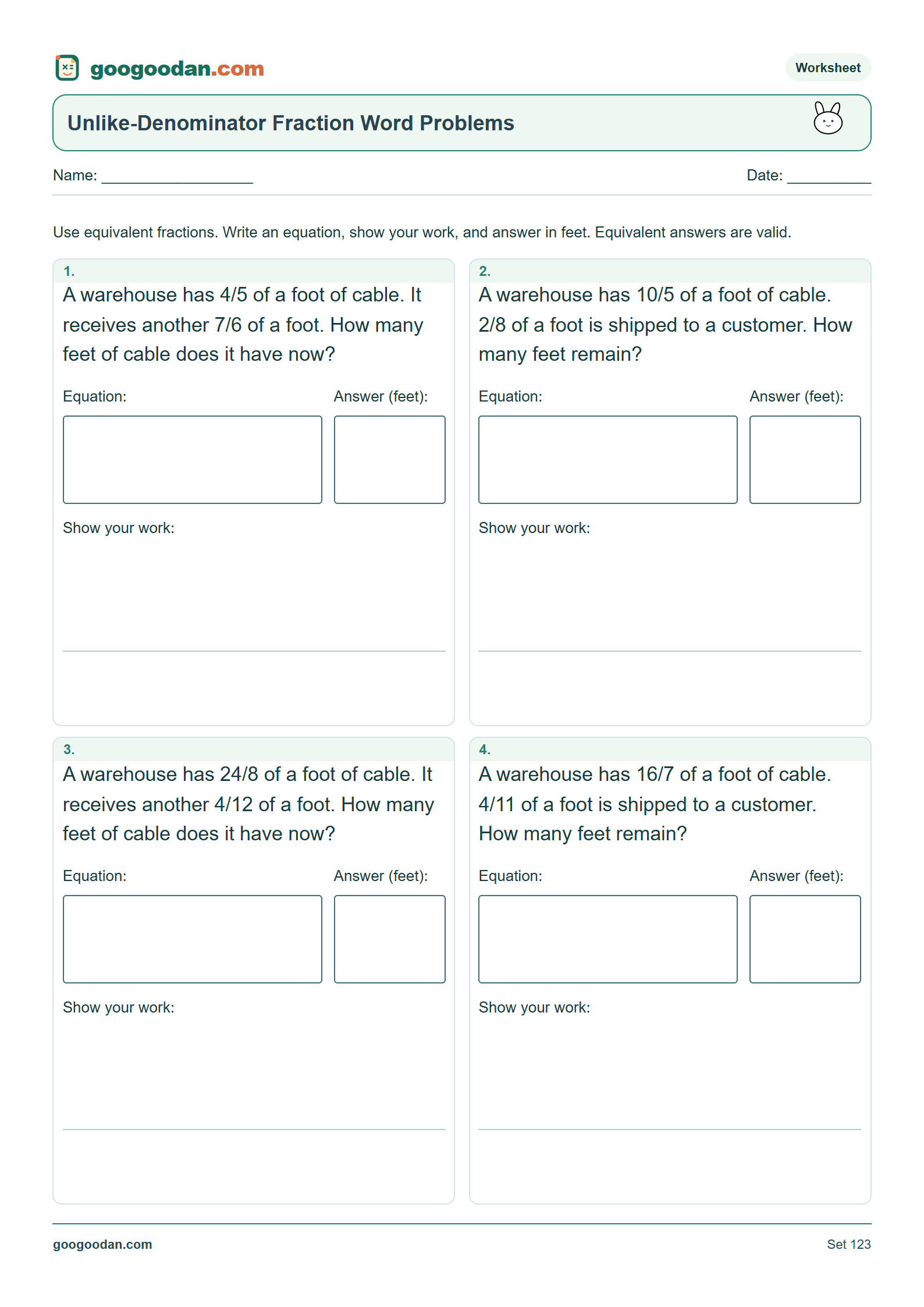 Word problems
Adding and Subtracting Fractions Word Problems With Unlike Denominators
Use equivalent fractions to combine or remove cable lengths measured against the same one-foot whole.
4 problems · Answer key included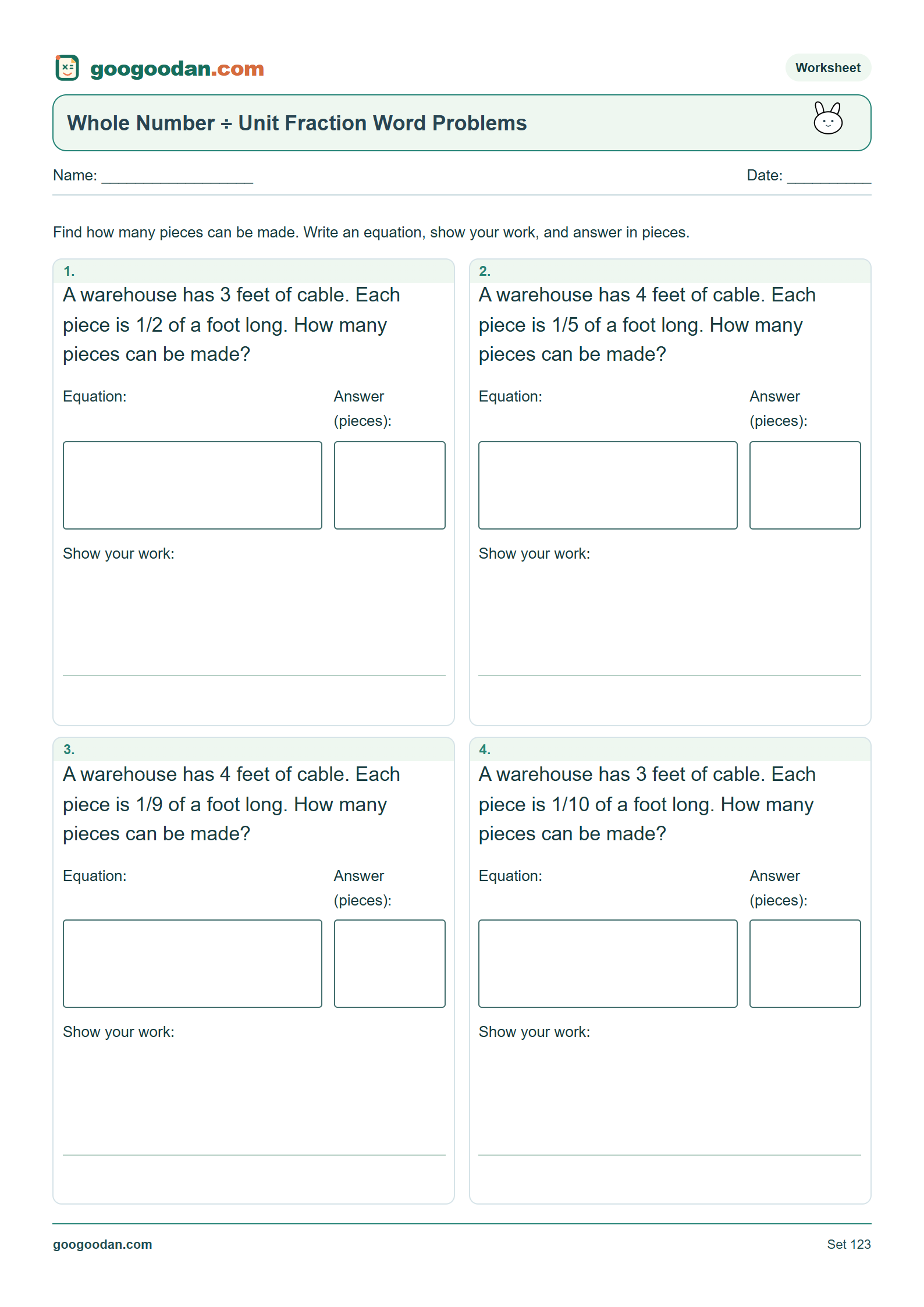 Word problems
Dividing Whole Numbers by Unit Fractions Word Problems
Count fractional-foot cable pieces in a whole-number length, using equal groups and multiplication to check.
4 problems · Answer key included
More about division · Grade 6 worksheets
Grade 6 selected skill connection: Selected 6.NS.A.1: interpret fraction division as measuring equal groups, with non-whole totals, non-unit-fraction divisors, and whole-number quotients only; no fractional-piece counts or leftovers. See the Common Core standards for this grade. This worksheet does not cover every requirement in the standard.